Commercial Cooking Energy Transition: Electric Induction vs LPG
Source:Indian Express ↗
Why It Matters
Highlights a crucial economic shift in clean cooking fuels, emphasizing the need for a policy pivot towards commercial electrification to curb urban air pollution and reduce India's import dependence on LPG.
Summary
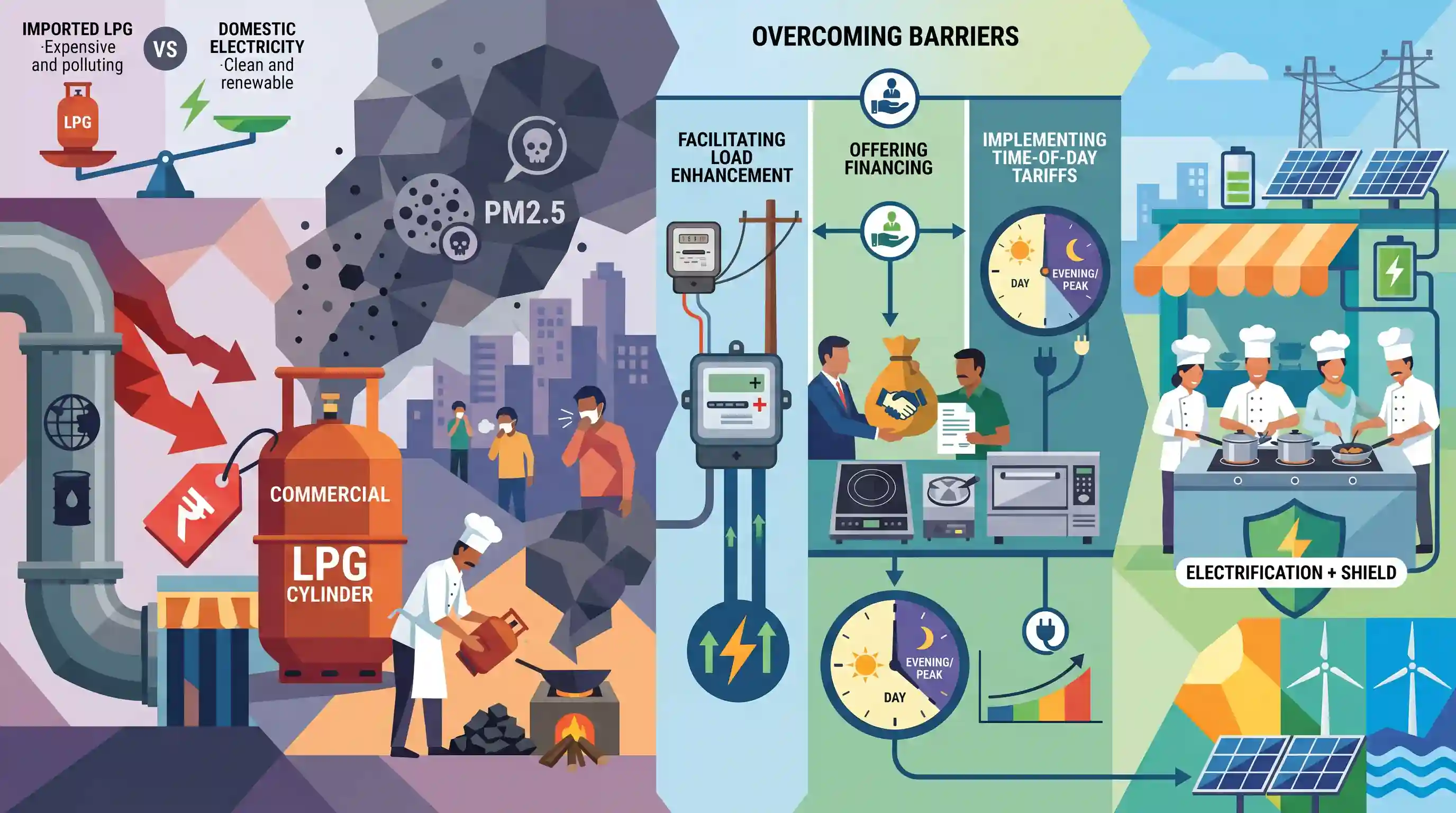
The article argues that India's clean cooking strategy must pivot from subsidizing LPG to promoting electric induction cooking, particularly for small commercial eateries. High commercial LPG costs, exacerbated by geopolitical tensions and supply constraints, are forcing many establishments back to polluting fuels like coal and biomass, worsening urban PM2.5 emissions. With electricity now offering a significantly cheaper and cleaner alternative, the government should overcome infrastructural barriers by facilitating electrical load enhancements, offering equipment financing, and implementing time-of-day tariffs to drive a national commercial kitchen electrification program.
Key Points
- Small commercial eateries contribute roughly 10% of PM2.5 emissions in cities like Varanasi, Guwahati, and Ludhiana, and are reverting to coal and biomass due to rising commercial LPG costs.
- Induction cooking is now up to 50% cheaper than LPG, with induction costing about Rs 17.5 per useful kWh compared to LPG's Rs 22.5 per useful kWh at commercial tariffs.
- Geopolitical risks affecting LPG imports, such as tensions in the Strait of Hormuz and dollar volatility, highlight the need to improve energy security by reducing import dependence.
- The primary barriers to electric cooking transition are no longer economic, but rather informational and infrastructural, including inadequate sanctioned electrical loads for commercial meters.
- Future clean cooking policies should shift from subsidizing LPG to supporting commercial electrification through equipment financing, fast-tracked load enhancements, and time-of-day tariffs.
Important Terms
iForest (International Forum for Environment, Sustainability & Technology)

An independent non-profit environmental think tank whose research focuses on pollution sources like biomass cooking, significantly informing India's policy on air quality and energy transition.
UPSC context
Relevant for GS Paper III (Environment/Energy); tests understanding of non-state actors in environmental policy research.
National Efficient Cooking Programme (NECP)
A 2023 initiative by Energy Efficiency Services Limited (EESL) to promote large-scale adoption of energy-efficient induction cookstoves, aimed at reducing LPG imports and household costs.
UPSC context
GS Paper III (Infrastructure/Energy); crucial for questions on energy efficiency and clean energy transitions.
Time-of-Day (ToD) Tariffs
A tariff structure where electricity rates vary by time—offering lower 'solar hour' rates—to manage grid demand and incentivize energy-intensive tasks like electric cooking.
UPSC context
GS Paper III (Indian Economy/Energy); essential for power sector reforms and smart grid management.
PM2.5 (Particulate Matter 2.5)
Atmospheric particulate matter with a diameter less than 2.5 micrometers, originating from fuel combustion (like biomass/coal) and linked to severe respiratory and cardiovascular health risks.
UPSC context
GS Paper III (Environment/Pollution); fundamental for understanding urban air quality and public health policy.
Go Electric Campaign
A Ministry of Power initiative launched in 2021 to spread awareness about the benefits of electric mobility and electric cooking to enhance India's energy self-reliance.
UPSC context
GS Paper III (Energy/Environment); covers government schemes for decarbonization and sustainable development.
Energy Security
The state of having reliable and affordable energy access while minimizing vulnerability to external supply shocks, such as volatile global prices of imported LPG.
UPSC context
GS Paper III (Infrastructure/Security); core concept for analyzing fuel diversification and import-dependence strategies.
Prelims Trap
India's massive domestic refining capacity makes it self-sufficient in LPG supply for domestic and commercial use.
While India is a net exporter of refined products like petrol and diesel, it imports roughly 60% of its LPG, making it highly vulnerable to global shocks.
Static Concepts Connected
How do Time of Day (ToD) tariffs function in India's power sector?
- Variable Pricing: Electricity prices vary based on the time of day, reflecting peak versus off-peak demand on the grid.
- Solar Hours: Under the 2023 Consumer Rules, tariffs must be 10-20% cheaper during the daytime when solar generation is abundant.
- Peak Surcharges: Surcharges apply during evening and night peak hours to discourage non-essential consumption and balance grid load.
What are India's key policy initiatives for transitioning to clean cooking?
- PM Ujjwala Yojana: Provides subsidised LPG connections to BPL households to curb indoor air pollution and biomass reliance.
- National Efficient Cooking Programme: Promotes the adoption of non-polluting, energy-efficient induction cookstoves to reduce LPG import dependency.
- Go Electric Campaign: A Bureau of Energy Efficiency (BEE) campaign pushing for nationwide adoption of e-mobility and electric cooking.
Cross-Topic Patterns
Geopolitics of the Strait of Hormuz
Over 85% of India's imported LPG traverses this chokepoint. Tensions here directly inflate urban PM2.5 as high commercial costs force Indian eateries back to biomass.
DISCOM health vs. Electric Cooking
Transitioning to induction requires upgraded sanctioned loads. The poor financial health of DISCOMs limits the distribution grid enhancements needed for a nationwide commercial electrification push.

Expect a 2026 Mains question linking DISCOM infrastructure, ToD tariffs, and the viability of India's shift to electric cooking.
Linked PYQs · 3
Linked PYQs · 3
- 2018MainsGS3
“Access to affordable, reliable, sustainable and modern energy is the sine qua non to achieve Sustainable Development Goals (SDGs).” Comment on the progress made in India in this regard.
- 2025MainsGS2
"Energy security constitutes the dominant kingpin of India's foreign policy, and is linked with India's overarching influence in Middle Eastern countries.” How would you integrate energy security with India's foreign policy trajectories in the coming years?
- 2021MainsGS3
Describe the key points of the revised Global Air Quality Guidelines (AQGs) recently released by the World Health Organisation (WHO). How are these different from its last update in 2005? What changes in India's National Clean Air Programme are required to achieve these revised standards?
