LPG Interoperability Framework Proposed to Empower Consumers
Source:The Hindu ↗
Why It Matters
Illustrates the role of statutory regulatory bodies (PNGRB) in enhancing market competition, ensuring consumer rights, and improving public utility governance in the downstream energy sector.
Summary
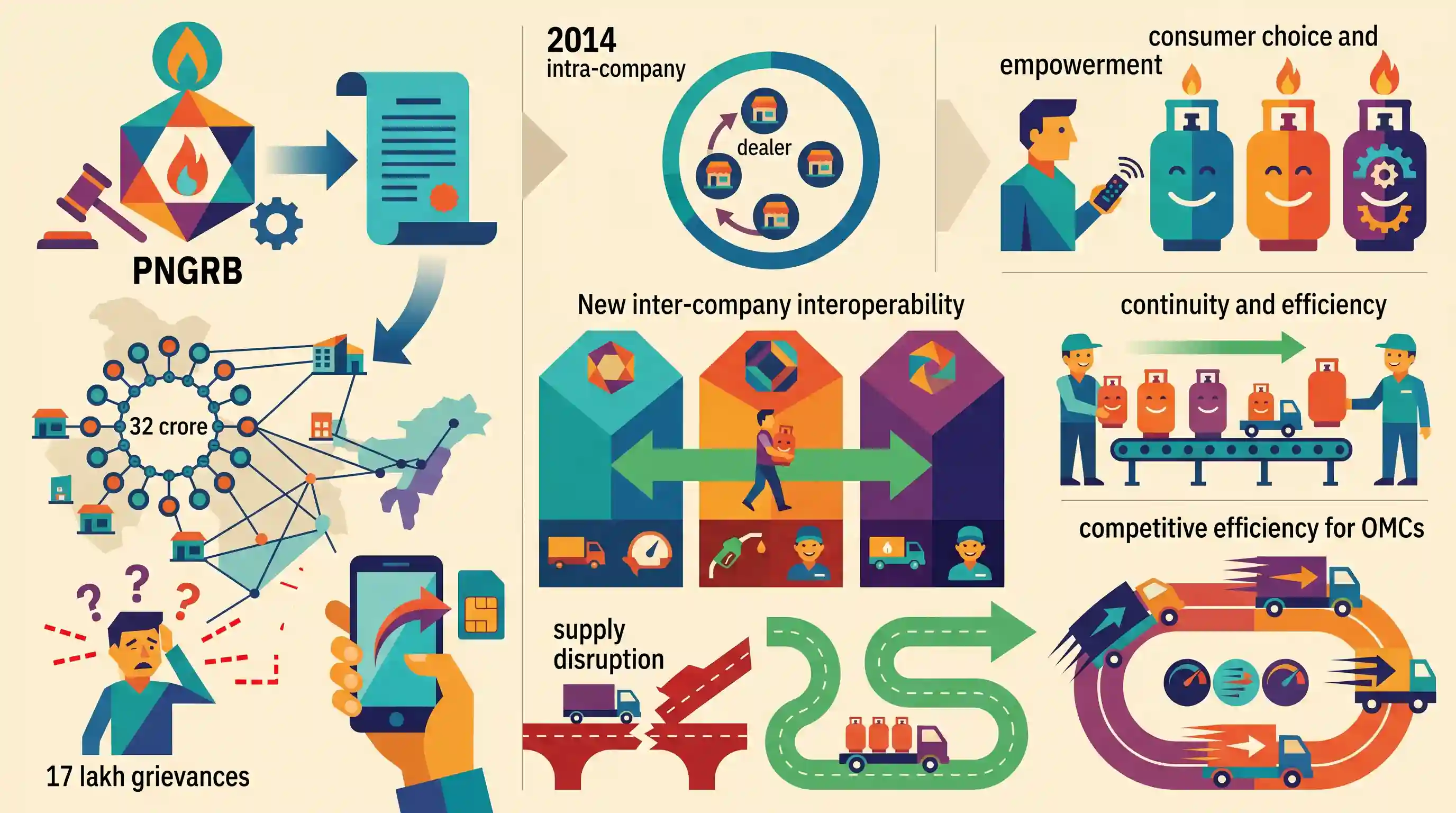
The Petroleum and Natural Gas Regulatory Board (PNGRB) has introduced a draft LPG Interoperability Framework allowing cooking gas consumers to switch their supplier companies (e.g., from Indane to HP Gas or Bharat Gas) without altering their existing connection. Modeled on mobile number portability, the policy seeks to alleviate supply disruptions and resolve the 17 lakh annual consumer grievances within India's 32-crore LPG connection network. By enabling inter-company portability—an upgrade from the 2014 intra-company dealer portability scheme—the regulator aims to foster a continuity-centric approach, empowering consumers with choice and driving competitive efficiency among Oil Marketing Companies (OMCs).
Key Points
- The Petroleum and Natural Gas Regulatory Board (PNGRB) has proposed the LPG Interoperability Framework to allow cooking gas consumers to switch their supplier companies.
- Similar to mobile number portability, the framework will enable inter-company switching (e.g., from Indane to Bharat Gas) to promote consumer choice and improve service quality.
- The move expands upon a 2014 scheme that permitted portability only among dealers of the same oil marketing company (OMC), not across different companies.
- India has over 32 crore LPG household connections; the interoperability aims to address over 17 lakh annual consumer grievances related to delayed deliveries and supply disruptions.
Important Terms
Petroleum and Natural Gas Regulatory Board (PNGRB)

A statutory body established under the PNGRB Act, 2006, to regulate downstream activities including refining, storage, transportation, and marketing of petroleum and natural gas.
UPSC context
GS-2/GS-3; Regulatory bodies and energy infrastructure. Tests understanding of statutory oversight in essential fuel supply chains.
LPG Interoperability Framework
A proposed PNGRB policy allowing consumers to switch between different oil companies (e.g., Indane to HP Gas) without changing equipment, ensuring cross-company service during delays.
UPSC context
GS-3; Government policies and interventions. Relevant for topics on energy security, consumer rights, and digital-led service reforms.
Oil Marketing Companies (OMCs)
State-owned enterprises (IOCL, BPCL, HPCL) that manage the refining, distribution, and retail of petroleum products; they control nearly 90% of India's fuel market.
UPSC context
GS-3; Energy and Economic Development. Key to understanding the public sector's role in India's energy infrastructure and supply.
LPG Connection Portability Scheme
An earlier scheme (2014) that permitted LPG consumers to switch distributors only within the same oil company (intra-company portability) to improve local service levels.
UPSC context
GS-3; Infrastructure. Important for tracing the evolution of energy reforms from dealer-level changes to full company-level interoperability.
Downstream Sector
The segment of the oil and gas industry involving the refining of crude oil and the distribution/marketing of products like petrol, diesel, and LPG.
UPSC context
GS-3; Infrastructure and Industry. Defines the specific regulatory jurisdiction of the PNGRB compared to upstream (exploration) activities.
Universal Service Obligation (USO)
A principle requiring essential service providers to ensure minimum service availability to all citizens, often regardless of commercial viability or company boundaries.
UPSC context
GS-3; Infrastructure. A core concept in regulated sectors like telecom and energy to ensure equitable and uninterrupted public access.
Prelims Trap
"PNGRB regulates the entire petroleum and natural gas sector, including upstream crude oil production."
PNGRB only regulates midstream and downstream activities (refining, distribution, marketing). Upstream exploration and production fall under the Directorate General of Hydrocarbons (DGH).
Static Concepts Connected
What is the mandate and jurisdiction of the PNGRB?
- Statutory nature: Established under the PNGRB Act, 2006 to protect consumer interests and promote competitive petroleum markets.
- Jurisdiction scope: Regulates midstream and downstream activities like refining, storage, distribution, and marketing. Excludes upstream crude production.
- Appellate authority: Appeals against PNGRB decisions are heard by the Appellate Tribunal for Electricity (APTEL), not a petroleum tribunal.
Cross-Topic Patterns
LPG Portability & PAHAL (DBT)
Cross-company switching requires seamless backend integration with the PAHAL (DBTL) scheme to ensure direct benefit transfers for LPG subsidies remain uninterrupted during the transition.
Regulators driving market competition
PNGRB mirroring TRAI's mobile portability model highlights a broader governance trend: statutory regulators actively breaking localized service monopolies to empower consumers and enforce efficiency.

Expect a Prelims question combining PNGRB’s downstream-only jurisdiction, APTEL's appellate role, and LPG interoperability.
Linked PYQs · 3
Linked PYQs · 3
- 2019PrelimsGS1
Consider the following statements : 1. Petroleum and Natural Gas Regulatory Board (PNGRB) is the first regulatory body set up by the Government of India. 2. One of the tasks of PNGRB is to ensure competitive markets for gas. 3. Appeals against the decisions of PNGRB go before the Appellate Tribunals for Electricity. Which of the statements given above are correct?
- 2025PrelimsGS1
Consider the following activities : I. Production of crude oil II. Refining, storage and distribution of petroleum III. Marketing and sale of petroleum products IV. Production of natural gas How many of the above activities are regulated by the Petroleum and Natural Gas Regulatory Board in our country?
- 2015MainsGS2
For achieving the desired objectives, it is necessary to ensure that the regulatory institutions remain independent and autonomous. Discuss in the light of the experiences in recent past.
