West Asia Conflict Triggers Domestic LPG and Crude Oil Crisis
Source:The Hindu ↗
Why It Matters
This article offers a practical perspective on how global geopolitical shocks—such as conflict in the Middle East and maritime chokepoints—translate into domestic energy crises. It highlights the vulnerabilities of energy transition and the urgent regulatory actions required to manage essential commodities and avert supply chain collapses.
Summary
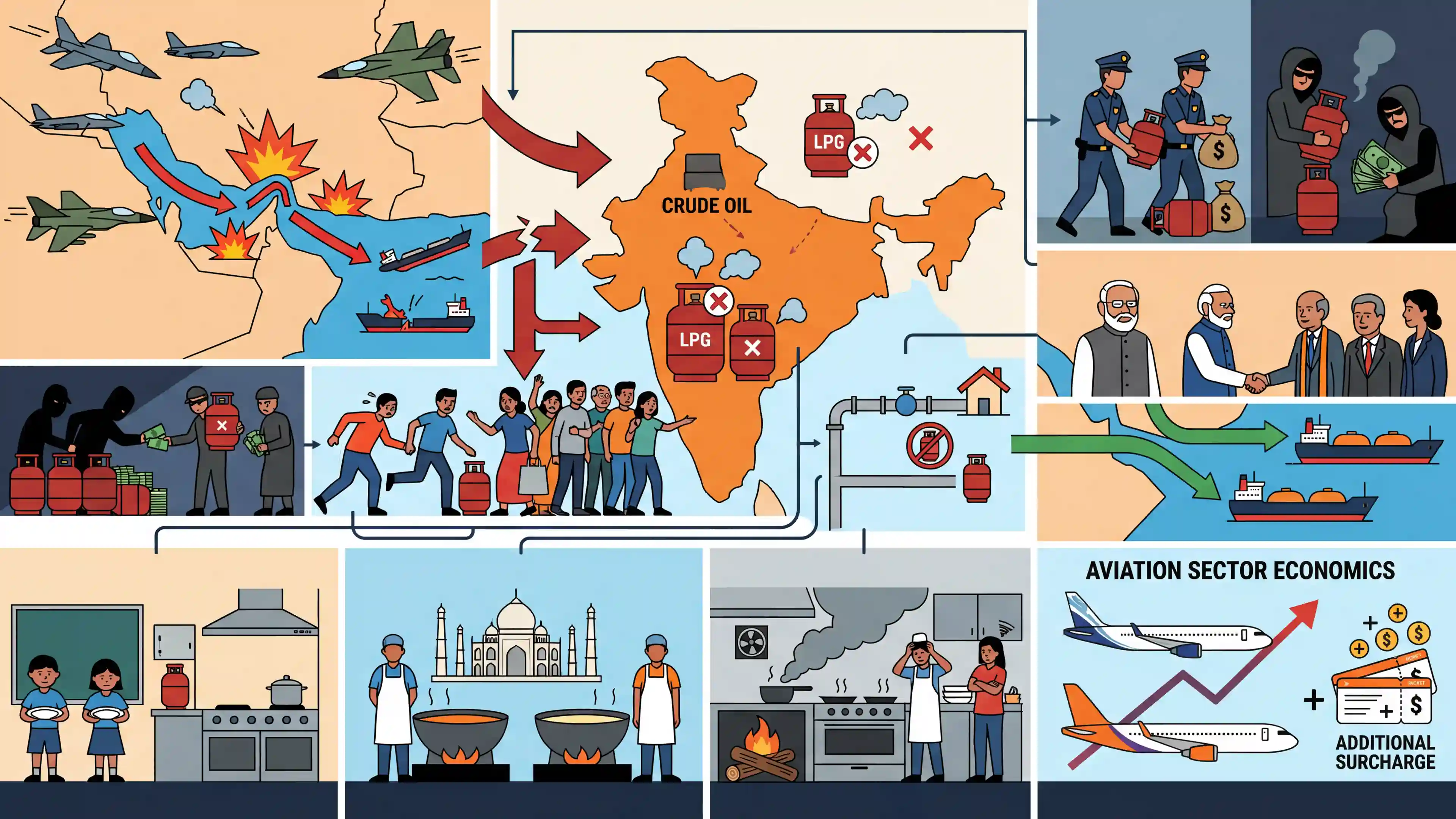
Live updates from March 14, 2026, detail an ongoing LPG and crude oil crisis in India triggered by the escalating Iran-Israel conflict, which caused severe shipping disruptions in the Strait of Hormuz. The crisis constrained both commercial and domestic LPG supplies in India, leading to widespread panic buying, hoarding, and black marketing. In response, the Indian government barred Piped Natural Gas (PNG) users from holding LPG connections to preserve stock and initiated nationwide raids under the Essential Commodities Act. Diplomatic interventions led by PM Narendra Modi facilitated the safe passage of two Indian LPG vessels through the Strait of Hormuz. The fuel scarcity triggered cascading economic effects, heavily impacting mid-day meal programs, forcing Agra's petha industry to halt production, and pushing Kerala hotels to rely on firewood as an alternative fuel. Furthermore, major airlines like IndiGo and Akasa Air introduced fuel surcharges in response to soaring jet fuel costs.
Key Points
- The Iran-Israel conflict significantly disrupted global energy supplies, severely affecting LPG imports passing through the Strait of Hormuz.
- Two Indian ships carrying LPG safely navigated the Strait of Hormuz, facilitated by India's diplomatic outreach globally.
- Widespread commercial LPG shortages led to panic buying and hoarding across India, prompting authorities to conduct raids and invoke the Essential Commodities Act.
- To manage domestic cooking fuel supplies, the government restricted Piped Natural Gas (PNG) users from retaining or refilling LPG connections.
- The crisis deeply impacted the hospitality and food sectors across states, forcing some Kerala eateries to shift to firewood and bringing Agra's petha industry to the brink of closure.
- Airlines, including IndiGo and Akasa Air, implemented fuel surcharges on tickets to offset the steep hike in aviation turbine fuel prices.
Important Terms
Essential Commodities Act 1955

A law empowering the government to regulate the production, supply, and distribution of specific "essential" goods (e.g., fuel, food) to prevent hoarding and ensure fair pricing.
UPSC context
GS2 (Governance)/GS3 (Economy); tests regulatory interventions and price stability mechanisms during supply-side shocks.
Ministry of Petroleum and Natural Gas
The Union ministry responsible for India's entire hydrocarbon value chain, including exploration, production, refining, distribution, and the formulation of national energy security policies.
UPSC context
GS3 (Energy Security); tests understanding of administrative oversight and strategic planning in India's energy sector.
Indian Oil Corporation Limited (IOCL)
India’s largest state-owned oil marketing company (OMC) and a 'Maharatna' PSU, managing a vast network of refineries, pipelines, and fuel retail outlets.
UPSC context
GS3 (Economy); tests knowledge of key PSUs and their role in national industrial infrastructure.
Bharat Petroleum Corporation Limited (BPCL)
A 'Maharatna' central public sector undertaking involved in refining crude oil and marketing petroleum products, forming a key pillar of India's downstream energy sector.
UPSC context
GS3 (Economy); relevant for topics on energy supply resilience and government disinvestment policies.
Hindustan Petroleum Corporation Limited (HPCL)
A 'Maharatna' PSU engaged in refining and marketing petroleum products across India, operating major refineries and an extensive retail distribution network.
UPSC context
GS3 (Economy); focuses on the operational significance of state-owned entities in maintaining fuel supply chains.
Indraprastha Gas Limited (IGL)
A leading City Gas Distribution (CGD) company providing Piped Natural Gas (PNG) and Compressed Natural Gas (CNG), primarily serving the Delhi-NCR region.
UPSC context
GS3 (Infrastructure); tests understanding of the transition toward a gas-based economy and urban energy systems.
Prelims Trap
"PNG and LPG are both primarily composed of methane and are lighter than air."
PNG is primarily methane (lighter than air), but LPG consists of propane and butane, making it heavier than air. This chemical distinction is a classic UPSC science-tech trap.
Static Concepts Connected
What is the strategic geography of the Strait of Hormuz?
- Location: Connects the Persian Gulf to the Gulf of Oman and the wider Arabian Sea.
- Bordering states: Bounded by Iran to the north and the Musandam Peninsula (an exclave of Oman) to the south.
- Global significance: An irreplaceable maritime chokepoint that facilitates the transit of nearly 20% of global oil production.
How does the Essential Commodities Act (ECA), 1955 regulate markets?
- Core objective: Empowers the Centre to regulate production, supply, and distribution to prevent hoarding during crises.
- Included items: Petroleum and its products, alongside foodstuffs, fertilizers, and essential drugs, are legally notified as essential commodities.
- State execution: While the Centre issues control orders and stock limits, enforcement and raids are executed by State governments.
Cross-Topic Patterns
Energy chokepoints + Diaspora diplomacy
India's diplomatic maneuvers to secure LPG shipments mirror past crisis responses (like Operation Ajay), highlighting West Asia's dual significance for New Delhi: strategic energy security and diaspora safety.
Imported inflation + RBI policy
Hormuz supply shocks directly drive imported inflation via freight and fuel surcharges, complicating the RBI's inflation targeting and potentially forcing tighter monetary policy despite domestic growth.

Expect a multi-statement question mapping West Asian chokepoints (Hormuz/Bab-el-Mandeb) to bordering nations and global energy trade.
Linked PYQs · 5
Linked PYQs · 5
- 2025MainsGS2
"Energy security constitutes the dominant kingpin of India's foreign policy, and is linked with India's overarching influence in Middle Eastern countries.” How would you integrate energy security with India's foreign policy trajectories in the coming years?
- 2017MainsGS2
The question of India's Energy Security constitutes the most important part of India's economic progress. Analyze India's energy policy cooperation with West Asian countries.
- 2018MainsGS3
“Access to affordable, reliable, sustainable and modern energy is the sine qua non to achieve Sustainable Development Goals (SDGs).” Comment on the progress made in India in this regard.
- 2022MainsGS3
What are the major challenges of Public Distribution System (PDS) in India ? How can it be made effective and transparent ?
- 2022PrelimsGS1
The term "Levant" often heard in the news roughly corresponds to which of the following regions?
