NITI Aayog Proposals for Bilateral Agricultural Trade Deal with US
Source:Indian Express ↗
Why It Matters
Bilateral trade agreements and agricultural trade policies are core components of the UPSC syllabus. Understanding the nuances of India's reliance on edible oil imports, customs duties, and the strategic push to export rice and spices helps answer both Prelims questions on agricultural commodities and Mains questions on international trade and economy.
Summary
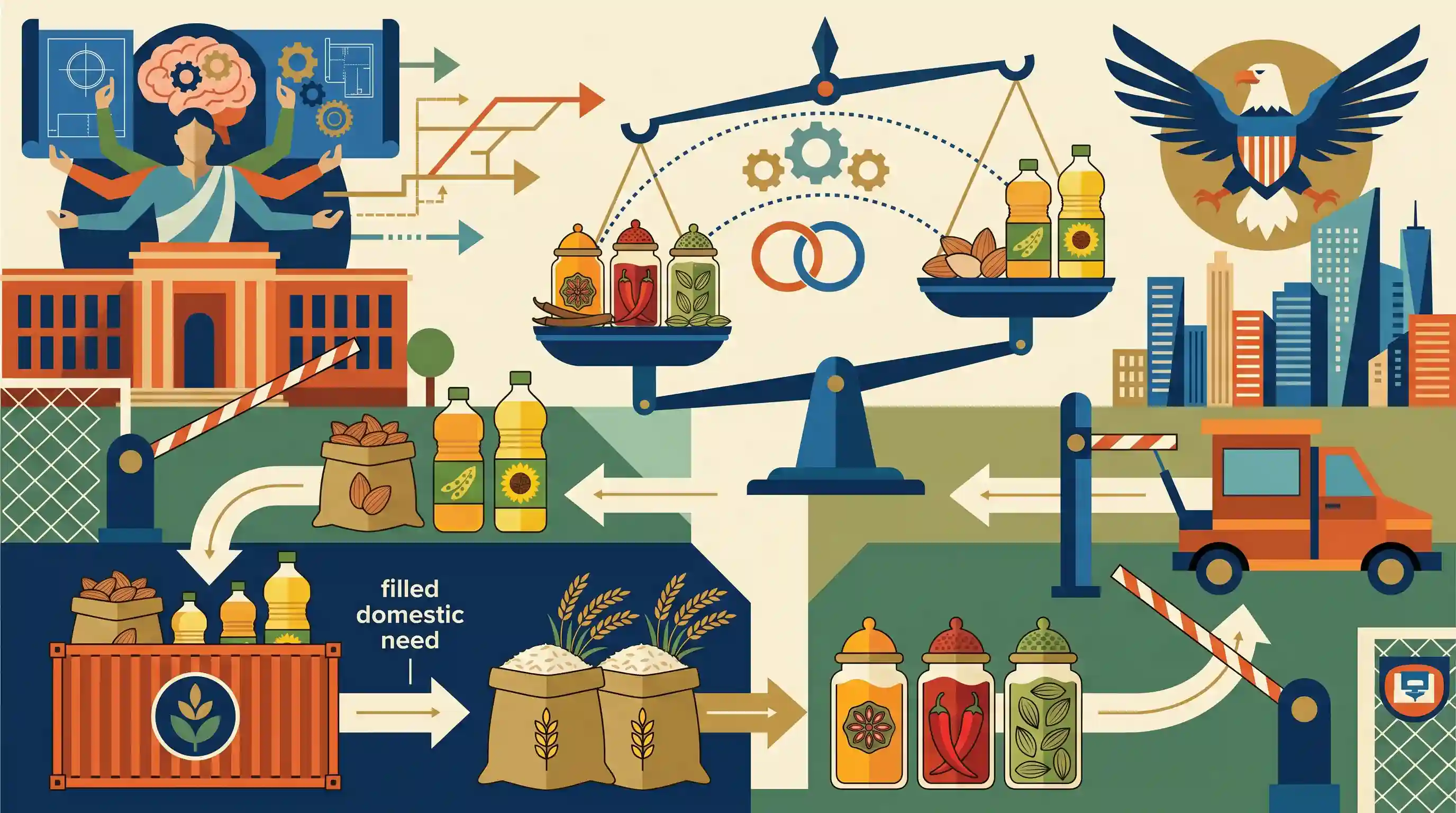
NITI Aayog has outlined a strategic approach for a potential trade deal with the US, proposing lower import duties on edible oils and nuts in exchange for enhanced market access for Indian agricultural exports, specifically spices and rice. This reciprocal strategy aims to leverage India's export strengths in agricultural commodities while addressing the persistent domestic demand-supply gap in edible oils through managed imports. The recommendations highlight a calculated push to deepen India-US bilateral trade by balancing domestic agricultural sensitivities with global trade opportunities.
Key Points
- NITI Aayog has recommended lowering import duties on edible oils and nuts to facilitate a prospective bilateral trade agreement with the US.
- In exchange, India is targeting increased market access and export growth for its spices and rice in the American market.
- The policy reflects a strategic balance, managing India\'s heavy reliance on edible oil imports (which consistently exceed domestic production) while pushing for growth in sectors where it has an export advantage.
- This approach underscores NITI Aayog\'s role as a policy think-tank in shaping India\'s macroeconomic and international trade negotiation strategies.
Important Terms
NITI Aayog

India's premier policy think tank (replacing the Planning Commission) providing strategic and technical advice to the Centre and States. It recommends balancing domestic agricultural protection with trade liberalization.
UPSC context
GS Papers II & III (Planning, Governance, Trade); tests understanding of policy-making and strategic trade recommendations.
India-US Bilateral Trade Agreement (BTA)
A proposed economic pact aiming to resolve trade disputes and increase bilateral trade to $500 billion by 2030 through mutual concessions on tariffs and market access.
UPSC context
GS Paper II (Bilateral Relations); crucial for questions on India-US economic ties and trade diplomacy.
Edible Oil Import Dependency
India's structural reliance on foreign cooking oils, importing approximately 57% of its annual needs (~15-16 million tonnes) to bridge the domestic demand-supply gap.
UPSC context
GS Paper III (Agriculture & Food Security); focuses on self-reliance (Atmanirbharta) and trade-offs in agricultural policy.
Reciprocal Tariffs
A trade policy where a country imposes tariffs on another's goods at the same rate that the other country imposes on its own, often used as a bargaining tool.
UPSC context
GS Paper II (International Relations); relevant for discussing global trade wars and protectionism.
Agricultural Export Basket
The range of farm commodities India sells globally; rice and spices are leading items, together with marine products contributing significantly to India's $50+ billion agri-export revenue.
UPSC context
GS Paper III (Economy & Exports); tests knowledge of export trends and commodity-specific trade challenges.
Market Access
The conditions, including both tariff and non-tariff barriers (like quality standards), under which a country's goods can enter a foreign market.
UPSC context
GS Papers II & III (Trade Policy); essential for understanding WTO issues and bilateral negotiations.
Prelims Trap
India's massive import bill for edible oils results in an overall agricultural trade deficit.
False. Despite heavy edible oil imports, India consistently maintains an overall trade surplus in agriculture, driven by exports of marine products, rice, and spices.
Static Concepts Connected
What is the composition and source profile of India's edible oil imports?
- Palm Oil: Accounts for roughly 60% of total edible oil imports, predominantly sourced from Indonesia and Malaysia.
- Soybean & Sunflower: Soybean oil is imported mainly from South America (Argentina/Brazil), while sunflower oil traditionally comes from the Black Sea region.
- Consumption Gap: India relies on imports to meet approximately 55-60% of its total domestic edible oil consumption requirement.
What are the key features of the National Mission on Edible Oils - Oil Palm (NMEO-OP)?
- Geographical Focus: Places special emphasis on expanding oil palm cultivation in the Northeast region and the Andaman & Nicobar Islands.
- Price Assurance: Provides a Viability Price (VP) mechanism to protect farmers from the volatility of international crude palm oil prices.
Cross-Topic Patterns
FTAs vs Domestic Agriculture
Lowering duties on US nuts (e.g., Californian almonds) impacts domestic growers, highlighting the classic tension between securing export markets (rice/spices) and protecting local farmers during FTA negotiations.
SPS Measures in US Trade
Realizing market access for Indian spices and rice in the US requires overcoming stringent Sanitary and Phytosanitary (SPS) measures by the US FDA, not just mutual tariff reductions.

Expect a multi-statement Prelims question comparing the import profiles of edible oils (palm vs soybean) and their primary source nations.
Linked PYQs · 3
Linked PYQs · 3
- 2018PrelimsGS1
Consider the following statements: 1. The quantity of imported edible oils is more than the domestic production of edible oils in the last five years. 2. The Government does not impose any customs duty on all the imported edible oils as a special case. Which of the statements given above is/are correct?
- 2019PrelimsGS1
Among the agricultural commodities imported by India, which one of the following accounts for the highest imports in terms of value in the last five years?
- 2015PrelimsGS1
The Government of India has established NITI Aayog to replace the
