Bay of Bengal Low Pressure: Andhra Pradesh Heavy Rain Alert
Source:the-week ↗
Why It Matters
Understanding the formation and impact of weather systems like low-pressure areas and cyclones in the Bay of Bengal is crucial for Geography. It also highlights the governance aspect of disaster management, focusing on early warning systems (IMD color codes) and state-level administrative responses to natural hazards.
Summary
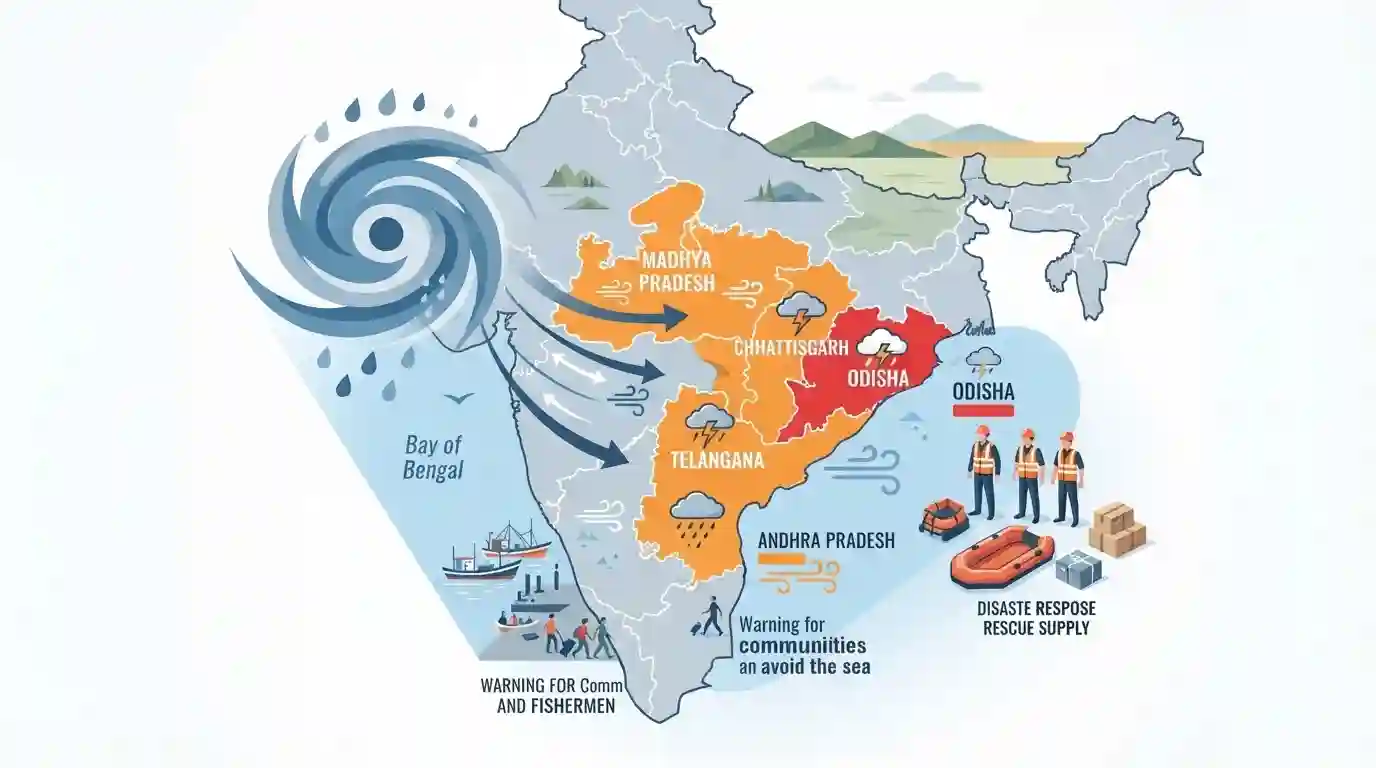
A low-pressure area over the northwest Bay of Bengal is set to bring heavy rainfall and severe weather to several eastern and central Indian states. The India Meteorological Department (IMD) has issued a red alert for Odisha and an orange alert for Andhra Pradesh, Madhya Pradesh, Chhattisgarh, and Telangana. In response, Andhra Pradesh authorities, led by Home and Disaster Management Minister Vangalapudi Anitha, have heightened disaster preparedness, warning coastal communities and fishermen to avoid venturing into the sea.
Key Points
- A low-pressure area has formed over the northwest Bay of Bengal and adjoining West Bengal-Bangladesh coasts, generating squally winds and widespread rainfall.
- The India Meteorological Department (IMD) has issued a red alert for Odisha, indicating the likelihood of extremely heavy rainfall.
- An orange alert has been declared for Andhra Pradesh, Madhya Pradesh, Chhattisgarh, and Telangana, signifying heavy to very heavy rainfall.
- Andhra Pradesh Home and Disaster Management Minister Vangalapudi Anitha directed district collectors to stay vigilant and issue warnings to coastal communities and fishermen.
Important Terms
India Meteorological Department (IMD)

The principal Indian government agency under the Ministry of Earth Sciences responsible for weather forecasting, meteorological observations, seismology, and issuing severe weather warnings.
UPSC context
Important for Geography and Disaster Management topics, testing knowledge of India's nodal weather forecasting and early warning institution.
Andhra Pradesh State Disaster Management Authority (APSDMA)
The chief nodal agency in Andhra Pradesh responsible for disaster management, preparedness, mitigation, and response at the state level under the Disaster Management Act.
UPSC context
Crucial for AP-specific Disaster Management syllabus, testing the state-level administrative framework for natural hazard response and mitigation.
Low-Pressure Area
An atmospheric region where air pressure is lower than its surroundings, causing air to rise and condense. It frequently leads to cloud formation, heavy rainfall, and cyclones.
UPSC context
Tested in Physical Geography and Climatology to explain monsoon mechanisms, rainfall patterns, and the formation of tropical cyclones.
Color-Coded Weather Alerts
A standardized early warning system used by the IMD. An Orange alert means authorities and the public should "be prepared," while a Red alert demands "taking action" against extreme weather.
UPSC context
Relevant for Disaster Management, testing the understanding of early warning protocols and administrative responses to impending natural disasters.
Prelims Trap
The State Disaster Management Authority (SDMA) is headed by the State Minister for Disaster Management.
Under the Disaster Management Act 2005, the SDMA is ex-officio chaired by the state's Chief Minister, not the Disaster Management Minister.
Static Concepts Connected
What conditions are required for tropical cyclone formation in the Bay of Bengal?
- Sea Surface Temperature: Must be 27°C or higher to provide a continuous supply of moisture and latent heat.
- Coriolis Force: Essential to create and maintain the cyclonic vortex or rotation; hence cyclones do not form exactly at the equator.
- Low Wind Shear: Low variations in vertical wind speed are required to keep the storm's vertical structure intact and prevent it from shearing apart.
What do the IMD's color-coded weather alerts signify for disaster response?
- Yellow Alert: Means "Be updated" regarding potentially severe weather that could cause isolated disruptions.
- Orange Alert: Means "Be prepared" for heavy to very heavy rainfall, warranting readiness for significant disruptions and power outages.
- Red Alert: Means "Take action" as extremely bad weather threatens life and infrastructure, requiring immediate evacuation and response.
Cross-Topic Patterns
BoB vs Arabian Sea Cyclogenesis
The Bay of Bengal's higher temperatures, lower salinity from river influx, and funnel shape make it significantly more prone to low-pressure systems and cyclones than the Arabian Sea.
Institutional framework of DM Act
Current weather events highlight the District Collector's role (heading the DDMA), bridging IMD's technical early warnings with the SDMA's policy execution at the ground level.

Expect a multi-statement question combining IMD color-code definitions with the statutory composition of the SDMA under the DM Act 2005.
Linked PYQs · 4
Linked PYQs · 4
- 2024APPSC_PRELIMSGS1
Match the following Climatic regions of India according to Koeppen's scheme: | List-I(Type of Climate) | List-II.(Areas) | |---|---| | A. Monsoon with short dry season | I. West coast of India, south of Goa | | B. Monsoon with dry summer | II. Coromandel coast of Tamil Nadu | | C. Monsoon with dry winter | III. Most of North-East India | | D. Semi-arid Steppe climate | IV. Northwestern Gujarat | Choose the correct answer using the codes given below: Code: A B C D
- 2012APPSC_PRELIMSGS1
Disaster Management Act was made in India in
- 2024APPSC_PRELIMSGS1
Identify the incorrect statement on extra-tropical cyclones:
- 2023APPSC_PRELIMSGS1
Given below are two statements, one labelled as Assertion (A) and the other labelled as Reason (R). Select your answer from the codes given below. Assertion (A) : National Income growth fluctuates with fluctuations in Agriculture growth in India. Reason (R) : Weather conditions, especially rains, are uncertain in India. Codes :
