Global Nursing Workforce Shortages and Developing Nation Challenges
Source:The Hindu ↗
Why It Matters
This report touches upon several critical UPSC themes, including the structural challenges of providing Universal Health Coverage (UHC) due to shortages in human resources, the migration of healthcare professionals (brain drain) from developing nations, and gender equity within the care economy. It provides crucial data points for GS-2 answers related to health governance, social justice, and international institutions.
Summary
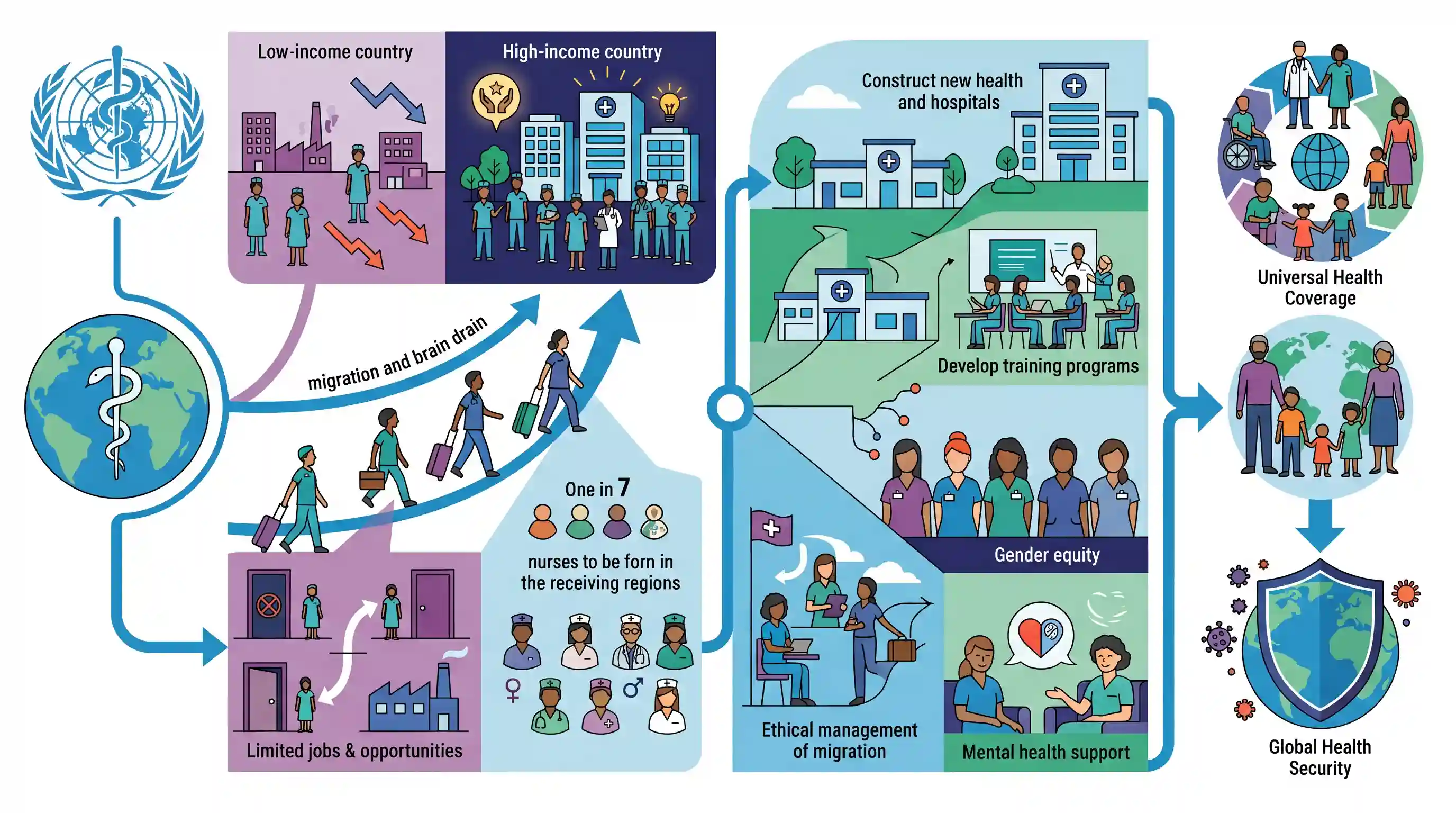
The WHO's 'State of the World's Nursing 2025' report highlights significant challenges and inequities in the global nursing workforce. While the total number of nurses has increased to nearly 30 million, severe regional disparities remain, disproportionately affecting low- and middle-income countries. These nations struggle to retain healthcare professionals due to lower employment opportunities and the migration of skilled nurses to high-income countries, where one in seven nurses is foreign-born. The report emphasizes the need for domestic investments to create health sector jobs, ethical management of international migration, and greater focus on gender equity and mental health support for a workforce that is 85% female. Addressing these gaps is critical for achieving Universal Health Coverage (UHC) and ensuring global health security.
Key Points
- The global nursing workforce grew to 29.8 million in 2023, reducing the projected global shortage to 4.1 million by 2030, according to the WHO's State of the World's Nursing 2025 report.
- Deep regional disparities persist, with 78% of the world's nurses concentrated in countries that account for just 49% of the global population.
- Low- and middle-income countries struggle with graduating, employing, and retaining nurses, necessitating increased domestic investments to sustain health sector jobs and prevent brain drain.
- The global healthcare system heavily relies on migration, with one in seven nurses worldwide (and 23% in high-income countries) being foreign-born, prompting calls for ethical bilateral agreements.
- Women make up 85% of the global nursing workforce, underscoring the need for programmatic interventions focused on gender equity, workplace safety, and mental well-being support, which is currently inadequate.
Important Terms
State of the World's Nursing 2025

A landmark WHO report providing a comprehensive analysis of the global nursing workforce, highlighting progress, shortages (5.8 million), and critical regional inequities.
UPSC context
GS Paper 2 (Health); provides critical data on global health workforce disparities and the feminized nature of nursing.
Universal Health Coverage (UHC)
The goal of ensuring all individuals and communities receive quality essential health services they need without suffering financial hardship.
UPSC context
GS Paper 2 (Social Justice/Health); central to National Health Policy 2017 and Ayushman Bharat.
Human Resources for Health (HRH)
The stock of all individuals engaged in actions whose primary intent is to enhance health, encompassing recruitment, training, and retention of professionals.
UPSC context
GS Paper 2; critical for health system strengthening and addressing India's rural-urban doctor/nurse density gaps.
Sustainable Development Goal 3 (SDG 3)
The UN goal to 'ensure healthy lives and promote well-being for all,' with Target 3.c specifically focusing on health workforce development in developing nations.
UPSC context
GS Paper 2 & 3; provides the international framework for health targets and performance monitoring.
Brain Drain (Healthcare)
The migration of skilled health professionals from low- and middle-income countries to high-income nations, leading to domestic shortages in their home countries.
UPSC context
GS Paper 2 (Health/International Relations); tests understanding of global workforce inequities and ethical recruitment practices.
World Health Organization (WHO)
The United Nations' specialized agency for health, providing leadership on global health matters, setting standards, and monitoring health trends globally.
UPSC context
GS Paper 2 (International Institutions); crucial for global health security and normative health guidance.
Prelims Trap
"The WHO report indicates the global shortage of nurses is widening and absolute numbers are declining."
The report notes the absolute global shortage is actually reducing (down to 4.1 million by 2030). The true crisis is the worsening regional disparity, not an aggregate global decline.
Static Concepts Connected
What are the core dimensions of Universal Health Coverage (UHC) under SDG 3?
- Population coverage: Ensuring all individuals and communities, especially vulnerable populations, are covered by the health system.
- Service coverage: Providing a comprehensive range of quality services, including preventive, curative, rehabilitative, and palliative care.
- Financial protection: Ensuring that the cost of using health services does not expose patients to financial hardship or impoverishment.
How does the 'Care Economy' intersect with female labor force dynamics?
- Disproportionate burden: Women perform the vast majority of unpaid domestic care and underpaid formal care work, restricting their broader economic mobility.
- Economic invisibility: Unpaid care work is excluded from traditional GDP calculations, structurally masking women's true macroeconomic contributions.
- Formalization mandate: Investing in public health and nursing transitions informal/unpaid care into formalized jobs, a key driver for improving FLFPR.
Cross-Topic Patterns
Medical brain drain & Remittances
India is a top global supplier of nurses. This boosts remittance inflows but exacerbates domestic rural healthcare shortages, creating a stark policy trade-off between labor export and domestic UHC goals.
Ethical workforce migration agreements
Connects to the WHO Global Code of Practice on International Recruitment. Emphasizes the need for bilateral mobility agreements (like India-UK pacts) that protect migrant workers and compensate origin countries.
Care economy & FLFPR linkages
With nursing being 85% female, expanding and formalizing the healthcare workforce directly impacts the Female Labor Force Participation Rate (FLFPR) while transitioning women from unpaid to paid care work.

Expect a GS-2 Mains question linking India's medical brain drain and the formalization of the care economy to achieving domestic UHC.
Linked PYQs · 4
Linked PYQs · 4
- 2015MainsGS2
Public health system has limitations in providing universal health coverage. Do you think that the private sector could help in bridging the gap? What other viable alternatives would you suggest?
- 2020MainsGS2
Critically examine the role of WHO in providing global health security during the Covid-19 pandemic.
- 2023MainsGS2
The crucial aspect of development process has been the inadequate attention paid to Human Resource Development in India. Suggest measures that can address this inadequacy.
- 2024MainsGS1
Distinguish between gender equality, gender equity and women's empowerment. Why is it important to take gender concerns into account in programme design and implementation?
