Louvre Museum Strike Highlights Global Crisis of Overtourism
Source:Indian Express ↗
Why It Matters
Overtourism is a pressing global governance and environmental issue. For UPSC aspirants, it is a crucial case study in the context of 'carrying capacity' and sustainable development. It is directly applicable to India's own challenges with overcrowding in ecologically sensitive zones like the Himalayas (e.g., Shimla, Kedarnath) and core areas of wildlife reserves.
Summary
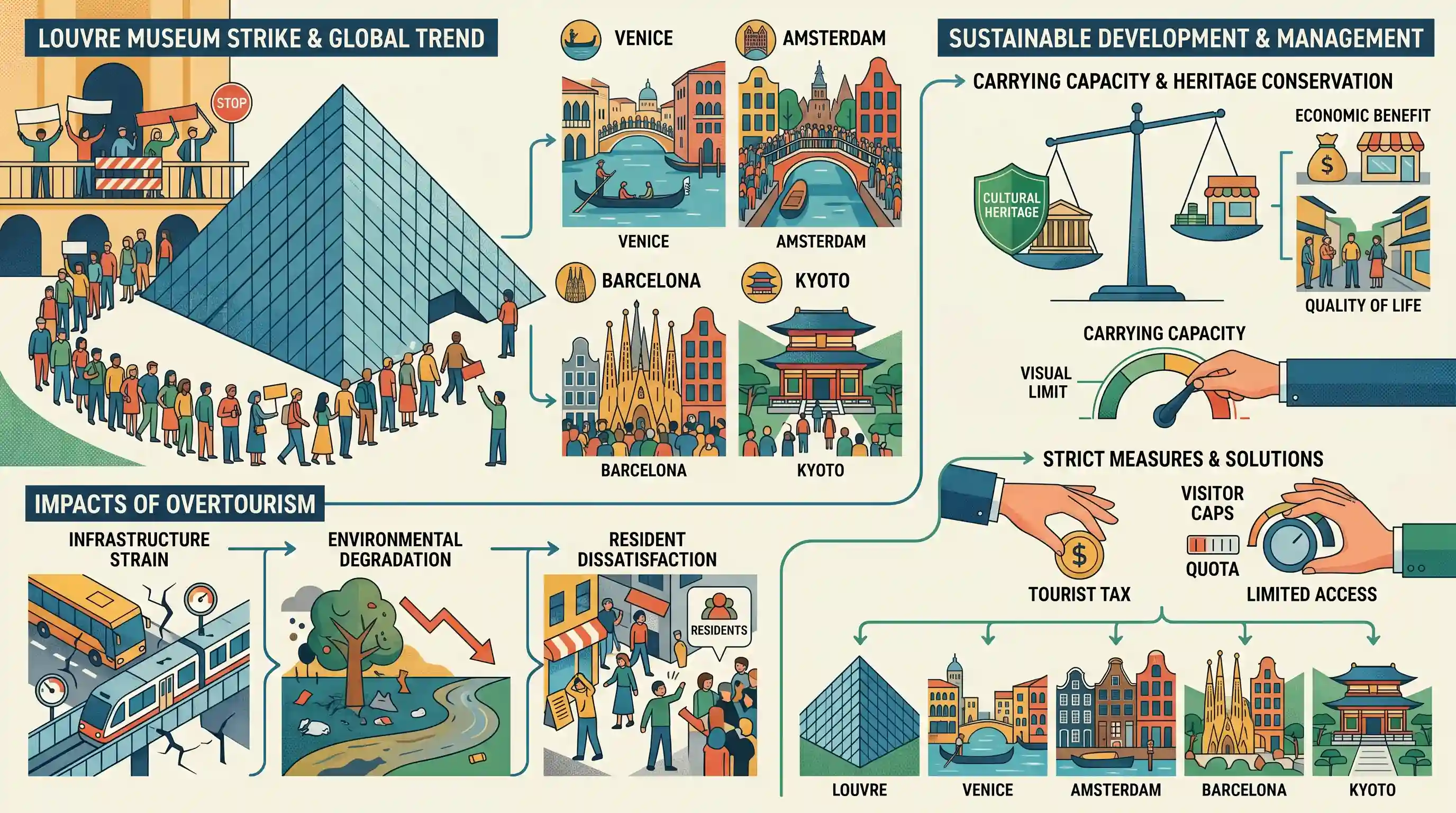
A strike by employees at the Louvre Museum in Paris has drawn global attention to the growing menace of "overtourism," where excessive visitor numbers overwhelm local carrying capacities. The crisis at the Louvre mirrors similar struggles in major tourist destinations like Venice, Amsterdam, Barcelona, and Kyoto, which are grappling with infrastructure strain, environmental degradation, and resident dissatisfaction. These cities are increasingly forced to adopt strict measures, such as tourist taxes and visitor caps, to strike a balance between the economic benefits of tourism and the sustainable preservation of their heritage and urban life.
Key Points
- Employees at the Louvre Museum in Paris went on strike to protest deteriorating working conditions caused by unprecedented overcrowding and "overtourism".
- Overtourism occurs when the number of visitors exceeds the carrying capacity of a destination, leading to degraded infrastructure, environmental strain, and diminished quality of life for local residents.
- Several global tourist hotspots, including Venice, Amsterdam, Barcelona, and Kyoto, are implementing countermeasures like tourist taxes, restricting short-term rentals, or capping daily visitors to manage the influx.
- The situation highlights the growing global conflict between maximizing tourism revenue and the sustainable management of heritage sites and urban ecosystems.
Important Terms
Overtourism

The phenomenon where excessive visitor numbers saturate a destination, exceeding its capacity to handle them without negatively impacting the local community, environment, and visitor experience quality.
UPSC context
GS Paper I (Urbanization) and GS Paper III (Sustainable Development). Tests knowledge of demographic pressures on infrastructure.
Tourism Carrying Capacity (TCC)
The maximum level of visitor use an area can sustain while maintaining high-quality resources and visitor satisfaction without causing irreversible physical, social, or environmental degradation.
UPSC context
GS Paper III (Environment). Essential for questions on ecologically fragile regions like the Himalayas or heritage sites.
Sustainable Tourism
An approach to tourism development that balances economic growth with social equity and environmental preservation, ensuring long-term resource viability for future generations.
UPSC context
GS Paper III (Economy/Environment). Linked to India's National Strategy for Sustainable Tourism and global Sustainable Development Goals.
Visitor Caps
Administrative limits on daily or seasonal entries to specific sites (like the Louvre or national parks) to control crowd density and prevent physical damage.
UPSC context
GS Paper I (Heritage Management). Examines policy interventions for site preservation and effective urban crowd management.
Tourist Tax
A fiscal levy on visitors intended to recover the 'hidden costs' of tourism, such as infrastructure wear, waste management, and environmental restoration in popular destinations.
UPSC context
GS Paper III (Economy). Relevant for resource mobilization and addressing negative externalities in local governance.
Heritage Conservation
The active protection and maintenance of cultural and natural sites of historical importance to ensure their integrity and aesthetic value persist for future generations.
UPSC context
GS Paper I (Art and Culture). Tests understanding of the conflict between economic exploitation and archaeological preservation.
CGT Union
One of France's largest trade unions (Confédération Générale du Travail), frequently leading industrial actions in the cultural sector to protest labor conditions and understaffing.
UPSC context
GS Paper II (Polity). Illustrates the role of organized labor and pressure groups in influencing public institutions.
Prelims Trap
UNESCO legally mandates strict daily visitor caps for all World Heritage Sites to prevent overtourism.
UNESCO provides guidelines and can list sites as 'In Danger', but enforcing visitor caps or tourist taxes remains the exclusive jurisdiction of local governments.
Static Concepts Connected
What are the core dimensions of 'Carrying Capacity' in tourism?
- Physical Capacity: The absolute maximum number of people or vehicles an area can spatially accommodate without breakdown.
- Ecological Capacity: The limit before ecosystem degradation (flora, fauna, water resources) becomes irreversible.
- Social Capacity: The threshold beyond which local residents suffer a severe decline in their quality of life.
- Economic Capacity: The point where mass tourism crowds out other essential local economic activities and businesses.
How does India legally regulate tourism in fragile ecosystems?
- Eco-Sensitive Zones (ESZ): Notified under the Environment Protection Act 1986, these zones act as 'shock absorbers' limiting commercial tourism around protected areas.
- CRZ Rules: Regulates and restricts commercial tourism infrastructure, like resorts, near the High Tide Line to prevent coastal erosion.
- NGT Interventions: The NGT increasingly mandates state governments to conduct strict carrying capacity assessments for hill stations before approving new constructions.
Cross-Topic Patterns
Overtourism + Himalayan Land Subsidence
Global overtourism mirrors India's hill station crises (e.g., Joshimath). Unregulated hotel construction exceeding local carrying capacity directly links tourism to GS3 disaster management.
Carrying Capacity + Western Ghats Ecology
Western Ghats conservation debates (Gadgil/Kasturirangan) frequently hinge on tourism carrying capacity, directly tying GS3 environmental ecology with GS1 urbanization.

Expect a GS1 or GS3 Mains question linking global overtourism countermeasures to Himalayan carrying capacity and recent hill-station disasters.
Linked PYQs · 3
Linked PYQs · 3
- 2015MainsGS1
The states of Jammu and Kashmir, Himachal Pradesh and Uttarakhand are reaching the limits of their ecological carrying capacity due to tourism. Critically evaluate.
- 2012MainsGS1
The issue of tourism in core areas of tiger reserve forests in the country is a subject matter of debate. Critically examine various aspects of this issue, keeping in view relevant recent judicial pronouncements.
- 2019MainsGS3
Define the concept of carrying capacity of an ecosystem as relevant to an environment. Explain how understanding this concept is vital while planning for sustainable development of a region.
