Artificial light at night and its ecological impact on wildlife
Source:The Hindu ↗
Why It Matters
As urbanization accelerates globally, light pollution represents a critical yet under-discussed environmental hazard. For UPSC aspirants, understanding ALAN's precise impacts on wildlife behavior—such as migration and reproduction—and analyzing mitigation frameworks like Dark Sky reserves is essential for comprehensive coverage of GS-3 Environmental Conservation and Pollution topics.
Summary
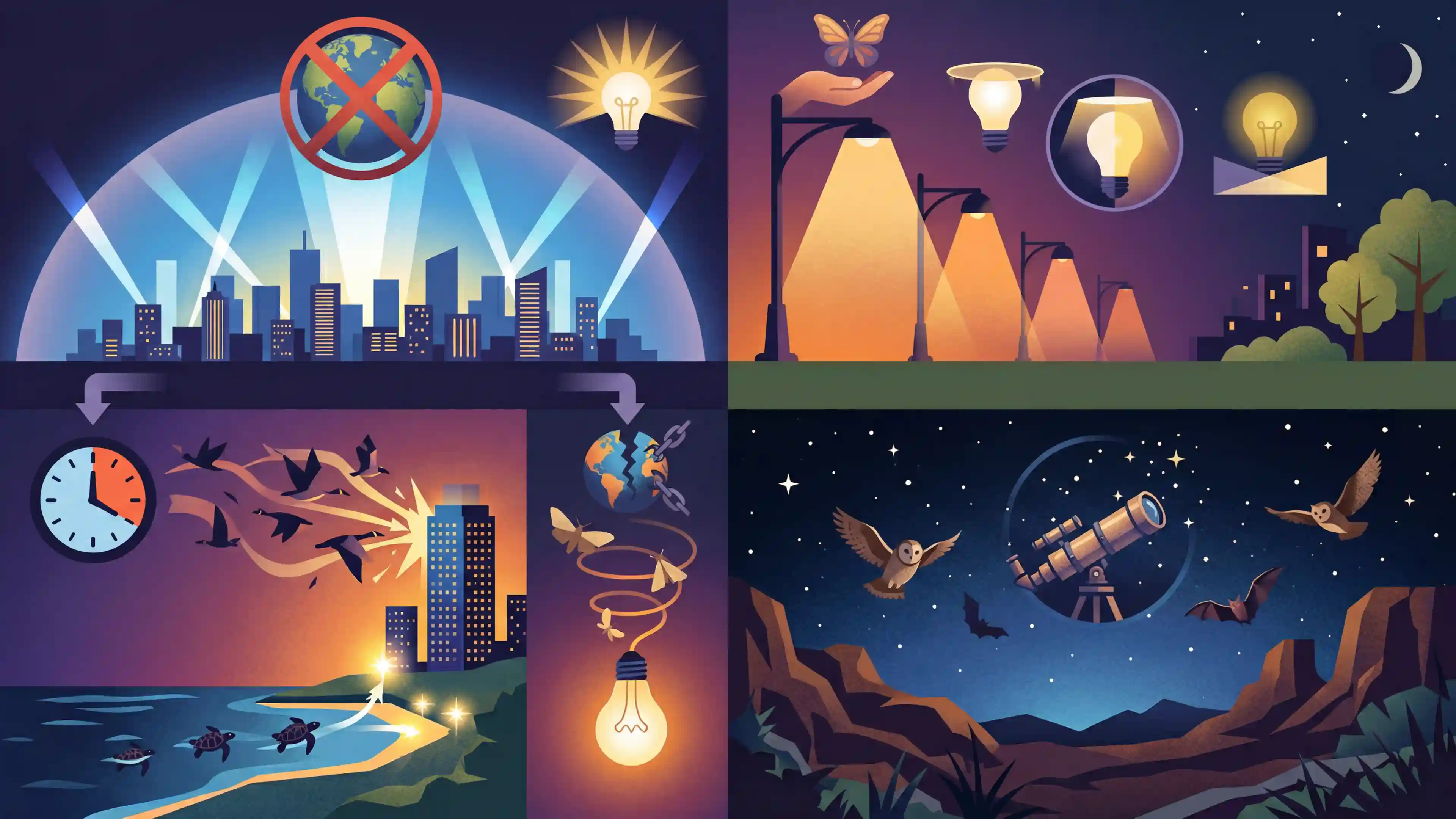
The article highlights the escalating ecological crisis caused by Artificial Light at Night (ALAN), framing it as a severe but often overlooked form of pollution. Unregulated urban illumination disrupts the circadian rhythms of wildlife, leading to fatal consequences such as migratory birds colliding with buildings, sea turtle hatchlings moving inland instead of toward the ocean, and declining insect populations due to fatal attraction. To combat this issue, the piece advocates for practical mitigation strategies, including the use of shielded and warm-colored lighting, the reduction of unnecessary night glow, and the promotion of Dark Sky Parks to safeguard nocturnal biodiversity.
Key Points
- Artificial Light at Night (ALAN) has emerged as a pervasive form of pollution, disrupting the circadian rhythms and natural behaviors of diverse wildlife species.
- Excessive urban illumination causes fatal disorientation in migratory birds, leading to building collisions, and triggers steep population declines in insects drawn to artificial lights.
- Coastal light pollution threatens sea turtle hatchlings by misdirecting them inland towards artificial light sources instead of their natural ocean habitat.
- Effective mitigation strategies include shielding light fixtures, using warm-colored lights to reduce ecological disruption, minimizing unnecessary night-time illumination, and designating Dark Sky Parks to preserve nocturnal environments.
Prelims Trap
"India's first Dark Sky Reserve was established at Pench Tiger Reserve to protect nocturnal wildlife and night skies."
Pench is India's first Dark Sky *Park* (wildlife focus). Hanle (Ladakh) is India's first Dark Sky *Reserve* (astronomy focus). Aspirants often swap the two locations and their primary designations.
Static Concepts Connected
What is the CMS (Bonn Convention) and its role in sensory pollution?
- UNEP Treaty: An environmental treaty under the UNEP, it is the only global convention specializing in the conservation of migratory species, their habitats, and migration routes.
- Appendices: Appendix I lists endangered migratory species; Appendix II lists species whose conservation requires international cooperative agreements.
- Sensory Pollutants: CMS COP-14 recently introduced international guidelines addressing artificial light and noise pollution, recognizing them as major barriers that disorient migratory birds.
How does coastal artificial illumination threaten sea turtle ecology?
- Visual Navigation: Hatchlings instinctively crawl toward the brightest natural horizon immediately after birth, which historically has been the moon and stars reflecting off the ocean surface.
- ALAN Disorientation: Coastal urban lights create a brighter artificial horizon, misdirecting hatchlings inland where they perish from exhaustion, dehydration, or terrestrial predators.
- Arribada Vulnerability: Mass nesting sites (like Odisha's Olive Ridley rookeries) are highly sensitive to nearby port, highway, and urban lighting infrastructure, necessitating strict blackout periods.
Cross-Topic Patterns
ALAN, Astro-Tourism and Hanle Reserve
Mitigating light pollution is vital for both ecology and astronomy. The Hanle Dark Sky Reserve in Ladakh specifically promotes astro-tourism while enforcing strict light regulations to preserve night skies.
Sensory Pollution and Human Endocrine Disruption
ALAN bridges environmental ecology and human biology. It acts as an endocrine disruptor by suppressing melatonin production, thereby linking urban pollution directly to human sleep and cognitive disorders.

Expect a 2026 Prelims question mapping Dark Sky designations (Hanle vs. Pench) alongside ALAN's impacts on migratory birds and melatonin.
Linked PYQs · 2
Linked PYQs · 2
- 2023PrelimsGS1
Consider the following fauna: 1. Lion-tailed Macaque 2. Malabar Civet 3. Sambar Deer How many of the above are generally nocturnal or most active after sunset?
- 2023MainsGS3
What is oil pollution? What are its impacts on the marine ecosystem? In what way is oil pollution particularly harmful for a country like India?
