Electoral Shifts and Regional Impacts in Recent Assembly Elections
Source:The Hindu ↗
Why It Matters
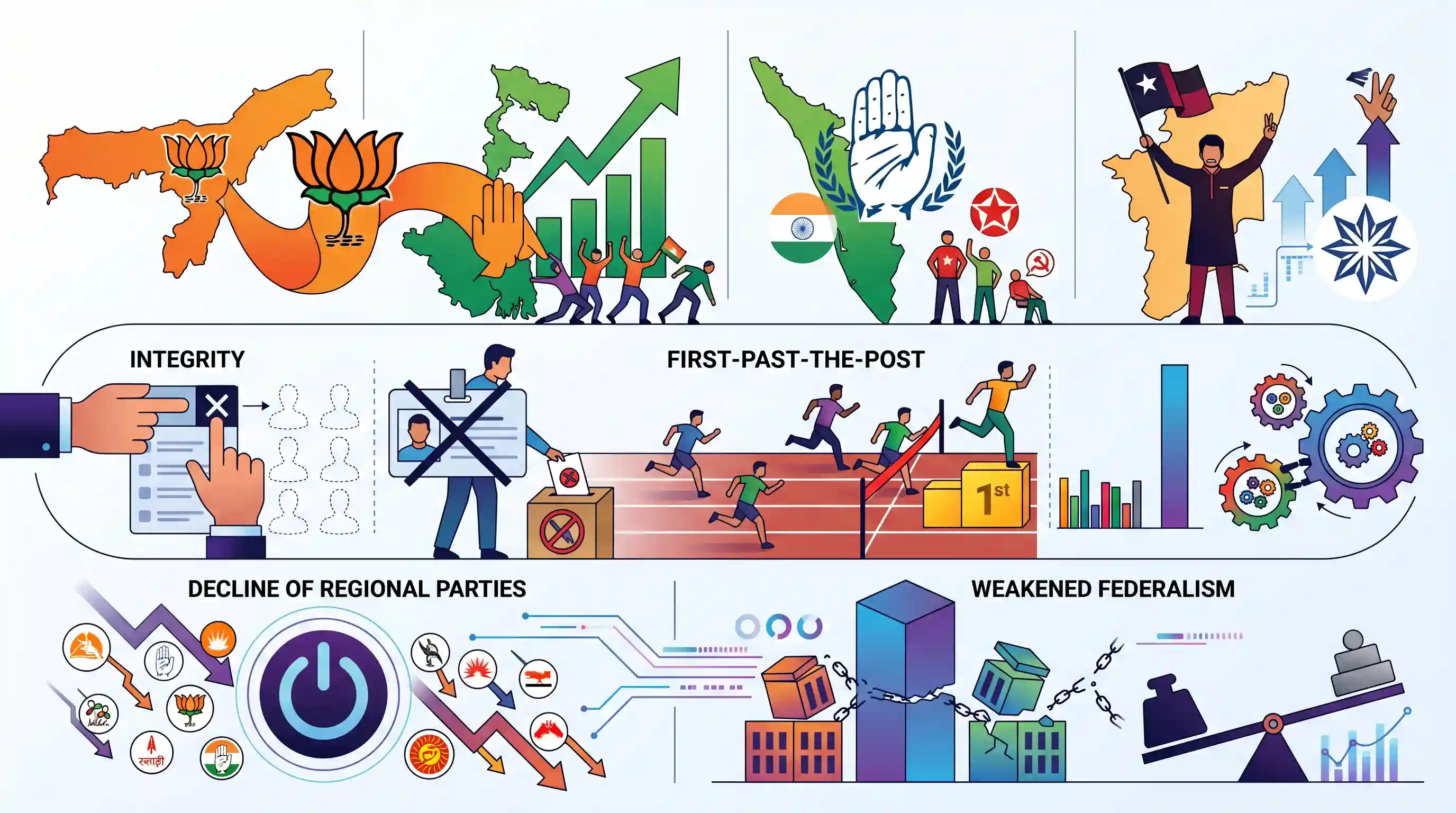
These election outcomes provide highly relevant case studies for GS2 topics on electoral mechanisms (the mathematical effects of the first-past-the-post system), vulnerabilities in the Representation of the People Act (arbitrary voter roll deletions), and the evolving dynamics of Indian federalism (the tension between national centralization and regional political parties).
Summary
The 2026 Assembly elections saw the BJP retain Assam and decisively capture West Bengal, while the Congress-led UDF reclaimed Kerala and actor C. Joseph Vijay's TVK registered a historic debut win in Tamil Nadu. The outcomes highlight significant shifts in India's political landscape: the decline of established regional parties, concerns over democratic and electoral integrity due to massive voter roll deletions, and the profound, disproportionate impact of the first-past-the-post system in multi-cornered contests. The weakening of dominant state-level opposition parties could further reshape the balance of Indian federalism.
Key Points
- The BJP's strategic wins in West Bengal and Assam strengthen its national dominance but raise concerns over electoral integrity, highlighted by the arbitrary deletion of 27 lakh voters from Bengal's electoral rolls.
- The TVK's victory in Tamil Nadu marks a historic rupture in Dravidian politics, facilitated by the first-past-the-post mechanism yielding an outsized seat advantage in a multi-cornered contest.
- The defeat of robust regional parties (TMC, DMK) weakens key bulwarks of Opposition politics and state autonomy, potentially enabling central unilateralism on federal issues like the Delimitation Bill.
- The election results set the stage for a major realignment within the national Opposition, offering the Congress a window to consolidate anti-BJP political forces following its win in Kerala.
Important Terms
Representation of the People Act

The primary legislation (1950 & 1951) governing voter qualifications, seat allocation, and the actual conduct of elections and electoral disputes in India.
UPSC context
GS2: Salient features of the RPA; essential for questions on electoral reforms and democratic integrity.
First-Past-The-Post (FPTP) System
An electoral system where the candidate with the most votes wins, regardless of whether they achieve an absolute majority (50% + 1).
UPSC context
GS2: Comparison of electoral systems; tests understanding of representative distortions and multi-cornered contests.
Federalism
A constitutional arrangement dividing power between the Union and State governments, ensuring state autonomy while maintaining national integrity.
UPSC context
GS2: Federal structure and distribution of powers; tests challenges to state autonomy and center-state relations.
Delimitation
The process of redrawing boundaries of Lok Sabha and Assembly constituencies based on population data to ensure "one vote, one value."
UPSC context
GS2: Constitutional/statutory bodies; relevant to future seat reallocation and North-South political parity.
Tamilaga Vettri Kazhagam (TVK)
A regional political party in Tamil Nadu founded by actor Vijay in 2024, aimed at challenging established Dravidian parties.
UPSC context
GS2: Party system and regionalism; examines the impact of personality-led movements on state politics.
Regionalism
Political mobilization based on regional identity, language, or culture, often leading to the rise of state-specific political parties.
UPSC context
GS1: Diversity and social issues; GS2: Dynamics of the Indian party system and its impact on federalism.
Prelims Trap
The preparation and revision of electoral rolls are governed by the Representation of the People Act, 1951.
Electoral rolls are governed by RPA 1950, not 1951. Aspirants frequently confuse RPA 1950 (voter registration) with RPA 1951 (conduct of elections/disqualifications).
Static Concepts Connected
What are the powers and constitutional status of the Delimitation Commission?
- Constitutional basis: Established by Parliament under Article 82 (national) and Article 170 (states) to readjust territorial constituencies after every census.
- Force of law: Its orders carry the force of law and cannot be questioned in any court, ensuring electoral maps are not delayed by litigation.
- No modifications: Neither the Lok Sabha nor State Legislative Assemblies can modify the Commission's orders once they are laid before them.
How does the First-Past-The-Post (FPTP) system impact multi-cornered contests?
- Vote-to-seat asymmetry: FPTP allows a candidate or party to win a massive majority of seats with a relatively low vote share if the opposition is deeply fragmented.
- Constitutional mandate: India uses FPTP for direct elections to the Lok Sabha and State Legislative Assemblies, prioritizing stable governments over strict proportional representation.
Cross-Topic Patterns
FPTP distortions & Delimitation freeze
Outsized seat margins yielded by FPTP in multi-cornered state contests compound Southern anxieties regarding the impending post-2026 lifting of the delimitation freeze and potential loss of federal leverage.
RPA 1950 vs Article 326 limits
Mass voter roll deletions test the fundamental safeguard of universal adult suffrage (Article 326) against the Election Commission's statutory administrative powers regarding electoral rolls under RPA 1950.

Expect a Mains question linking FPTP vote-to-seat distortions and the decline of regional parties to the upcoming post-2026 Delimitation.
Linked PYQs · 3
Linked PYQs · 3
- 2016MainsGS2
The Indian party system is passing through a phase of transition which looks to be full of contradictions and paradoxes." Discuss.
- 2022MainsGS2
Discuss the procedures to decide the disputes arising out of the election of a Member of the Parliament or State Legislature under The Representation of the People Act, 1951. What are the grounds on which the election of any returned candidate may be declared void ? What remedy is available to the aggrieved party against the decision ? Refer to the case laws.
- 2022MainsGS2
“While the national political parties in India favour centralisation, the regional parties are in favour of State autonomy.” Comment.
