Airshed Management and Structural Deficits in Pollution Control
Source:The Hindu ↗
Why It Matters
Air pollution in North India is a recurring and severe environmental crisis relevant to GS3 (Environment) and GS2 (Governance). This article helps aspirants understand the concept of 'airshed' management and critically evaluate the efficacy of institutions like the CAQM.
Summary
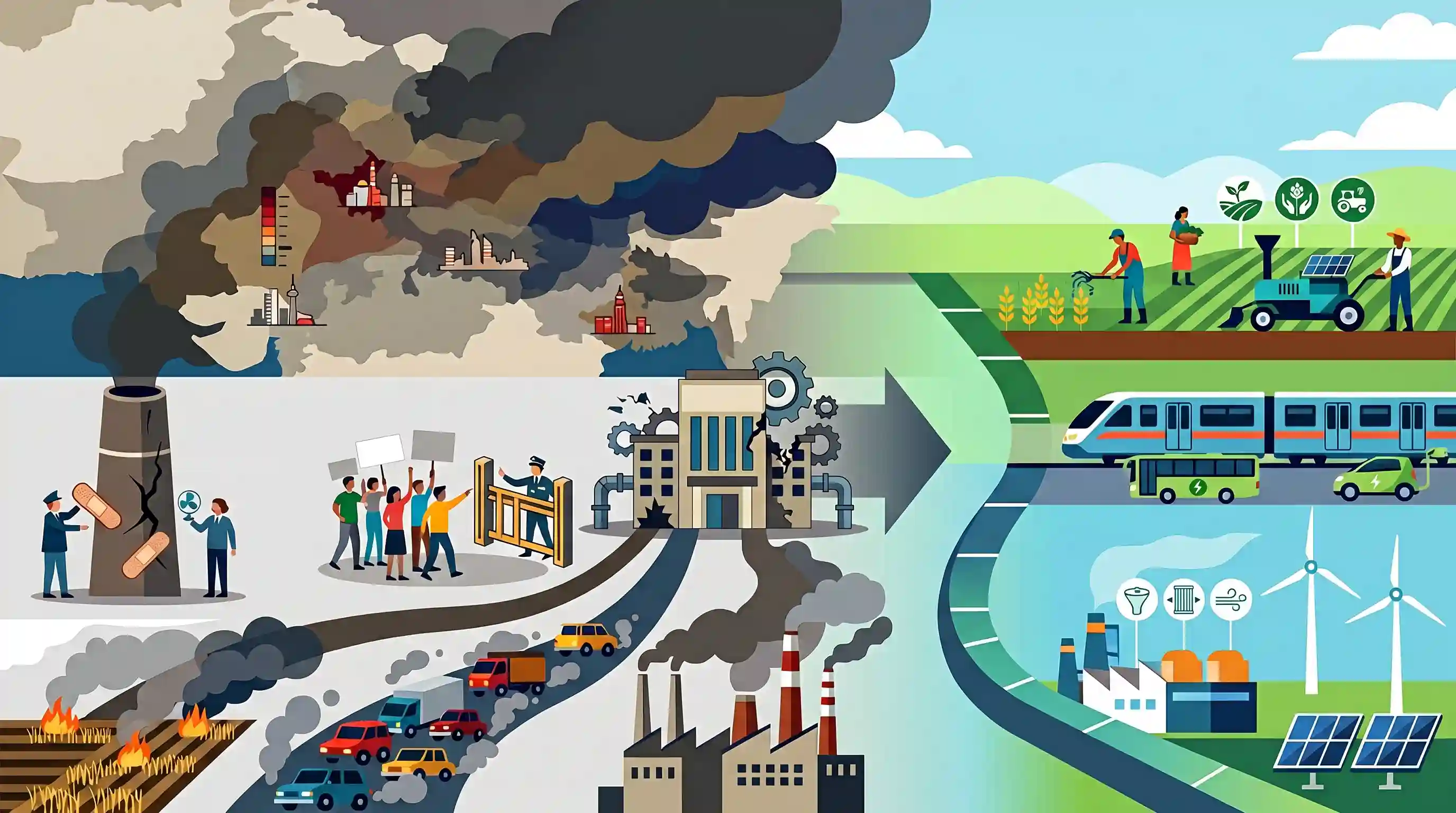
The editorial criticizes the ad-hoc governance approach toward North India's severe winter air pollution, which consistently pushes the AQI into hazardous territory. Highlighting that the problem is a regional 'airshed' issue spanning from Pakistan to Bihar, the author argues against temporary technical fixes and punitive responses to citizen protests. Despite establishing the Commission for Air Quality Management (CAQM) to unify fragmented authorities, systemic challenges persist across agriculture, transport, and industry. The piece calls for a shift toward substantive, time-bound sectoral emission reduction plans to tackle the root causes of pollution effectively.
Key Points
- North India's air quality crisis is an 'airshed' issue that spans geographically from Islamabad to Bihar, demanding cooperative, cross-border strategies rather than isolated local fixes.
- Authorities often respond to air quality protests as a law-and-order challenge, masking their failure to address structural environmental governance deficits.
- The Commission for Air Quality Management (CAQM), established to resolve the problem of fragmented environmental authority, has not yet delivered comprehensive sectoral emission reductions.
- The editorial urges abandoning short-term technical solutions in favor of time-bound, sector-specific interventions targeting transport, power generation, industry, construction, and agricultural crop-burning.
Important Terms
Commission for Air Quality Management (CAQM)

A statutory body established in 2021 to coordinate and oversee air quality management specifically in the National Capital Region (NCR) and its adjoining states like Punjab and Haryana.
UPSC context
GS Paper III/Environment; tests knowledge of statutory environmental governance and regional inter-state coordination.
Airshed
A geographical region where common topography and meteorology trap pollutants, meaning air quality in one area affects another, necessitating a regional rather than local management approach.
UPSC context
GS Paper III/Environment; critical for understanding the transboundary nature of pollution and regional planning.
Graded Response Action Plan (GRAP)
An emergency response framework for Delhi-NCR that activates incremental restrictive measures (Stages I-IV) based on worsening Air Quality Index (AQI) levels to prevent pollution spikes.
UPSC context
GS Paper III/Environment; relevant for questions on urban pollution management and emergency policy frameworks.
Air Quality Life Index (AQLI)
A global pollution index developed by the University of Chicago that translates particulate matter (PM2.5) concentrations into their quantifiable impact on human life expectancy.
UPSC context
GS Paper III/Environment; provides data-driven evidence for the public health costs of air pollution.
National Clean Air Programme (NCAP)
India's flagship national strategy (launched 2019) aiming for a 40% reduction in particulate matter concentrations by 2026 across 131 identified 'non-attainment' cities.
UPSC context
GS Paper III/Environment; tests knowledge of national targets, city-specific action plans, and environmental policy performance.
National Air Quality Index (AQI)
A standardized system that simplifies complex pollutant data into a single number and color-coded category (e.g., 'Severe') to communicate air quality and health risks to the public.
UPSC context
GS Paper III/Pollution; essential for understanding air quality monitoring standards and public communication tools.
Prelims Trap
"The CAQM exercises statutory jurisdiction over the entire Indo-Gangetic airshed to manage regional pollution."
CAQM's mandate is legally restricted to the NCR and adjoining areas (Punjab, Haryana, Rajasthan, UP), not the entire Indo-Gangetic airshed spanning to Bihar.
Static Concepts Connected
What is an 'airshed' and why is it crucial for North India?
- Definition: A geographic region sharing common meteorological and topographical characteristics where air pollutants are trapped and dispersed together.
- Policy shift: Moves governance away from localized, city-specific boundaries (which fail as pollution travels) to regional cooperative management.
- Geographic trap: The Indo-Gangetic plain acts as a massive airshed bounded by the Himalayas, trapping winter emissions via temperature inversion.
How does the CAQM alter environmental governance in the NCR?
- Statutory backing: Formed under a 2021 Act, replacing the Supreme Court-appointed EPCA to provide a permanent, legislative framework.
- Superseding authority: CAQM's directives override those of the Central Pollution Control Board (CPCB) and State governments in case of conflict.
- Jurisdiction limits: Restricted specifically to the National Capital Region and adjoining states (Punjab, Haryana, Rajasthan, Uttar Pradesh).
Cross-Topic Patterns
Crop MSPs + Regional Air Pollution
The MSP regime and free electricity strongly incentivize paddy cultivation in Northwest India, inextricably linking agricultural policy to the winter stubble-burning and regional air quality crisis.
Cooperative Federalism vs Airsheds
Ecological boundaries (airsheds) conflict with political borders, triggering inter-state blame games. This makes supra-state bodies like CAQM critical case studies for environmental federalism.

CAQM’s statutory overriding powers versus State Pollution Boards is prime for a tricky multi-statement polity/environment question in 2026.
Linked PYQs · 4
Linked PYQs · 4
- 2016PrelimsGS1
In the cities of our country, which among the following atmospheric gases are normally considered in calculating the value of Air Quality Index? 1. Carbon dioxide 2. Carbon monoxide 3. Nitrogen dioxide 4. Sulfur dioxide 5. Methane Select the correct answer using the code given below.
- 2022PrelimsGS1
In the context of WHO Air Quality Guidelines, consider the following statements: 1. The 24-hour mean of PM2.5 should not exceed 15 µg/m³ and annual mean of PM2.5 should not exceed 5 µg/m³. 2. In a year, the highest levels of ozone pollution occur during the periods of inclement weather. 3. PM10 can penetrate the lung barrier and enter the bloodstream. 4. Excessive ozone in the air can trigger asthma. Which of the statements given above are correct?
- 2025PrelimsGS1
Artificial way of causing rainfall to reduce air pollution makes use of
- 2024MainsGS3
Industrial pollution of river water is a significant environmental issue in India. Discuss the various mitigation measures to deal with this problem and also the government's initiatives in this regard.
