India-Israel Bilateral Ties and Strategic Technology Partnership
Source:The Hindu ↗
Why It Matters
The upcoming visit provides crucial context for answering questions on India's evolving Middle East policy and its specific strategic relationship with Israel. It showcases how ties have diversified from traditional defense and agriculture into high-tech areas like AI, while also highlighting the practical diplomatic challenges posed when a partner nation's domestic political fractures spill over into foreign visits.
Summary
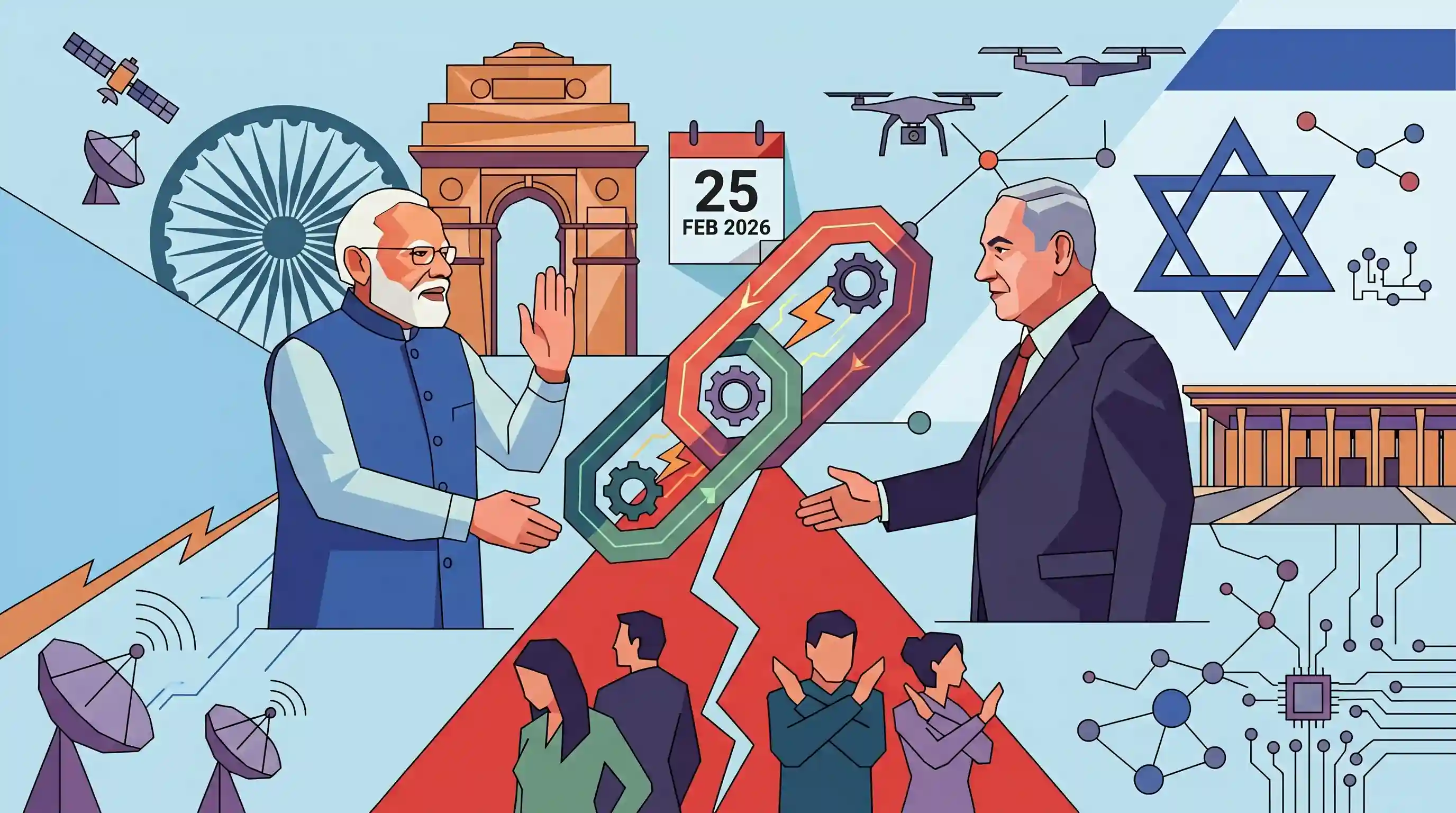
Prime Minister Narendra Modi is scheduled to visit Israel on February 25, 2026, aiming to reinforce the multifaceted strategic partnership between the two nations. Both PM Modi and Israeli PM Benjamin Netanyahu highlighted their nations' deepening ties, focusing on mutual interests in innovation, artificial intelligence, security, and regional cooperation. While the leaders praised the enduring friendship built on trust and a shared commitment to peace, the diplomatic visit is facing turbulence due to Israel's internal domestic politics, as local Opposition leaders have threatened to boycott Modi's address to the Israeli parliament (Knesset).
Key Points
- PM Narendra Modi is scheduled to visit Israel on February 25, 2026, marking a significant step in bilateral diplomacy.
- Israeli PM Benjamin Netanyahu praised the ties as a 'powerful alliance' based on shared strategic visions.
- The bilateral partnership emphasizes cooperation in innovation, artificial intelligence (AI), regional cooperation, and security.
- The visit is complicated by Israel's internal politics, with the Israeli Opposition threatening to boycott PM Modi's planned address to the Knesset.
Important Terms
Knesset

The unicameral national legislature of Israel, consisting of 120 members, responsible for passing laws, electing the President, and approving the cabinet.
UPSC context
GS Paper II: Comparison of world legislatures; understanding host-nation political dynamics during Indian state visits.
Special Strategic Partnership
A high-level diplomatic framework where two nations commit to deep cooperation in areas like defense, innovation, and trade; upgraded in 2026 to include 'Peace, Innovation, and Prosperity'.
UPSC context
GS Paper II: Bilateral groupings and agreements involving India and affecting its interests.
De-hyphenation Policy
India's diplomatic strategy of treating its relations with Israel and Palestine as independent and separate tracks, allowing for close ties with both without one impacting the other.
UPSC context
GS Paper II: Significant shift in India's West Asia foreign policy calculus.
I2U2 Grouping
A 'minilateral' grouping of India, Israel, the UAE, and the USA focused on joint investments in food security, water, energy, and space.
UPSC context
GS Paper II: Regional and global groupings and their impact on India's strategic footprint.
Tech Diplomacy
The use of scientific and technological collaboration (such as Artificial Intelligence and cybersecurity) as a primary tool to achieve foreign policy objectives.
UPSC context
GS Paper II & III: Integration of emerging technologies like AI into international relations and national security.
Security Cooperation
The long-standing pillar of India-Israel ties involving the joint development of missile systems (Barak-8), drones, and intelligence sharing for counter-terrorism.
UPSC context
GS Paper III: Internal security and defense indigenization under 'Atmanirbhar Bharat'.
Prelims Trap
India's strategic partnership with Israel signifies a formal shift away from its support for a sovereign Palestinian state.
India follows a strict 'de-hyphenation' policy, pursuing independent, mutually beneficial ties with Israel on its own merits without abandoning its traditional support for the Palestinian two-state solution.
Static Concepts Connected
What is India's 'De-hyphenation' policy in West Asia?
- Core Meaning: Treating bilateral relations with Israel and Palestine independently, rather than viewing one through the lens of the other.
- Strategic Objective: Maximizing strategic, economic, and defense ties with both sides based on mutual interests without linking diplomatic visits or policy stances.
- Diplomatic Precedent: Officially visible when PM Modi visited Israel in 2017 without a parallel visit to Ramallah, breaking past diplomatic protocol.
What is the I2U2 grouping and its core focus areas?
- Member Nations: India, Israel, UAE, and the USA. It is occasionally referred to as the 'West Asian Quad'.
- Primary Focus: Geoeconomics over hard security, specifically targeting joint investments in water, energy, transport, space, health, and food security.
- Geopolitical Significance: It leverages the Abraham Accords to seamlessly integrate Indian markets, Israeli technology, UAE capital, and US backing.
Cross-Topic Patterns
I2U2, Abraham Accords & Geoeconomics
India's strengthening tech and security ties with Israel are highly synergistic with its UAE relationship, operationalized via the I2U2 grouping which leverages the Abraham Accords for geoeconomic cooperation.
Domestic Determinants of Foreign Policy
The Knesset boycott threat illustrates how a partner nation's internal polarization can disrupt strategic diplomatic engagements, a recurring theme in GS2 for assessing domestic determinants of foreign policy.
Shift from Defense to Deep Tech
While historically anchored in arms sales and agriculture, India-Israel ties are rapidly pivoting towards AI, cyber defense, and innovation, mirroring India's broader tech-diplomacy strategy.

Expect a 2026 Prelims question testing the distinction between I2U2's geoeconomic mandate and the Quad's security/maritime undertones.
Linked PYQs · 1
Linked PYQs · 1
- 2018MainsGS2
“India’s relations with Israel have, of late, acquired a depth and diversity, which cannot be rolled back.” Discuss.
