Aging population healthspan metrics and geriatric care policy
Source:Indian Express ↗
Why It Matters
India is rapidly transitioning towards an aging society. The socio-economic impacts of this demographic shift will define the country's development trajectory in the coming decades. Emphasizing 'healthspan' over 'lifespan' is critical for public health policy and addresses core themes in UPSC GS1 (Population & Ageing), GS2 (Health and Geriatric Care), and GS3 (Biomedical Innovation).
Summary
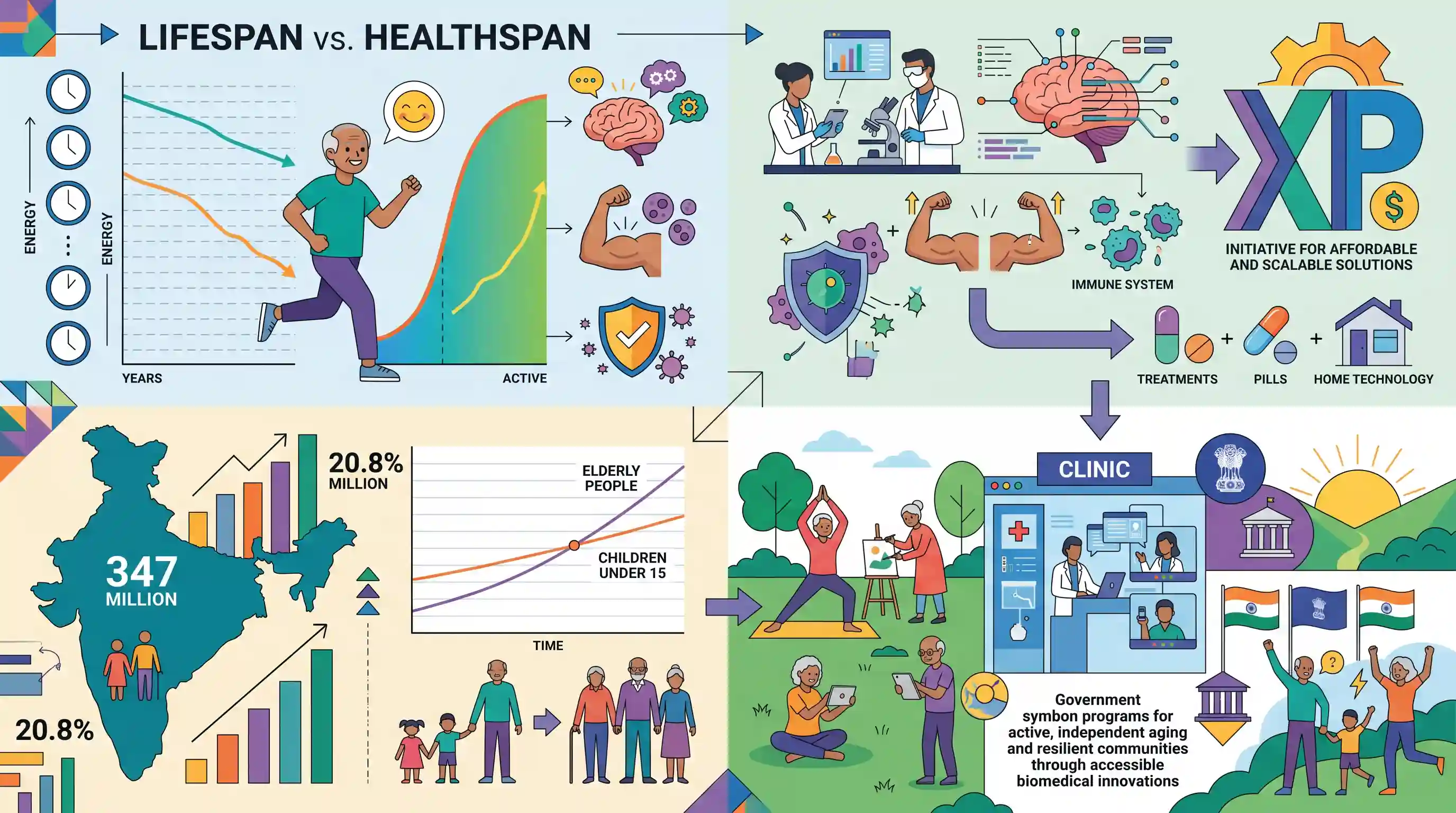
The article highlights a paradigm shift in the field of longevity, emphasizing 'healthspan' (quality of health and functional capability) over mere 'lifespan' (number of years lived). Initiatives like the $101 million XPrize Healthspan aim to rejuvenate vital bodily systems—such as cognition, muscles, and immunity—by a decade, focusing on scalable and affordable solutions. This shift is highly pertinent to India, which is undergoing a rapid demographic transition. According to the India Ageing Report 2023, the elderly population is expected to reach 347 million (20.8% of the population) by 2050, and will outnumber children under 15 by 2046. This demographic reality underscores the necessity for robust geriatric healthcare policies and accessible biomedical innovations that allow older populations to remain active, independent, and resilient, transforming the traditional outlook on aging.
Key Points
- The $101 million XPrize Healthspan initiative focuses on extending 'healthspan'—the period of life spent in good health—rather than merely extending 'lifespan'.
- The goal is to develop accessible, affordable, and scalable solutions that restore muscle, cognitive, and immune functions in people aged 50-80 by at least a decade.
- This shifts the focus of longevity away from superficial age-reversal and 'eternal youth' fantasies towards maintaining independence, mobility, and mental clarity in old age.
- According to the India Ageing Report 2023, India's elderly population will reach 347 million (20.8% of the total population) by 2050.
- By 2046, the number of elderly people in India is projected to surpass the number of children under 15, emphasizing the urgent need to address geriatric health and rethink socio-economic structures.
Important Terms
India Ageing Report 2023

A joint publication by UNFPA and IIPS highlighting that India's elderly population will double to 20.8% (347 million) by 2050, outnumbering children under 15 by 2046.
UPSC context
GS1/GS2: Critical for questions on demographic shifts, geriatric healthcare, and social security for vulnerable sections.
Healthspan
The period of life an individual spends in good health, free from chronic disease or functional disability, emphasizing quality of life over total years lived.
UPSC context
GS2/GS3: Tests understanding of public health goals beyond life expectancy and technological interventions in healthcare.
XPrize Healthspan
A $101 million global competition seeking safe, scalable therapeutics to rejuvenate muscle, cognitive, and immune functions by at least 10 years in adults aged 50-80.
UPSC context
GS3: Relevant for innovations in biotechnology and geroscience aiming at affordable and accessible healthcare solutions.
Demographic Transition
A model describing the shift from high birth/death rates to low birth/death rates as a country develops; India is currently in the late third stage.
UPSC context
GS1: Core concept for population geography, urbanisation, and resource planning.
Dependency Ratio
The ratio of the non-working age population (children and elderly) to the working-age population (15-59 years), indicating the economic burden on the productive workforce.
UPSC context
GS1/GS3: Essential for analyzing the long-term sustainability of the demographic dividend versus an aging population.
UNFPA
The United Nations agency focused on sexual and reproductive health and population data, which co-authored the 2023 report on India's aging trends.
UPSC context
GS2: Important international organization related to social development and population-related health issues.
Prelims Trap
"The India Ageing Report 2023 states that India's elderly population currently outnumbers children under 15."
Aspirants confuse projected demographic milestones (2046) with present realities. Always check temporal keywords (currently vs. projected) in demographic data statements.
Static Concepts Connected
What are the 4 stages of the Demographic Transition Model?
- Stage 1: High birth rates and high death rates (pre-industrial societies with slow population growth).
- Stage 2: High birth rates but rapidly falling death rates (better healthcare), leading to explosive population growth.
- Stage 3: Falling birth rates and slowly falling death rates, causing population growth to gradually slow down.
- Stage 4: Low birth and death rates, resulting in an aging population and stationary or declining growth.
What are India's core welfare schemes targeting the elderly population?
- SAGE Initiative: Promotes startups providing elder-care products and services to address the growing silver economy.
- Rashtriya Vayoshri Yojana: Provides physical aids and assisted-living devices for BPL senior citizens suffering from age-related disabilities.
- IGNOAPS (Pension): A non-contributory monthly pension provided to BPL individuals aged 60 and above.
Cross-Topic Patterns
Demographic Dividend to Silver Economy
Aging projections shift economic planning from youth skill development to 'Silver Economy' policies, creating new markets for elder-tech, pensions, and geriatric care startups.
NCDs and Universal Health Coverage
Increased lifespan without matching healthspan directly worsens India's Non-Communicable Disease (NCD) burden, complicating the fiscal sustainability of Ayushman Bharat and primary care.

Expect a 2026 GS1/GS2 multi-statement question interlinking India Ageing Report 2023 demographic milestones with 'Silver Economy' schemes.
Linked PYQs · 3
Linked PYQs · 3
- 2020MainsGS2
In order to enhance the prospects of social development, sound and adequate health care policies are needed particularly in the fields of geriatric and maternal health care. Discuss.
- 2013MainsGS1
Critically examine the effect of globalization on the aged population in India.
- 2021MainsGS3
What are the research and developmental achievements in applied biotechnology? How will these achievements help to uplift the poorer sections of the society?
