Coal Exchange Rules 2026 introduce market based trading for coal
Source:The Hindu ↗
Why It Matters
Transitioning to market-based pricing for an essential commodity like coal has profound implications for India's energy security, electricity pricing, and overall industrial input costs, making it a critical topic under GS-3 Economy and Infrastructure.
Summary
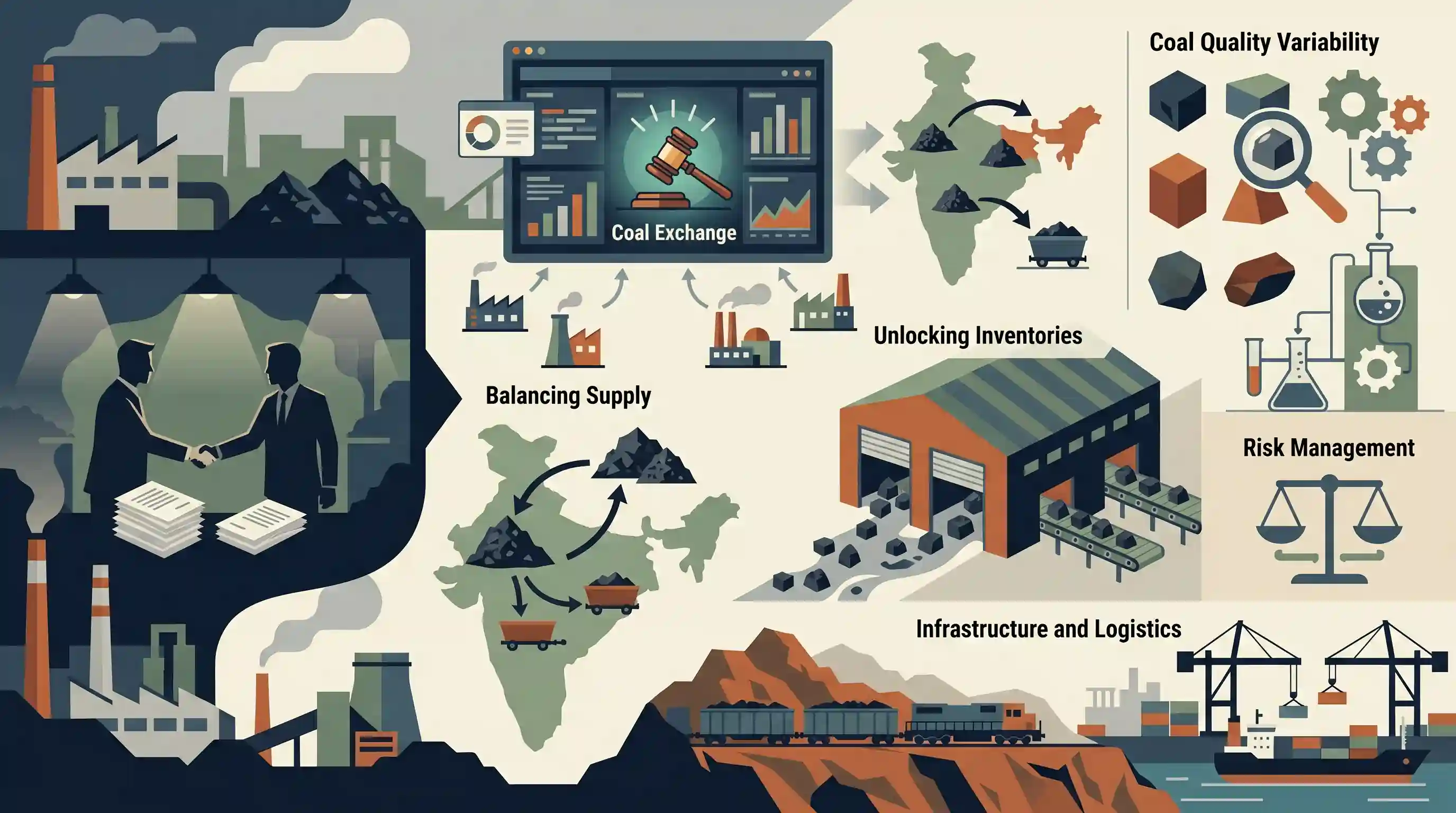
The newly unveiled Coal Exchange Rules, 2026 aim to establish regulated platforms for trading coal in India, marking a shift away from opaque bilateral agreements towards transparent, market-based price discovery. Drawing parallels with existing power exchanges, the initiative intends to better balance regional surpluses and shortages, unlock inventories, and provide smaller consumers with easier access to coal. However, significant challenges remain, primarily the non-fungible nature of coal due to its highly variable quality, which requires robust standardization and quality assurance mechanisms. Ultimately, the success of coal exchanges will depend on implementing effective safeguards against price volatility, strong dispute resolution mechanisms, and improving underlying transportation logistics.
Key Points
- The Coal Exchange Rules, 2026, propose a structural shift in India's coal trade, emphasizing market mechanisms and regulated trading platforms over traditional long-term bilateral contracts.
- Modeled on power exchanges, coal exchanges aim to facilitate transparent price discovery, broader market participation, and efficient balancing of regional surpluses and shortages.
- A critical objective is to provide retail and smaller consumers with better access to coal, reducing entry barriers.
- Unlike electricity, coal is not highly fungible; its diverse grades and qualities pose significant challenges for standardized trading, necessitating rigorous quality assurance protocols.
- To be effective, the exchanges must incorporate safeguards against price volatility, robust dispute resolution processes, and be supported by improved transportation logistics.
Important Terms
Coal Exchange Rules, 2026

A regulatory framework notified in June 2026 to establish electronic platforms for market-driven coal trading. It aims to replace opaque bilateral contracts with transparent price discovery and improve access for smaller consumers.
UPSC context
GS Paper 3: Energy and Infrastructure. Tests understanding of resource allocation reforms, market liberalization, and energy security strategies in India.
Coal Controller’s Organization (CCO)
A subordinate office under the Ministry of Coal that serves as the statistical authority for coal and lignite. It monitors captive blocks, ensures quality grading, and is the designated regulator for coal exchanges.
UPSC context
GS Paper 3: Energy Sector. Relevant for statutory/subordinate bodies and their role in resource governance and quality surveillance.
Power Exchanges
Regulated electronic platforms (e.g., IEX, PXIL) for trading electricity. They serve as a template for coal exchanges by facilitating regional demand-supply balancing and providing transparent price signals for the energy sector.
UPSC context
GS Paper 3: Infrastructure. Important for understanding market-based dispatch and the 'One Nation, One Grid, One Price' initiative.
Fungibility
The property of a commodity where individual units are interchangeable. Coal’s lack of fungibility due to variable grade and ash content is a primary challenge for exchange-based trading.
UPSC context
GS Paper 3: Economics. Tests technical understanding of commodity markets and the barriers to standardizing natural resources for trade.
MMDR (Amendment) Act, 2025
The 2025 legislation that introduced the concept of 'Mineral Exchanges' in India. It empowers the Centre to frame rules for transparent mineral trading, providing the legal basis for the Coal Exchange Rules, 2026.
UPSC context
GS Paper 2: Government Policies. Crucial for understanding the legislative evolution of mining and mineral rights in India.
Prelims Trap
"Coal exchanges in India are regulated by SEBI as they function as commodity markets."
Coal exchanges facilitate physical spot delivery of coal, not financial derivatives. Therefore, regulatory authority is vested in the Coal Controller's Organisation (CCO), not SEBI or CERC.
Static Concepts Connected
What are the core functions of the Coal Controller's Organisation (CCO)?
- Grade Surveillance: Statutory authority to assess, inspect, and declare the grade of coal seams in all mining operations.
- Mine Monitoring: Monitors the development progress of captive coal blocks and collects excise duty under the CM(C&D) Act.
- Data Nodal Agency: Acts as the nodal agency for collecting, compiling, and publishing comprehensive national coal statistics.
Why is Indian coal difficult to standardize for exchange trading?
- Non-fungibility: Unlike electricity, physical differences in moisture and carbon mean one ton of coal isn't perfectly substitutable for another.
- High Ash Content: Indian bituminous coal typically contains high ash levels (35-45%), complicating uniform quality standardisation across batches.
- Calorific Variance: Pricing is strictly tied to Gross Calorific Value (GCV) bands, requiring complex, grade-specific contracts rather than a single market price.
Cross-Topic Patterns
Commercial mining evolution
Following the 2020 opening of commercial coal mining to private players, coal exchanges represent the logical next step to break state monopolies and establish true market-driven price discovery.
Sectoral vs Financial regulators
Like power exchanges under CERC, coal exchanges are regulated by the Coal Controller's Organisation. This highlights a UPSC trend: physical spot markets often fall under sectoral regulators, not SEBI.

Expect a multi-statement question on the CCO's expanded mandate linking coal exchanges, grade surveillance, and captive mine oversight.
Linked PYQs · 2
Linked PYQs · 2
- 2022PrelimsGS1
In India, what is the role of the Coal Controller's Organization (CCO)? 1. CCO is the major source of Coal Statistics in Government of India. 2. It monitors progress of development of Captive Coal/Lignite blocks. 3. It hears any objection to the Government's notification relating to acquisition of coal-bearing areas. 4. It ensures that coal mining companies deliver the coal to end users in the prescribed time. Select the correct answer using the code given below:
- 2018MainsGS3
“Access to affordable, reliable, sustainable and modern energy is the sine qua non to achieve Sustainable Development Goals (SDGs).” Comment on the progress made in India in this regard.
