Lok sabha speaker forms parliamentary friendship groups globally
Source:The Hindu ↗
Why It Matters
Highlights the growing role of parliamentary diplomacy in India's foreign policy toolkit and showcases the administrative powers of the Lok Sabha Speaker in fostering international legislative dialogues. Important for understanding soft power projection and inter-parliamentary cooperation.
Summary
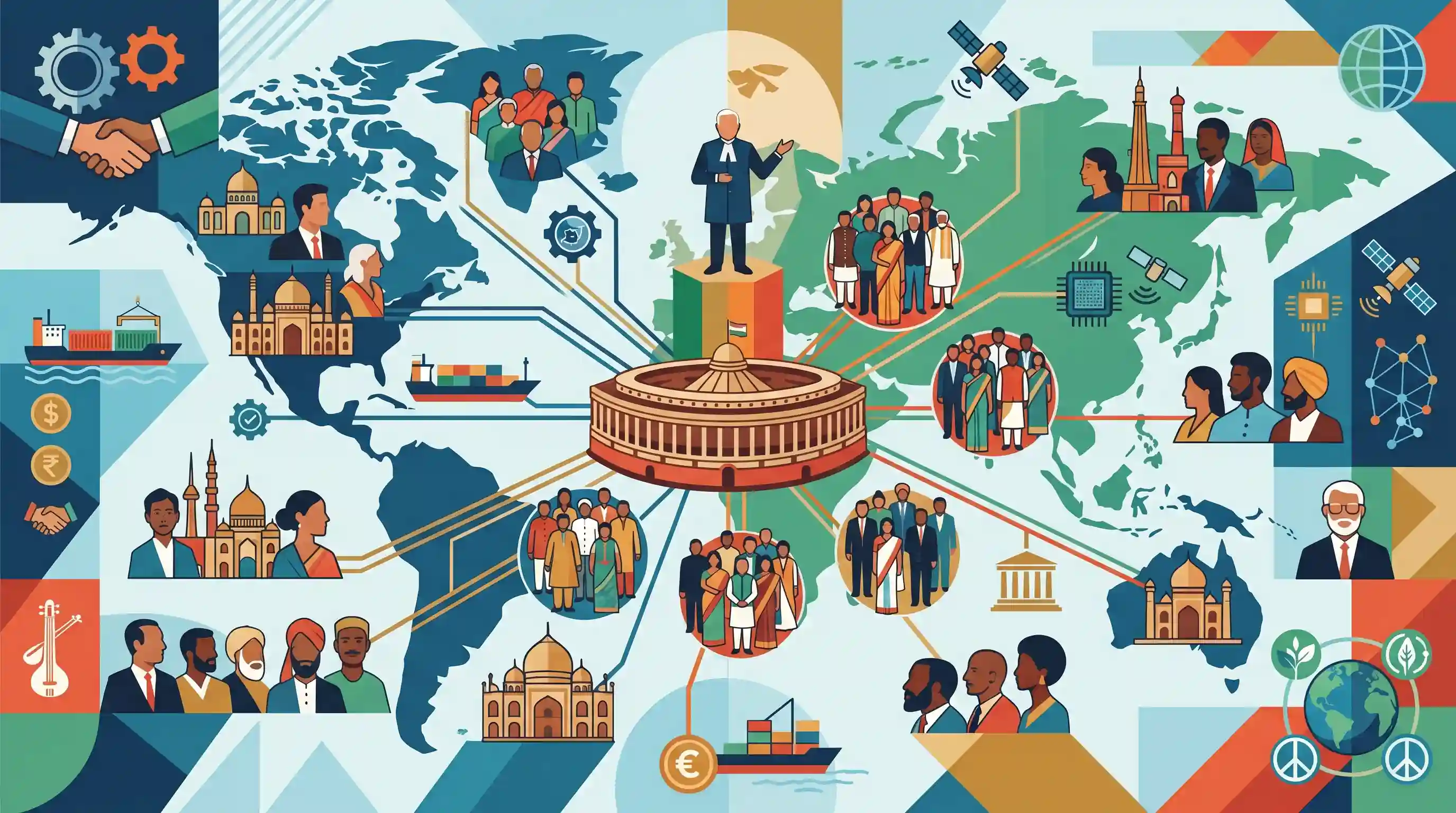
Lok Sabha Speaker Om Birla has constituted 'Parliamentary Friendship Groups' with 64 countries to deepen India's global parliamentary engagement. Featuring prominent political leaders from across party lines, these groups are intended to facilitate regular dialogue, the exchange of legislative best practices, and enhanced cooperation on trade, technology, culture, and global challenges. The initiative highlights a concerted push toward parliamentary diplomacy, continuing recent unified, multi-party diplomatic outreach efforts by India.
Key Points
- Lok Sabha Speaker Om Birla constituted Parliamentary Friendship Groups with 64 nations to strengthen inter-parliamentary cooperation and legislative dialogue.
- The initiative involves a wide spectrum of senior political leaders from across parties to lead these groups.
- The first phase covers engagements with major global partners like the US, Russia, UK, France, Germany, and neighboring countries.
- These groups will facilitate regular dialogue, exchange of legislative practices, and cooperation on trade, technology, culture, and shared global challenges.
- This move builds on India's post-Operation Sindoor outreach, reflecting a unified, multi-party approach to national interest and parliamentary diplomacy.
Important Terms
Parliamentary Diplomacy

The use of legislative interactions, such as debates and delegation visits, to supplement formal executive-led foreign policy, build trust, and share best governance practices between nations.
UPSC context
GS Paper II: International Relations and Soft Power. Tests understanding of non-executive diplomatic channels.
Parliamentary Friendship Groups
Informal platforms comprising Members of Parliament from diverse political parties, established to facilitate direct dialogue, exchange of legislative experiences, and institutional cooperation with foreign legislatures.
UPSC context
GS Paper II: Parliament and State Legislatures. Tests knowledge of parliamentary outreach and bipartisan diplomacy.
Parliament of India
The supreme legislative body of India, established under Article 79, consisting of the President and two houses: the Lok Sabha (Lower House) and the Rajya Sabha (Upper House).
UPSC context
GS Paper II: Constitutional Provisions. Fundamental for questions on the structure and functions of the Union Legislature.
Lok Sabha
The lower house of India's bicameral Parliament, directly elected by the people on the basis of universal adult suffrage, and primarily responsible for lawmaking and executive oversight.
UPSC context
GS Paper II: Parliament structure. Essential for topics regarding democratic representation and the Speaker’s role.
European Parliament
A directly elected legislative body of the European Union that exercises legislative, supervisory, and budgetary responsibilities and approves international agreements for the EU.
UPSC context
GS Paper II: International Relations. Relevant for India-EU relations and global legislative cooperation.
Prelims Trap
"Parliamentary Friendship Groups are executive bodies formed by the MEA and consist only of Lok Sabha members."
Although constituted by the Lok Sabha Speaker, these groups are informal forums containing MPs from *both* the Lok Sabha and Rajya Sabha, acting independently of the executive.
Static Concepts Connected
What is the Indian Parliamentary Group (IPG)?
- Autonomous Body: Established in 1949, it is an autonomous body serving as a direct link between the Parliament of India and the various parliaments of the world.
- Ex-officio Leadership: The Lok Sabha Speaker is the ex-officio President. The Deputy Speaker (LS) and Deputy Chairman (RS) act as ex-officio Vice-Presidents.
- Bicameral Membership: Membership is open to all current Members of Parliament. Former MPs can join as associate members but cannot vote or represent the IPG.
- Global Representation: It functions as India's 'National Group' to the Inter-Parliamentary Union (IPU) and acts as the main India branch of the Commonwealth Parliamentary Association.
What is the Inter-Parliamentary Union (IPU)?
- Genesis: Established in 1889, it is one of the oldest international organizations and the first permanent forum for political multilateral negotiations.
- Headquarters & Mandate: Headquartered in Geneva, Switzerland, it facilitates parliamentary dialogue worldwide to promote peace, cooperation, and representative democracy.
Cross-Topic Patterns
Parliamentary Diplomacy as Soft Power
Supplements traditional executive-led foreign policy. Cross-party legislative exchanges build broad consensus on contentious issues like trade, tech, and security without formal diplomatic rigidities.
Bipartisanship in Foreign Policy
By involving opposition leaders in active external engagement, India signals domestic unity on core national interests and strategic outreach on the global stage.

Expect a prelims question testing the composition of the Indian Parliamentary Group and the ex-officio role of the Lok Sabha Speaker.
Linked PYQs · 3
Linked PYQs · 3
- 2020MainsGS2
Once a Speaker, Always a Speaker' ! Do you think this practice should be adopted to impart objectivity to the office of the Speaker of Lok Sabha ? What could be its implications for the robust functioning of parliamentary business in India?
- 2018MainsGS2
Why do you think the committees are considered to be useful for parliamentary work? Discuss, in this context, the role of the Estimates Committee.
- 2023MainsGS2
Explain the structure of the Parliamentary Committee system. How far have the financial committees helped in the institutionalisation of Indian Parliament?
