Transgender Persons Protection Legislation and Identity Rights
Source:Indian Express ↗
Why It Matters
This topic directly relates to social justice, rights of vulnerable and marginalized groups, gender justice, and parliamentary legislative processes, which are core components of the UPSC GS Paper 2 syllabus.
Summary
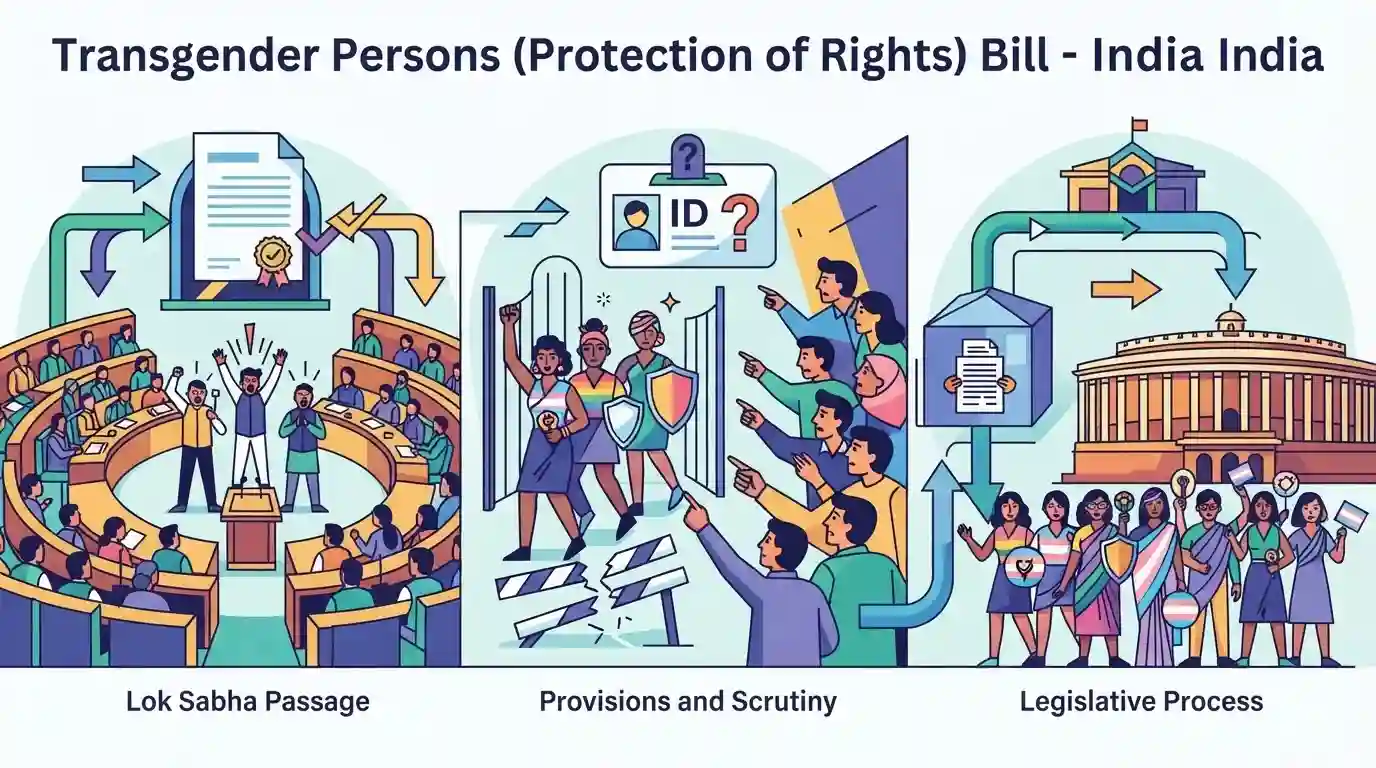
The Lok Sabha passed the Transgender Persons (Protection of Rights) Bill amid opposition protests and calls for referral to a parliamentary standing committee. The legislation aims to safeguard the rights of transgender individuals, prevent discrimination, and establish a mechanism for identity certification, though it has faced scrutiny from activists and opposition lawmakers over provisions related to identity determination.
Key Points
- Lok Sabha passed the Transgender Persons (Protection of Rights) Bill amidst opposition protests and demands for review by a standing committee.
- The legislation seeks to protect the rights of transgender persons, prohibit discrimination, and define the process for identity certification.
- Critics and opposition members raised concerns regarding specific provisions of the bill, such as the screening committee requirement for legal identity recognition, arguing it infringed upon self-determined gender identity.
- The bill highlights the ongoing legislative and social discourse surrounding gender justice and the rights of marginalized communities in India.
Important Terms
Transgender Persons Protection of Rights Bill

Legislation enacted to protect the rights of transgender persons, prevent discrimination, and provide a mechanism for identity certification, addressing socio-economic empowerment and legal recognition.
UPSC context
UPSC GS Paper I & II: Social Justice, vulnerable sections, welfare schemes, and rights-based legislation for marginalized communities.
Lok Sabha
The lower house of India's bicameral Parliament, directly elected by the citizens, holding primary authority over law-making, financial matters, and executive accountability.
UPSC context
UPSC GS Paper II: Indian Polity, Parliament structure, functioning, conduct of business, and legislative powers.
Parliament
India's supreme legislative body comprising the President and two houses—Lok Sabha and Rajya Sabha—responsible for enacting laws, policy oversight, and national governance.
UPSC context
UPSC GS Paper II: Parliament and State Legislatures—structure, functioning, conduct of business, powers & privileges and issues arising out of them.
Prelims Trap
The legislation requires a mandatory medical board screening committee approval for legal gender recognition.
Aspirants often assume the final Act requires a mandatory physical/medical screening committee for identity certification, whereas the revised provision requires a certificate from the District Magistrate based on an application without mandatory surgery.
Static Concepts Connected
What were the key directions of the Supreme Court in the NALSA v. Union of India (2014) judgment?
- Legal Recognition: Third gender status: Recognized transgender persons as the 'third gender' for all legal and constitutional purposes.
- Gender Identity: Self-determination: Affirmed the right of individuals to self-perceive their gender as male, female, or third gender.
- Constitutional Basis: Fundamental rights: Held that non-recognition of transgender identity violates Articles 14, 15, 19, and 21 of the Constitution.
- State Obligations: Welfare measures: Directed central and state governments to take steps for social integration, reservation, healthcare, and public awareness.
Cross-Topic Patterns
Transgender Rights and Judicial Expansion of Fundamental Rights
The NALSA judgment expands Articles 14, 19, and 21 to cover gender identity, mirroring how the Puttaswamy verdict operationalized privacy within fundamental rights jurisprudence.
Vulnerable Sections Welfare and Cooperative Federalism
Legislative mechanisms for transgender welfare intersect with federal administrative implementation, as states operationalize welfare boards, housing, and anti-discrimination mandates.

NALSA judgment + Transgender Persons Act identity certification mechanism will be tested in a multi-statement prelims question.
Linked PYQs · 1
Linked PYQs · 1
- 2023MainsGS2
Explain the constitutional perspectives of Gender Justice with the help of relevant Constitutional Provisions and case laws.
