Procedural Dynamics During Passage of Motion of Thanks in Lok Sabha
Source:The Hindu ↗
Why It Matters
The passing of the Motion of Thanks without the Prime Minister's reply is a rare procedural occurrence. It highlights the extensive powers of the Speaker in managing House proceedings and security, while drawing attention to the persistent challenge of parliamentary disruptions affecting debates and executive accountability.
Summary
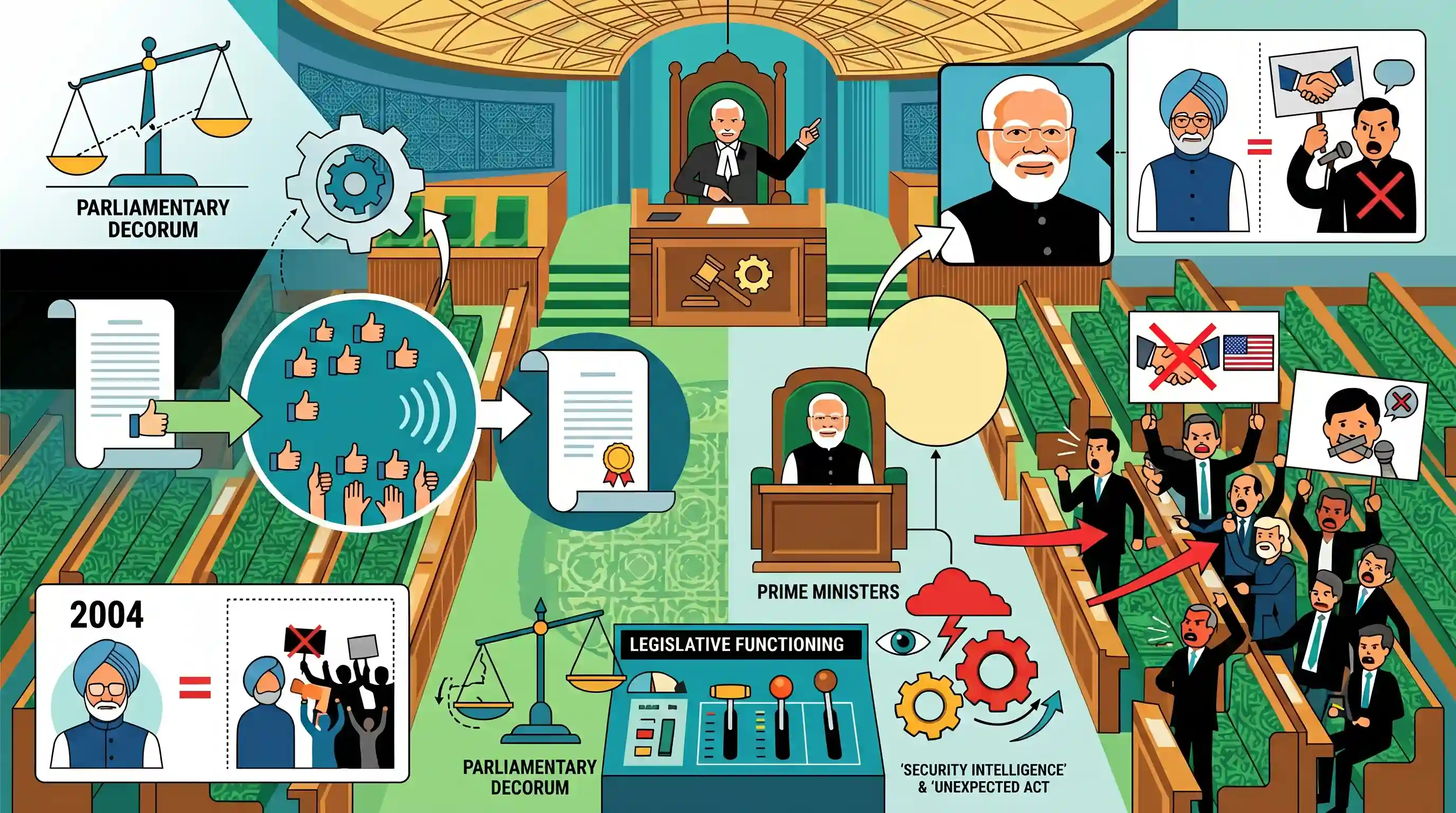
The Lok Sabha passed the Motion of Thanks on the President's address via voice vote without the customary reply by Prime Minister Narendra Modi. Speaker Om Birla advised the Prime Minister to skip the session based on intelligence indicating that Congress MPs planned an 'unexpected act' of protest near the PM's seat. The protests stemmed from demands to discuss the Indo-U.S. trade deal and allegations that Leader of the Opposition Rahul Gandhi was not allowed to speak. The incident, mirroring a 2004 event during Manmohan Singh's tenure, underscores ongoing challenges regarding parliamentary decorum, the Speaker's role in managing proceedings, and legislative disruptions.
Key Points
- The Lok Sabha passed the Motion of Thanks on the President's Address via a voice vote without the customary reply by the Prime Minister.
- Lok Sabha Speaker Om Birla advised PM Narendra Modi to skip the session citing 'concrete information' about planned protests by Congress MPs near the PM's seat.
- The Opposition's protests were driven by demands for a discussion on the Indo-U.S. trade deal and claims that Rahul Gandhi was denied an opportunity to speak.
- The omission of the PM's reply mirrors a similar incident from June 2004 during Manmohan Singh's tenure, highlighting persistent issues with parliamentary disruptions and decorum.
Important Terms
Motion of Thanks

A formal parliamentary motion moved to express gratitude for the President’s Address. It serves as a debate on government policies and must be passed to avoid a perceived loss of confidence.
UPSC context
GS Paper II (Polity): Tests understanding of parliamentary procedures and executive accountability to the legislature.
President’s Address (Article 87)
A constitutional mandate (Article 87) where the President addresses both Houses at the start of the first session annually and after general elections to outline the government's roadmap.
UPSC context
GS Paper II: Constitutional provisions regarding the President's role and the opening of parliamentary sessions.
Speaker of the Lok Sabha
The presiding officer and constitutional head of the Lower House responsible for maintaining order, interpreting procedural rules, and protecting the rights and privileges of members.
UPSC context
GS Paper II: Powers, functions, and the importance of an impartial presiding officer in a democracy.
Leader of the Opposition (LoP)
A statutory post (Salaries and Allowances of Leaders of Opposition in Parliament Act, 1977) held by the leader of the largest opposition party to ensure government accountability.
UPSC context
GS Paper II: Significance of the LoP in parliamentary checks and balances and statutory selection committees.
Voice Vote
A voting procedure where the Speaker gauges the House's decision based on the volume of members' vocal responses ("Ayes" or "Noes") rather than a recorded count.
UPSC context
GS Paper II: Procedural aspects of legislative decision-making and challenges during parliamentary disruptions.
Indo-U.S. Trade Deal
A strategic economic agreement between India and the U.S. aimed at resolving tariff disputes and enhancing market access in sectors like energy, technology, and agriculture.
UPSC context
GS Paper II/III: Bilateral relations and the impact of international trade policies on the Indian economy.
Parliamentary Decorum
The standard of conduct and discipline required for the House to function orderly. The Speaker is the final authority in enforcing these rules to prevent disruptions.
UPSC context
GS Paper II: Functioning of Parliament and the impact of frequent disruptions on legislative productivity.
Prelims Trap
"The Prime Minister's reply to the Motion of Thanks is constitutionally mandated under Article 87."
The Prime Minister's reply is a parliamentary convention, not a constitutional mandate. The motion can be legally passed via voice vote without it.
Static Concepts Connected
What are the parliamentary rules governing the Motion of Thanks?
- Constitutional basis: Article 87 mandates the President's address at the first session of the year and post-election. The Motion of Thanks is the formal debate on this address.
- Government survival: Defeat of the motion in the Lok Sabha is equivalent to a no-confidence vote, forcing the immediate resignation of the Council of Ministers.
- RS Amendments: Both Houses can move amendments. While Lok Sabha defeat is fatal, Rajya Sabha amendments only signify a political setback and do not mandate government resignation.
What are the Speaker's disciplinary powers to manage parliamentary disruptions?
- Ultimate authority: The Speaker derives power from the Rules of Procedure (Rules 373, 374, 374A) to maintain absolute decorum in the Lok Sabha.
- Suspension mechanisms: The Speaker can direct members to withdraw or "name" them for suspension. However, revoking a suspension requires a formal motion passed by the House.
Cross-Topic Patterns
Motion of Thanks & Tenth Schedule
Because defeating the motion in Lok Sabha acts as a no-confidence vote, parties issue strict whips. Defying this whip directly invites disqualification proceedings under the Tenth Schedule (Anti-Defection Law).
Treaty Ratification vs Legislative Scrutiny
Protests over the Indo-U.S. trade deal highlight a constitutional asymmetry: under Article 253, the Indian Executive signs international treaties without requiring prior parliamentary ratification, unlike the United States Congress.

Expect a 2026 Prelims question testing the constitutional differences between defeating the Motion of Thanks in Lok Sabha vs Rajya Sabha.
Linked PYQs · 3
Linked PYQs · 3
- 2020MainsGS2
Once a Speaker, Always a Speaker' ! Do you think this practice should be adopted to impart objectivity to the office of the Speaker of Lok Sabha ? What could be its implications for the robust functioning of parliamentary business in India?
- 2021MainsGS2
To what extent, in your view, the Parliament is able to ensure accountability of the executive in India?
- 2020PrelimsGS1
Consider the following statements: 1. The President of India can summon a session of the Parliament at such place as he/she thinks fit. 2. The Constitution of India provides for three sessions of the Parliament in a year, but it is not mandatory to conduct all three sessions. 3. There is no minimum number of days that the Parliament is required to meet in a year. Which of the statements given above is/are correct?
