Lok Sabha Passes MSME Development Amendment Bill on Delayed Payments
Source:The Hindu ↗
આ શા માટે મહત્વનું છે
The MSME sector is a critical engine of India's economic growth, and resolving its liquidity bottlenecks is a frequent UPSC GS3 theme. Additionally, the recurring trend of passing significant legislation without parliamentary debate touches upon GS2 topics concerning democratic accountability and legislative scrutiny.
સારાંશ
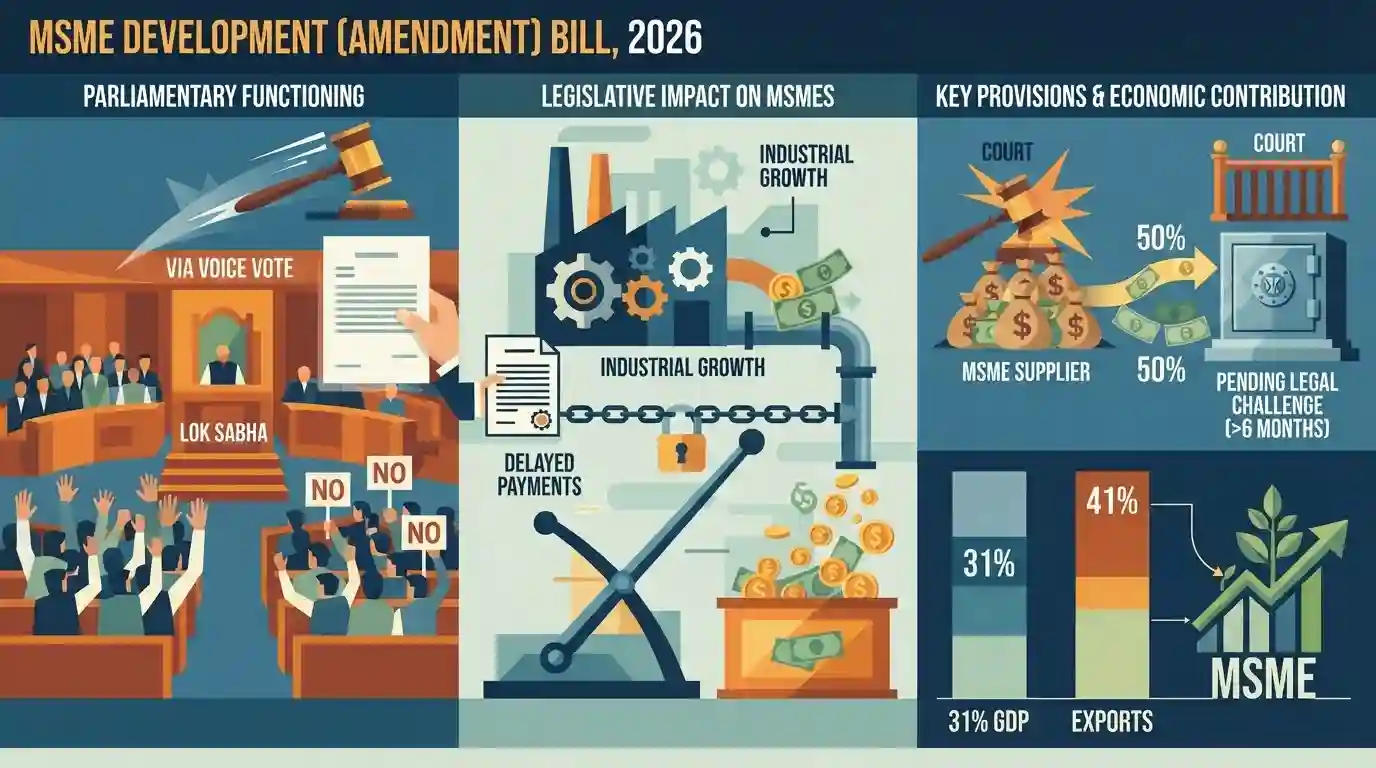
The Lok Sabha passed the Micro, Small and Medium Enterprises Development (Amendment) Bill, 2026 without debate amidst opposition protests. The legislation introduces strict timelines for dispute adjudication to resolve the persistent problem of delayed payments, which severely hampers MSME liquidity. Crucially, it mandates courts to direct payment of at least 50% of an awarded amount to MSME suppliers if a legal challenge remains pending for over six months. Given that MSMEs contribute roughly 31% to GDP and 41% to exports, the Bill seeks to bolster their financial resilience, though its passage via voice vote without parliamentary discussion raises procedural and democratic concerns.
મુખ્ય મુદ્દા
- The Lok Sabha passed the MSME Development (Amendment) Bill, 2026 without debate via voice vote amid opposition protests.
- The Bill introduces strict timelines to ensure faster adjudication of disputes concerning delayed payments to MSMEs.
- It empowers courts to mandate payment of at least 50% of the awarded amount to MSME suppliers if a challenge order is pending for over six months.
- The legislation aims to resolve severe liquidity issues in the MSME sector, which contributes 31% to India's GDP, 36% to manufacturing, and 41% to exports.
- Passing significant economic bills without parliamentary debate raises concerns about the quality of legislative scrutiny.
મહત્વપૂર્ણ શબ્દો
Micro, Small and Medium Enterprises Development (Amendment) Bill, 2026

A 2026 legislation amending the MSMED Act of 2006 to resolve delayed payments. It enforces strict adjudication timelines and mandates a minimum 50% payout to MSME suppliers if a legal challenge exceeds six months.
UPSC context
Crucial for GS Paper 2 (Legislative Amendments) and GS Paper 3 (Economy). Highlights reforms addressing MSME liquidity.
MSMED Act, 2006
The principal Indian legislation that classifies micro, small, and medium enterprises. It provides the statutory framework for their promotion, development, and protection, encompassing credit access, market expansion, and timely payment mandates.
UPSC context
Foundational for GS Paper 3 (Indian Economy). Tests knowledge of statutory mechanisms supporting industrial growth and entrepreneurship.
MSME (Micro, Small and Medium Enterprises)
Enterprises classified by investment and turnover thresholds that form the backbone of the Indian economy. They contribute significantly to employment, accounting for roughly 31% of the GDP and over 40% of national exports.
UPSC context
Essential for GS Paper 3 (Economy). Consistently tested regarding employment generation, industrial contribution, and inclusive growth.
Lok Sabha
The directly elected lower house of India's bicameral Parliament. As the primary legislative body, it holds the executive accountable and passes central legislation, though passing bills without debate raises democratic concerns.
UPSC context
Core to GS Paper 2 (Indian Polity). Tests understanding of parliamentary processes, democratic functioning, and legislative scrutiny.
Delayed Payments
The chronic failure of corporate or government buyers to pay small enterprises within statutory timelines. This chokes the working capital and liquidity of MSMEs, threatening their financial resilience and operational survival.
UPSC context
Relevant to GS Paper 3 (Economic Issues). Highlights structural bottlenecks facing the MSME sector and industrial health.
Voice Vote
A legislative voting procedure where the presiding officer gauges support based on the volume of oral 'ayes' and 'noes'. It lacks a formal recorded tally, which can obscure individual legislator accountability.
UPSC context
GS Paper 2 (Polity). Highlights parliamentary procedures and raises questions about legislative scrutiny during widespread protests.
પ્રિલિમ્સ ટ્રેપ
"The strict 45-day payment deadline and Section 43B(h) tax disallowances apply to all MSMEs."
The strict 45-day payment limit and Section 43B(h) tax deduction disallowances apply ONLY to Micro and Small Enterprises (MSEs). Medium enterprises are excluded from this protection.
સંલગ્ન સ્થિર ખ્યાલો
What is the composite criteria for MSME classification in India?
- Dual metrics: Classification requires evaluating both Investment in Plant & Machinery and Annual Turnover thresholds.
- Category shift: Exceeding either the investment or the turnover ceiling automatically pushes the enterprise into the next higher category.
- Export exemption: Export turnover is completely excluded when calculating the total annual turnover for MSME registration on the Udyam portal.
How does the MSMED Act penalize buyers for delayed payments?
- Strict deadlines: Payments must be made within 45 days (if a written agreement exists) or 15 days (without agreement).
- Punitive interest: Buyers must pay compound interest with monthly rests at three times the RBI's prevailing bank rate for delays.
- Tax disallowance: The penal interest paid to MSEs is entirely disallowed as a business expense deduction under the Income Tax Act.
આંતર-વિષય પેટર્ન
MSME liquidity & Pre-pack IBC
Resolving delayed payments curbs MSME defaults, linking this Bill's 50% payout mandate to the Pre-packaged Insolvency Resolution Process (PPIRP) designed specifically to shield MSMEs from liquidation.
Voice votes & legislative scrutiny
Passing major economic bills via voice vote without debate highlights a recurring Polity theme: the declining role of Parliamentary Standing Committees and increased reliance on rushed legislative procedures.

Expect a multi-statement 2026 question merging the revised MSME composite limits, 45-day payment rules, and Section 43B tax deduction norms.
સંલગ્ન PYQ · 4
સંલગ્ન PYQ · 4
- 2023MainsGS3
Faster economic growth requires increased share of the manufacturing sector in GDP, particularly of MSMEs. Comment on the present policies of the Government in this regard.
- 2026PrelimsGS1
Which of the following statements about M1xchange's role in Micro, Small & Medium Enterprises (MSMEs) financing is/are correct ? 1. M1xchange provides collateral based loans to MSMEs. 2. M1xchange facilitates discounting of invoices and Bills of Exchange for MSMEs. 3. M1xchange functions as a credit rating agency for MSMEs. Select the answer using the code given below :
- 2023PrelimsGS1
Consider the following statements with reference to India: 1. According to the 'Micro, Small and Medium Enterprises Development (MSMED) Act, 2006', the 'medium enterprises' are those with investments in plant and machinery between ₹ 15 crore and ₹ 25 crore. 2. All bank loans to the Micro, Small and Medium Enterprises qualify under the priority sector. Which of the statements given above is/are correct?
- 2024PrelimsGS1
With reference to the Indian Parliament, consider the following statements: 1. A bill pending in the Lok Sabha lapses on its dissolution. 2. A bill passed by the Lok Sabha and pending in the Rajya Sabha lapses on the dissolution of the Lok Sabha. 3. A bill in regard to which the President of India notified his/her intention to summon the Houses to a joint sitting lapses on the dissolution of the Lok Sabha. Which of the statements given above is/are correct?
