Lok Sabha passes Insolvency and Bankruptcy Code Amendment Bill
Source:Indian Express ↗
Why It Matters
The Insolvency and Bankruptcy Code (IBC) is a cornerstone of India's economic reforms to resolve NPAs and improve credit discipline. Amendments to the IBC are directly relevant to the UPSC GS-3 syllabus covering banking, mobilization of resources, and changes in industrial policy. Understanding these reforms is crucial for analyzing the evolving framework for corporate distress resolution in India.
Summary
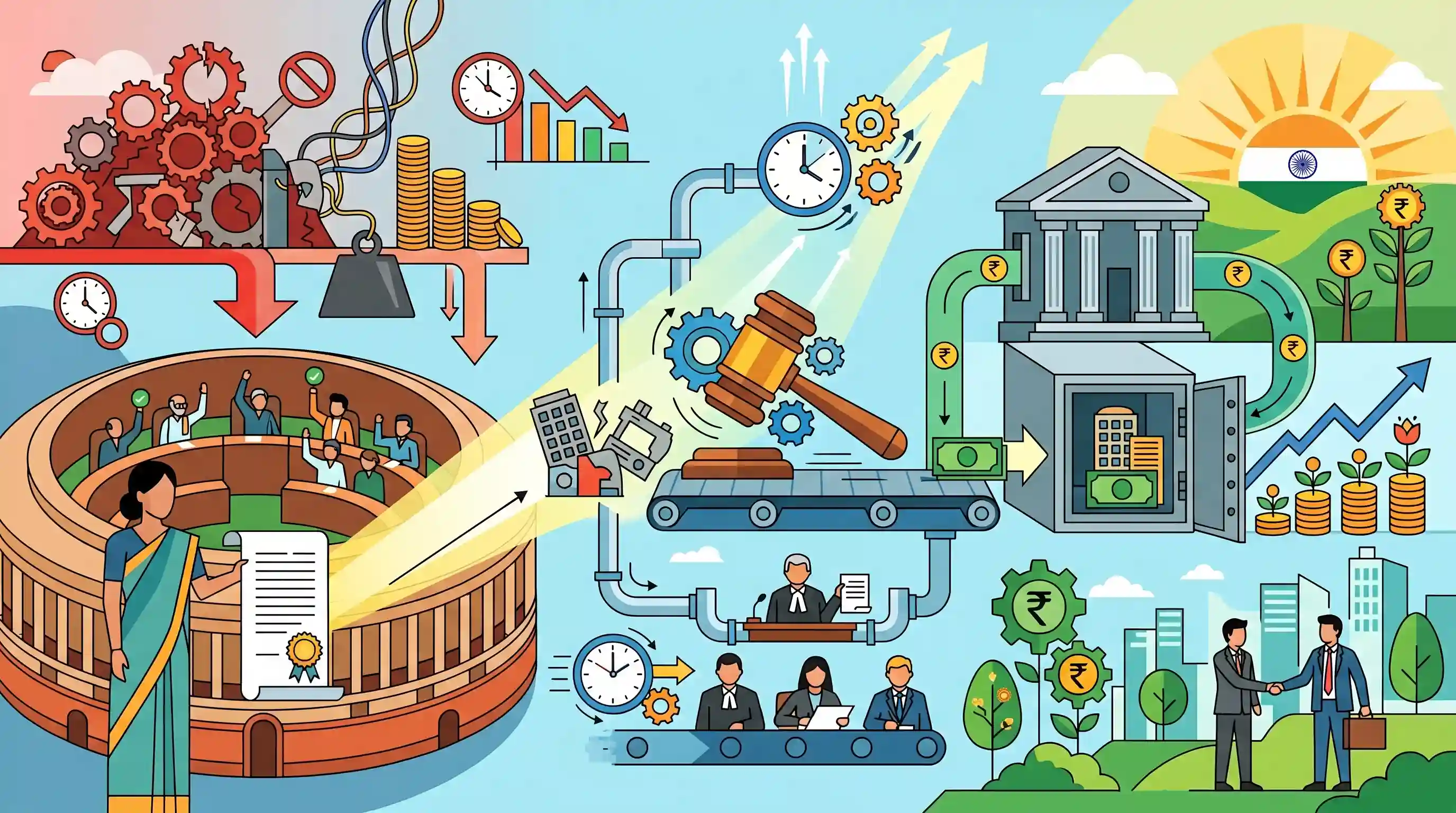
The Lok Sabha has successfully passed the Insolvency and Bankruptcy Code (Amendment) Bill, 2025. Piloted by Finance Minister Nirmala Sitharaman, the legislation introduces crucial reforms to the existing bankruptcy framework to minimize delays in the Corporate Insolvency Resolution Process (CIRP). The amendments focus on maximizing asset value, streamlining mechanisms at the NCLT, and enhancing the overall debt recovery ecosystem, thereby tackling Non-Performing Assets (NPAs) and bolstering the ease of doing business in India.
Key Points
- The Lok Sabha passed the Insolvency and Bankruptcy Code (Amendment) Bill, 2025, introduced by Finance Minister Nirmala Sitharaman.
- The amendment aims to reduce delays in the Corporate Insolvency Resolution Process (CIRP) and maximize the value of distressed assets.
- The legislative changes are expected to address critical bottlenecks in the resolution framework and streamline proceedings at the National Company Law Tribunal (NCLT).
- The amendments further strengthen the ongoing efforts to resolve Non-Performing Assets (NPAs) and improve India's credit culture and ease of doing business.
Important Terms
Insolvency and Bankruptcy Code (Amendment) Bill, 2025

Legislation passed in 2026 introducing reforms like 150-day resolution timelines, cross-border insolvency frameworks, and a "debtor-in-possession" model to streamline debt recovery and minimize procedural delays in India.
UPSC context
GS Paper III: Indian Economy. Relevant for banking reforms, NPA management, and Ease of Doing Business initiatives.
National Company Law Tribunal (NCLT)
A specialized quasi-judicial body established under the Companies Act, 2013, acting as the adjudicating authority for corporate insolvency and liquidation processes under the IBC framework.
UPSC context
GS Paper II & III: Statutory and quasi-judicial bodies; adjudication of corporate disputes and insolvency.
Corporate Insolvency Resolution Process (CIRP)
A time-bound recovery mechanism under the IBC where creditors or debtors initiate legal proceedings to resolve insolvency through a resolution plan or liquidation.
UPSC context
GS Paper III: Economic reforms and banking. Tests understanding of the mechanism for resolving stressed assets.
Creditor-Initiated Insolvency Resolution Process (CIIRP)
A new out-of-court mechanism introduced in 2025 allowing financial creditors (holding 51% debt) to initiate insolvency, replacing the old "fast-track" process with a debtor-in-possession model.
UPSC context
GS Paper III: Innovation in insolvency frameworks; balancing creditor rights and corporate continuity.
Group Insolvency
A legal framework for resolving the insolvency of multiple entities belonging to the same corporate group simultaneously, ensuring a consolidated approach through a common NCLT bench.
UPSC context
GS Paper III: Advanced corporate governance and complex insolvency resolution involving parent-subsidiary structures.
Cross-Border Insolvency
An enabling framework for handling insolvency cases where the debtor has assets or creditors in multiple countries, aligning Indian law with UNCITRAL Model Law principles.
UPSC context
GS Paper III: Integration of Indian economy with global legal standards; international trade and investment protections.
Prelims Trap
"All insolvency processes under the IBC mandate a strict 'creditor-in-control' regime."
While standard CIRP is creditor-in-control, the Pre-packaged Insolvency Resolution Process (PPIRP) for MSMEs follows a 'debtor-in-possession' model where promoters retain management control.
Static Concepts Connected
How is adjudicating jurisdiction divided under the IBC?
- NCLT: Acts as the adjudicating authority for corporate debtors, including Companies and Limited Liability Partnerships (LLPs).
- DRT: The Debt Recovery Tribunal handles insolvency proceedings for individuals and general partnership firms.
What is the CIRP timeline mandate under the IBC?
- 330-day limit: The entire Corporate Insolvency Resolution Process (CIRP) must be completed within a maximum of 330 days, including all litigation time.
- Asset preservation: The strict timeline aims to prevent the depreciation of distressed assets, prioritizing a swift resolution over long-drawn liquidation.
Cross-Topic Patterns
IBC + Twin Balance Sheet synergy
IBC reforms are part of the broader toolkit to resolve India's Twin Balance Sheet syndrome, working alongside the Prompt Corrective Action (PCA) framework and NARCL (Bad Bank).
Economic Tribunals & Judicial Vacancies
Economic delays in NCLT CIRP processes connect directly to GS2 Polity themes regarding tribunalization, judicial vacancies, and executive-judiciary tussles over tribunal appointments.

Expect a multi-statement prelims question contrasting standard CIRP (creditor-in-control) with MSME pre-packs (debtor-in-possession).
Linked PYQs · 2
Linked PYQs · 2
- 2020PrelimsGS1
In the context of the Indian economy, non-financial debt includes which of the following? 1. Housing loans owed by households 2. Amounts outstanding on credit cards 3. Treasury bills Select the correct answer using the code given below:
- 2023MainsGS2
Compare and contrast the British and Indian approaches to Parliamentary sovereignty.
