Finance Bill Passage and Off-Budget Fiscal Liabilities
Source:Indian Express ↗
Why It Matters
Highlights the intersection of legislative procedure (passage of the Finance Bill) and macroeconomic management. It provides a practical example of how off-budget financing mechanisms like oil bonds obscure short-term fiscal deficits while creating enduring debt-servicing burdens for future administrations.
Summary
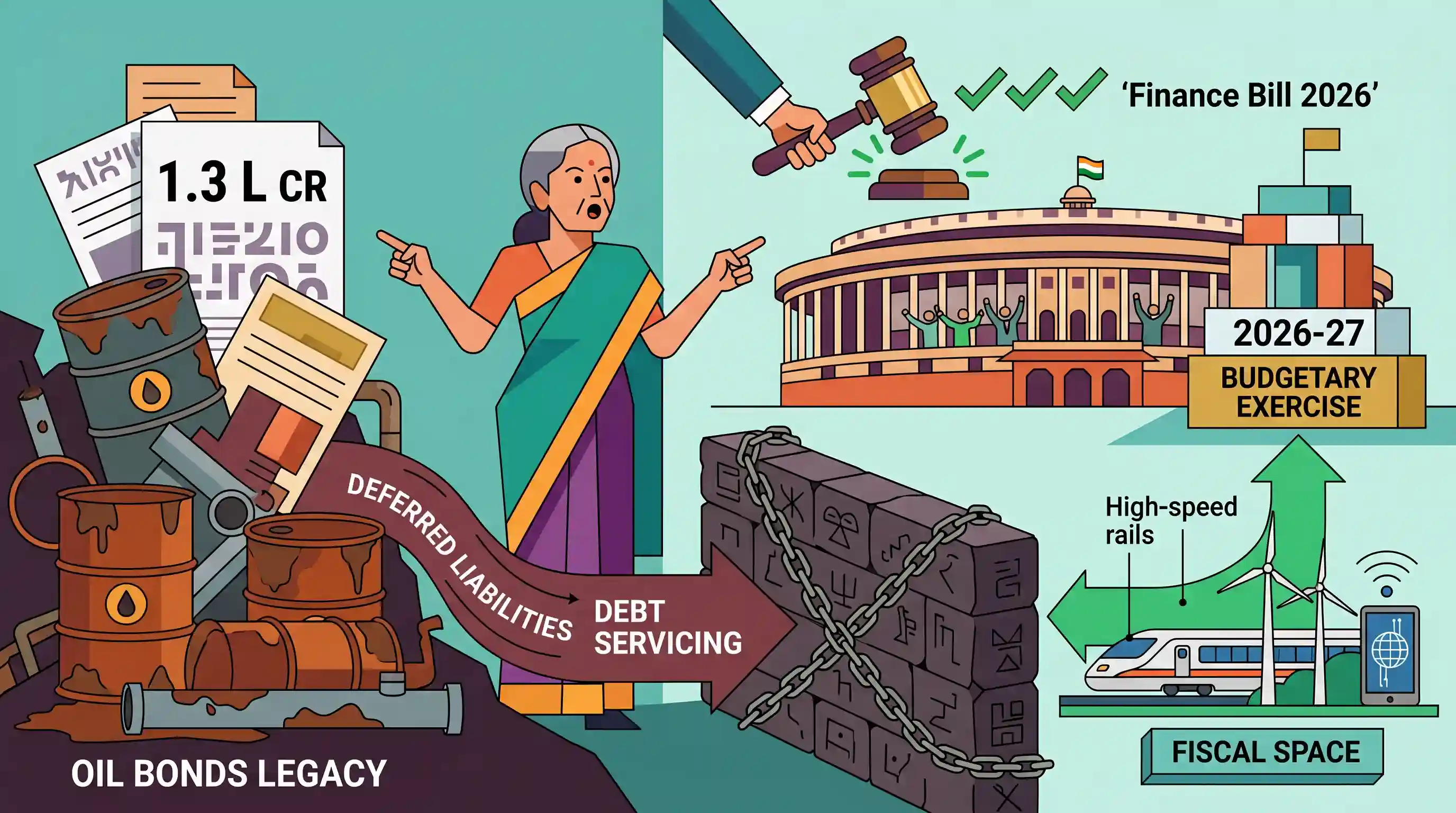
The Lok Sabha successfully passed the Finance Bill 2026, incorporating 33 government amendments and completing the budgetary exercise for the 2026-27 financial year. During her reply to the budget debate, Finance Minister Nirmala Sitharaman criticized the previous UPA administration for its Rs 1.3 lakh crore 'oil bond' legacy. She highlighted that these bonds, which were used to keep fuel prices artificially low while deferring government liabilities, continue to require substantial debt servicing by the current government, impacting modern fiscal space.
Key Points
- The Lok Sabha passed the Finance Bill 2026 with 33 government amendments, successfully completing the budgetary approval process for 2026-27 in the Lower House.
- During the debate, Finance Minister Nirmala Sitharaman pointed out the ongoing fiscal burden of the Rs 1.3 lakh crore 'oil bonds' issued by the previous UPA government.
- Oil bonds were utilized as a form of off-budget financing to compensate oil marketing companies for subsidized fuel prices without immediately expanding the reported fiscal deficit.
- The continued servicing of these historical oil bonds illustrates the long-term impact of deferred liabilities on current government expenditure and public debt.
Important Terms
Finance Bill 2026

A legislative proposal introduced alongside the Union Budget to implement tax changes for the upcoming fiscal year. Classified as a Money Bill under Article 110, it requires only Lok Sabha approval.
UPSC context
GS Paper 2 (Parliamentary Procedures) and GS Paper 3 (Budgeting). Tests knowledge of Money Bills and legislative financial cycles.
Oil Bonds
Special securities issued to oil companies as compensation for retail fuel subsidies. These "below-the-line" instruments defer fiscal liability to future generations, increasing long-term sovereign debt and interest servicing costs.
UPSC context
GS Paper 3 (Fiscal Policy). Tests understanding of deficit management, public debt, and the impact of subsidies on modern fiscal space.
Lok Sabha
The lower house of India's Parliament, representing the people through direct elections. It holds exclusive authority over Money Bills, which it must pass to authorize government revenue and expenditure.
UPSC context
GS Paper 2 (Polity). Essential for understanding the bicameral legislature, executive accountability, and the superiority of the Lower House in financial matters.
United Progressive Alliance (UPA)
A center-left political coalition led by the Indian National Congress that governed India from 2004 to 2014. It is often cited in fiscal debates regarding past economic policies and liabilities.
UPSC context
GS Paper 2 (Governance). Relevant for studying coalition politics and the long-term impact of administration-specific policy decisions on national economy.
Prelims Trap
Issuing Oil Bonds immediately increases the government's fiscal deficit for the year they are issued.
Oil bonds are off-budget financing. They intentionally bypass the current year's fiscal deficit, deferring the liability. However, the interest payouts and principal repayment expand the fiscal deficit and debt in subsequent years.
Static Concepts Connected
What are Oil Bonds and how do they impact the economy?
- Promissory notes: Special long-term securities or promissory notes issued by the government to Oil Marketing Companies (OMCs) in lieu of direct cash subsidies.
- Off-budget financing: They act as off-budget financing. They do not inflate the fiscal deficit in the year of issue but quietly add to the total national public debt.
- Deferred liability: The government must pay annual interest to the bondholders and repay the principal upon maturity, absorbing funds that could have been used for capital expenditure.
How does a Finance Bill differ from a Money Bill?
- Article 110 restrictions: A Money Bill (Article 110) exclusively deals with taxation, borrowing, or the Consolidated Fund. It requires the Speaker's certification and cannot be amended by the Rajya Sabha.
- Budget passage: The Annual Finance Bill gives effect to the budget's tax proposals. Because it usually deals strictly with taxation and revenues, it is introduced and passed as a Money Bill.
- Financial Bill II: A Financial Bill Type II (Article 117(3)) involves expenditure but lacks exclusive taxation/borrowing clauses. It can be introduced in either House and amended by the Rajya Sabha.
Cross-Topic Patterns
Off-budget borrowing & FRBM compliance
The historical use of oil bonds highlighted loopholes in FRBM targets. Recent budgets emphasize transparency by bringing off-budget liabilities (like NSSF loans to government agencies) explicitly onto the fiscal balance sheet.
Fuel subsidies vs. Energy transition
Historic fuel subsidies via bonds constrained fiscal space. Today's macroeconomic strategy pivots away from deferred consumption subsidies toward direct capital expenditure, funding infrastructure and the green energy transition.

Expect a multi-statement Prelims question comparing the fiscal deficit impact of sovereign bonds vs off-budget instruments like oil bonds.
Linked PYQs · 5
Linked PYQs · 5
- 2024PrelimsGS1
Which of the following statements are correct in respect of a Money Bill in the Parliament? 1. Article 109 mentions special procedure in respect of Money Bills. 2. A Money Bill shall not be introduced in the Council of States. 3. The Rajya Sabha can either approve the Bill or suggest changes but cannot reject it. 4. Amendments to a Money Bill suggested by the Rajya Sabha have to be accepted by the Lok Sabha. Select the answer using the code given below :
- 2023PrelimsGS1
With reference to Finance Bill and Money Bill in the Indian Parliament, consider the following statements: 1. When the Lok Sabha transmits Finance Bill to the Rajya Sabha, it can amend or reject the Bill. 2. When the Lok Sabha transmits Money Bill to the Rajya Sabha, it cannot amend or reject the Bill, it can only make recommendations. 3. In the case of disagreement between the Lok Sabha and the Rajya Sabha, there is no joint sitting for Money Bill, but a joint sitting becomes necessary for Finance Bill. How many of the above statements are correct?
- 2021PrelimsGS1
Which one of the following is likely to be the most inflationary in its effects?
- 2019MainsGS3
The public expenditure management is a challenge to the Government of India in the context of budget making during the post-liberalization period. Clarify it.
- 2025PrelimsGS1
A country's fiscal deficit stands at ₹50,000 crores. It is receiving ₹10,000 crores through non-debt creating capital receipts. The country's interest liabilities are ₹1,500 crores. What is the gross primary deficit?
