Central Excise Amendment Bill for Tobacco Taxation
Source:The Hindu ↗
Why It Matters
It illustrates the mechanics of India's indirect tax regime and federal financial relations, showing how the Centre manages the expiry of temporary transitional mechanisms like the GST compensation cess and controls the tax incidence on demerit goods.
Summary
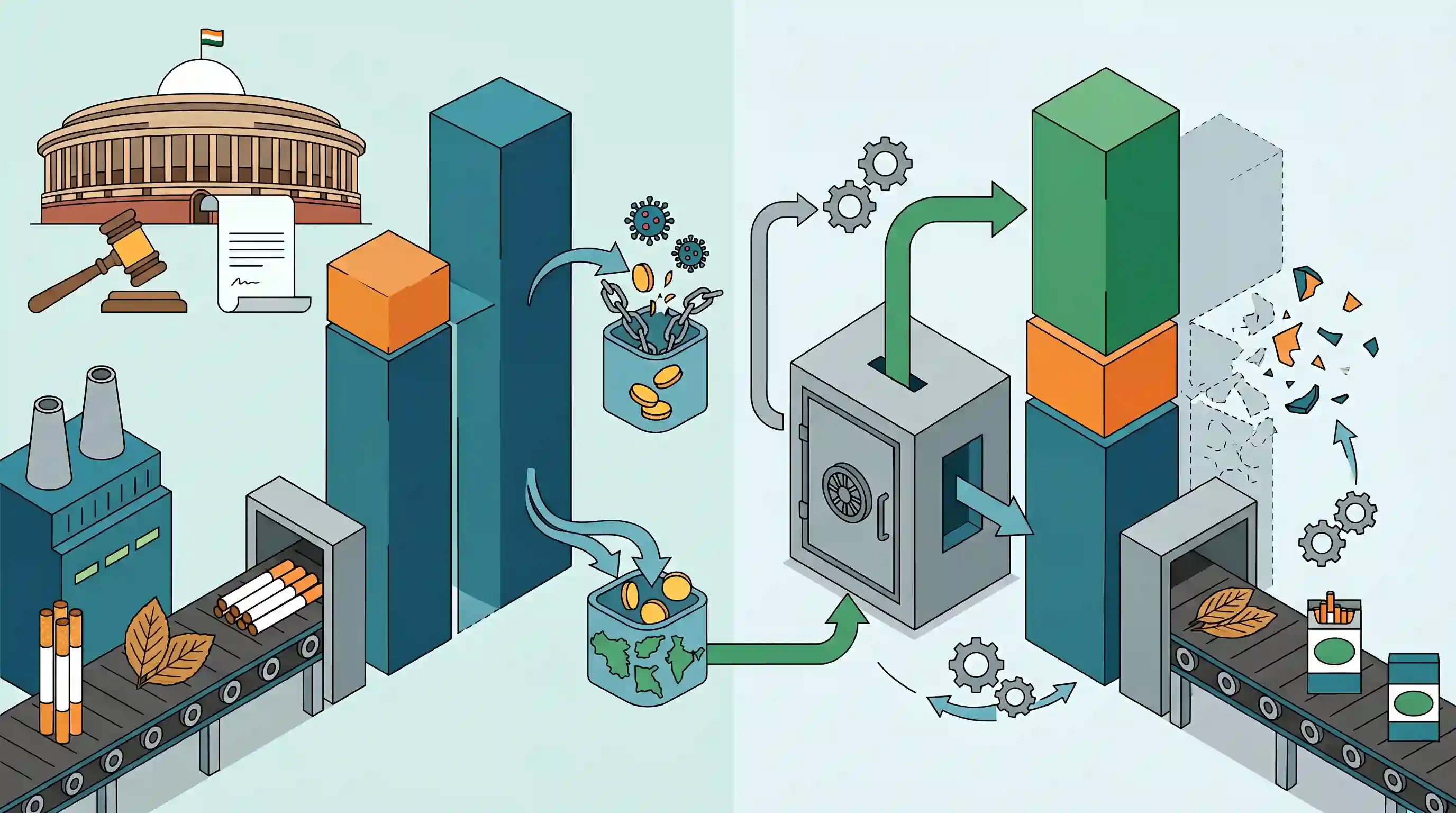
The Lok Sabha has passed the Central Excise (Amendment) Bill, 2025, empowering the government to impose significant excise duties on tobacco products to replace the soon-to-expire GST compensation cess. Introduced in 2017, the GST regime kept central excise duties on tobacco nominal so that a compensation cess could be levied to offset states' revenue losses without exorbitantly increasing prices. The cess was later extended to repay Covid-era borrowings, which are expected to be fully cleared shortly. To ensure tobacco products do not become cheaper once the cess lapses, the new Bill restores full excise duties—such as 60-70% on unmanufactured tobacco—maintaining the overall tax incidence (28% GST plus excise) on these demerit goods.
Key Points
- The Lok Sabha passed the Central Excise (Amendment) Bill, 2025 to increase excise duties on tobacco products.
- The measure will take effect once the GST compensation cess—originally instituted to compensate states for revenue shortfalls and later used to repay Covid-era loans—expires.
- The government expects the loans backed by the GST compensation cess to be fully cleared in the coming weeks.
- To prevent a drop in tobacco prices and maintain the current tax incidence, the Bill replaces the expiring cess with equivalent central excise duties (e.g., 60-70% on unmanufactured tobacco).
- Tobacco will continue to face a 28% GST alongside the newly restored excise duty, keeping total taxes on these demerit goods stable.
Important Terms
Central Excise (Amendment) Bill, 2025

A 2025 legislation amending the Central Excise Act, 1944, to increase excise duties on tobacco products, replacing the expiring GST compensation cess to maintain high tax incidence.
UPSC context
GS Paper III (Economy); tests knowledge of legislative shifts in indirect taxation and resource mobilization.
GST Compensation Cess
An additional tax levied on luxury and demerit goods under the GST (Compensation to States) Act, 2017, to compensate states for revenue losses during the GST transition.
UPSC context
GS Paper III (Economy/Fiscal Policy); critical for understanding federal fiscal relations and debt repayment mechanisms.
Demerit Goods
Products (e.g., tobacco, alcohol) considered socially harmful, typically subjected to high 'sin taxes' to discourage consumption and generate revenue for public health costs.
UPSC context
GS Paper III (Economy); relates to taxation as a tool for public policy and health.
Central Excise Act, 1944
The primary law governing the levy of excise duty on goods manufactured in India; it remains relevant for products like petroleum and tobacco that sit outside the full GST ambit.
UPSC context
GS Paper III (Economy); fundamental to understanding India’s historical and existing indirect tax framework.
GST (Compensation to States) Act, 2017
Legislative framework providing for the GST compensation cess, ensuring states received a guaranteed 14% revenue growth for five years (later extended to service Covid-era loans).
UPSC context
GS Paper II (Federalism) and III (Fiscal Policy); tests the legal basis of India's 'One Nation One Tax' transition.
Sin Tax
A high tax specifically levied on goods deemed harmful to society, such as tobacco and sugar-sweetened beverages, to decrease demand through higher prices.
UPSC context
GS Paper III (Economy); common term in fiscal discourse regarding revenue and public health trade-offs.
Prelims Trap
Tobacco products are completely outside the GST regime and only attract Central Excise Duty.
Tobacco uniquely attracts both GST (28%) and Central Excise Duty concurrently. It is not entirely outside GST like alcohol for human consumption.
Static Concepts Connected
Which goods attract taxes outside or alongside the GST regime?
- Alcohol: Completely outside GST; states levy State Excise Duty and Sales Tax/VAT on it.
- Petroleum: Five products (crude, petrol, diesel, ATF, natural gas) temporarily outside GST; attract Central Excise and State VAT.
- Tobacco: Subject to both GST (usually the peak rate of 28%) and Central Excise Duty concurrently.
What is the rationale behind taxing Demerit Goods?
- Negative Externalities: Demerit goods like tobacco and aerated drinks impose social costs, justifying higher tax burdens to discourage consumption.
- Pigovian Tax: This acts as a Pigovian tax, deliberately pricing in the negative externalities to align private cost with social cost.
Cross-Topic Patterns
Fiscal Federalism & Divisible Pool
Replacing the GST compensation cess with Central Excise alters revenue sharing. While the cess managed state shortfalls, the new excise enters the Centre's gross tax revenue, subject to Finance Commission devolution.
WHO FCTC & Public Health
Maintaining high tobacco prices through excise hikes aligns with India's WHO Framework Convention on Tobacco Control (FCTC) commitments to leverage fiscal tools against Non-Communicable Diseases (NCDs).

UPSC 2026 will likely test the concurrent levy of GST and Excise Duty on tobacco vs petroleum/alcohol in a multi-statement question.
Linked PYQs · 4
Linked PYQs · 4
- 2001PrelimsGS1
Consider the following taxes: I. Corporation tax II. Customs duty III. Wealth tax IV. Excise duty Which of these is/are indirect taxes?
- 2017PrelimsGS1
What is/are the most likely advantages of implementing 'Goods and Services Tax (GST)'? 1. It will replace multiple taxes collected by multiple authorities and will thus create a single market in India. 2. It will drastically reduce the 'Current Account Deficit' of India and will enable it to increase its foreign exchange reserves. 3. It will enormously increase the growth and size of economy of India and will enable it to overtake China in the near future. Select the correct answer using the code given below:
- 2019MainsGS3
Enumerate the indirect taxes which have been subsumed in the Goods and Services Tax (GST) in India. Also, comment on the revenue implications of the GST introduced in India since July 2017.
- 2020MainsGS3
Explain the rationale behind the Goods and Services Tax (Compensation to States) Act of 2017. How has COVID-19 impacted the GST compensation fund and created new federal tensions?
