Public Examinations Amendment Bill and NEET Controversy
Source:Indian Express ↗
हे का महत्त्वाचे आहे
It addresses critical governance bottlenecks concerning transparency, accountability, and the credibility of public examination systems in India, directly tying into legislative interventions against unfair means.
सारांश
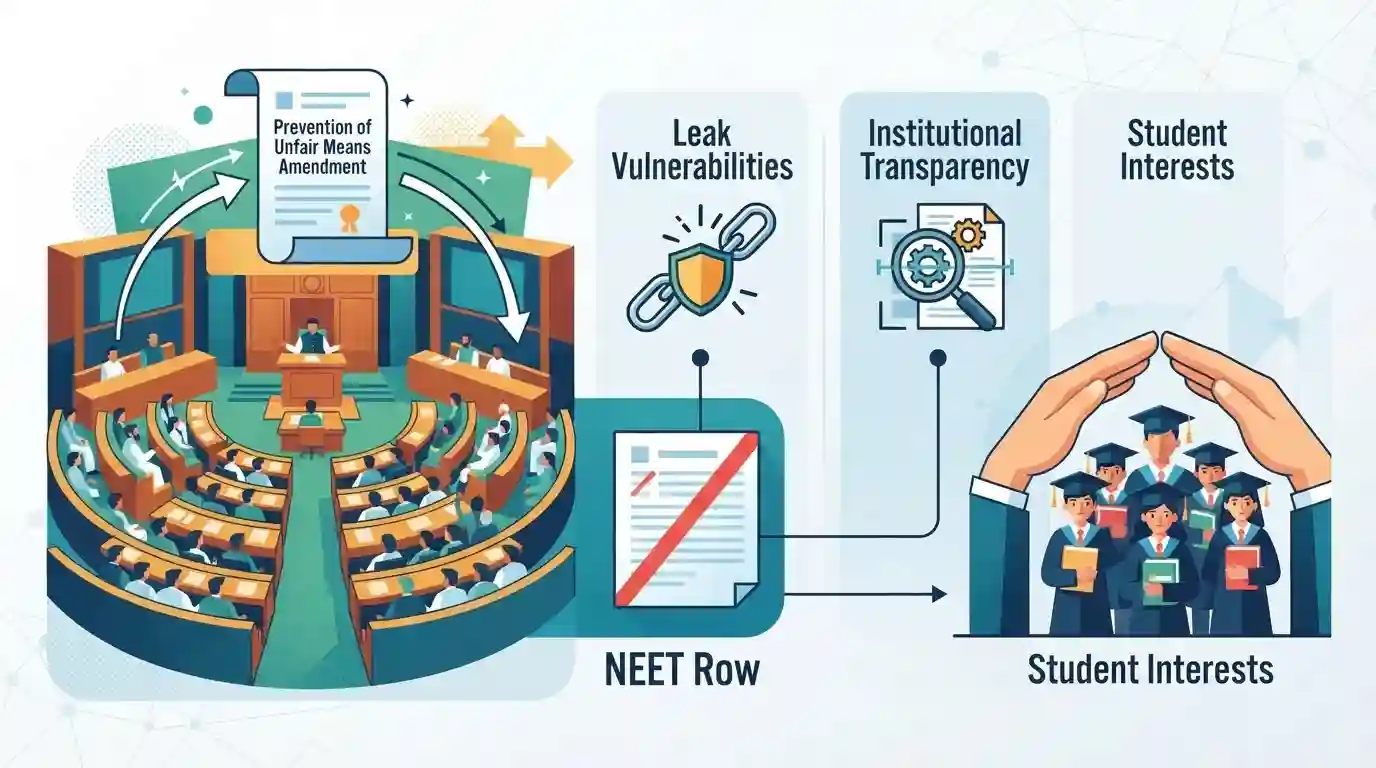
The Lok Sabha witnessed intense legislative debates concerning public examinations, highlighted by the introduction and consideration of the Public Examinations (Prevention of Unfair Means) Amendment Bill. The discussions heavily centered around the NEET row, addressing leak vulnerabilities, institutional transparency, and the protection of student interests in national competitive exams.
मुख्य मुद्दे
- The Lok Sabha took up discussions surrounding public examinations and legislative amendments related to the prevention of unfair means, drawing sharp focus on the NEET examination controversies.
- The Public Examinations (Prevention of Unfair Means) Amendment Bill aims to strengthen penal provisions and address systemic leak issues plaguing recruitment and entrance tests in India.
- Opposition parties and parliamentarians highlighted administrative vulnerabilities and the socio-economic impacts of examination paper leaks on youth and student aspirations.
महत्त्वाच्या संज्ञा
Public Examinations (Prevention of Unfair Means) Amendment Bill, 2026

A legislative measure introduced to tighten legal penalties and plug leak vulnerabilities in national recruitment and admission tests like NEET, addressing systemic cheating and fraud.
UPSC context
GS Paper II (Governance, Transparency & Accountability) — Tests understanding of legal reforms against exam fraud and institutional integrity.
Public Examinations (Prevention of Unfair Means) Act, 2024
The primary anti-paper leak legislation enacted to penalize unfair means, paper leaks, and organized cheating in central public examinations conducted by bodies like the NTA.
UPSC context
GS Paper II (Governance, Polity) — Important for questions on statutory frameworks governing recruitment transparency.
NEET
National Eligibility cum Entrance Test, an all-India competitive medical entrance examination conducted by the National Testing Agency for undergraduate medical and dental courses.
UPSC context
GS Paper II (Social Justice, Education) — Relevant for issues in public policy, educational equity, and transparency in competitive admissions.
Lok Sabha
The Lower House of the Indian Parliament, where legislative measures, budget policies, and national policy debates on public examinations take place.
UPSC context
GS Paper II (Indian Polity) — Essential for studying legislative procedures, parliamentary accountability, and lawmaking.
संबंधित स्थिर संकल्पना
What are the key penal provisions and nature of offences under the Public Examinations Act?
- Offence Nature: Cognizable status: Offences under the Act are cognizable, non-bailable, and non-compoundable, allowing police to arrest without a warrant.
- Jail Penalty: Imprisonment term: Carries a jail term ranging from 3 to 5 years, extendable up to 10 years for organized cheating syndicates.
- Service Provider Fine: Financial fines: Imposes heavy monetary penalties up to ₹1 crore on service providers involved in systemic examination leaks.
आंतर-विषय नमुने
Exam Leaks & Demographic Dividend Distress
Repeated paper leaks impact the demographic dividend, stalling employment generation and causing severe socio-economic distress among millions of youth preparing for central and state exams.
NTA Autonomy & Cooperative Federalism in Education
The convergence of centralized testing bodies like NTA with anti-cheat legislation highlights systemic issues in federal administrative accountability and institutional autonomy.

Public Examinations Act provisions (cognizable/non-bailable offences, fines) are prime targets for matching/statement-based Prelims questions.
संबंधित PYQ · 1
संबंधित PYQ · 1
- 2024MainsGS2
What are the aims and objects of recently passed and enforced, The Public Examination (Prevention of Unfair Means) Act, 2024? Whether University/State Education Board examinations, too, are covered under the Act ?
