Lok Sabha Speaker on Parliamentary Privileges and Rules
Source:Indian Express ↗
Why It Matters
The article is directly relevant to GS Paper II topics concerning the structure, functioning, and conduct of business in the Parliament. It touches upon the practical aspects of Article 105 (Parliamentary Privileges), the impartiality of the Speaker's office, and how procedural rules govern democratic debates.
Summary
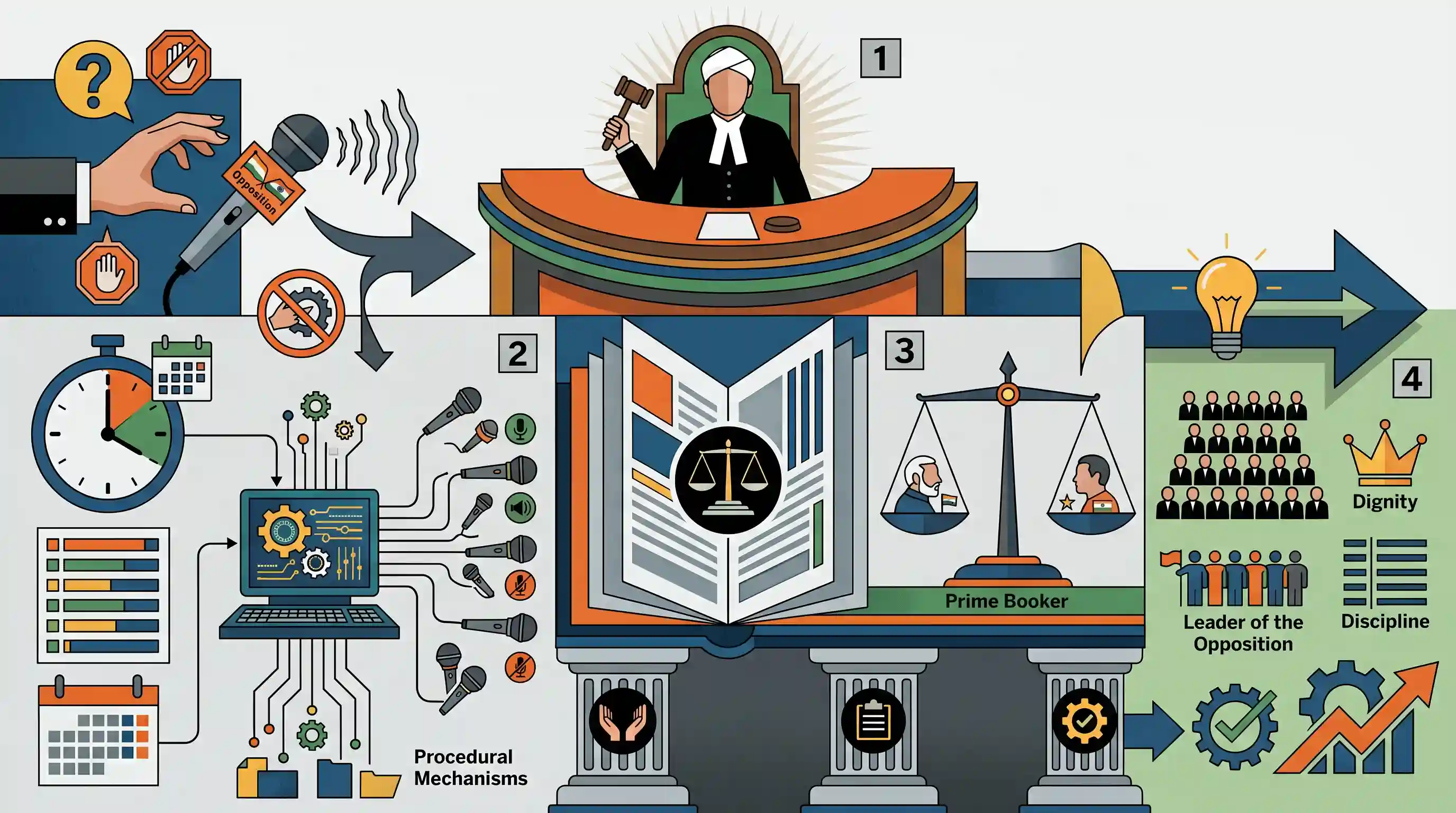
Lok Sabha Speaker Om Birla recently addressed the House to clarify the procedural mechanisms governing parliamentary debates. Rejecting allegations that the Chair selectively silences the Opposition, he explained that microphones are controlled by a computerized system based on time allotments, not manual intervention. He asserted that no Member of Parliament, including the Prime Minister and the Leader of the Opposition, possesses the privilege to speak outside the bounds of the Rules of Procedure. His remarks come amidst Opposition criticisms regarding the functioning of Parliament and focus heavily on maintaining the dignity, discipline, and efficiency of the House.
Key Points
- Speaker Om Birla emphasized that freedom of speech for MPs is governed strictly by the Rules of Procedure and Conduct of Business, with no special privileges for the Prime Minister or the Leader of the Opposition to speak arbitrarily.
- He clarified that microphone controls in the Lok Sabha are managed by an automated, computerized system aligned with allotted speaking times, refuting allegations that the Chair manually silences the Opposition.
- Birla criticized planned disruptions during parliamentary proceedings, emphasizing the importance of Question Hour, Zero Hour, and maintaining the dignity and productivity of the House.
- The statements highlight the ongoing debate over the impartiality of the Speaker's office and the regulation of parliamentary privileges.
Important Terms
Speaker of Lok Sabha

The presiding officer and constitutional head of the Lok Sabha (Article 93), responsible for maintaining order, interpreting rules, and representing the House's collective authority.
UPSC context
GS Paper II: Parliament and State Legislatures. Tests understanding of the Speaker’s neutrality and disciplinary powers in maintaining house decorum.
Rules of Procedure and Conduct of Business in Lok Sabha
A comprehensive set of guidelines framed under Article 118 to regulate debates, motions, and legislative conduct, ensuring systematic and predictable house functioning.
UPSC context
GS Paper II: Conduct of Business. Tests the legal framework governing MP conduct and the Speaker's final authority in rule interpretation.
Parliamentary Privileges
Special rights and immunities (Article 105) granted to MPs and committees to ensure they can discharge their duties without external interference or legal intimidation.
UPSC context
GS Paper II: Powers and Privileges of Parliament. Tests the boundary between free speech in the house and procedural limitations.
Leader of the Opposition (LoP)
A statutory position (1977 Act) held by the leader of the largest opposition party (min. 10% seats), accorded the rank and status of a Cabinet Minister.
UPSC context
GS Paper II: Functioning of Legislature. Tests the role of the LoP in ensuring executive accountability and participation in key appointments.
Article 118 of the Constitution
The constitutional provision that empowers each House of Parliament to frame its own rules to regulate its procedure and internal business conduct.
UPSC context
GS Paper II: Constitutional Provisions. Tests the source of legislative autonomy and the constitutional basis for house-specific standing orders.
Prelims Trap
MPs enjoy absolute freedom of speech during Parliamentary proceedings under Article 105.
Freedom of speech is not absolute; it is strictly subject to constitutional provisions (e.g., Article 121 regarding judges) and the Rules of Procedure of the House.
Static Concepts Connected
What are the constitutional limits on an MP's freedom of speech?
- Subject to Rules: Freedom of speech is expressly subject to the provisions of the Constitution and the Rules of Procedure of the House (Article 105).
- Judicial Conduct Restrictions: Article 121 prohibits discussing the conduct of Supreme Court or High Court judges in Parliament, except upon a motion for their removal.
- Absolute Court Immunity: MPs cannot be questioned in any court for anything said or any vote given in Parliament, granting them immunity from judicial scrutiny.
How is debate time allocated among political parties in the Lok Sabha?
- BAC Role: The Business Advisory Committee (BAC) recommends the allocation of time for legislative debates and other government business.
- Speaker as Chair: The Speaker serves as the ex-officio chairman of the BAC.
- Proportional Allocation: Time is distributed among parties and groups strictly in proportion to their numerical strength in the House.
Cross-Topic Patterns
Article 105 vs. Article 19(1)(a)
MP freedom of speech (Art 105) is independent of citizens' free speech (Art 19). The Supreme Court frequently adjudicates conflicts between legislative privileges and fundamental rights.
Tenth Schedule and Speaker Neutrality
The debate on Speaker impartiality closely ties into their quasi-judicial powers under the Tenth Schedule (Anti-Defection Law), contrasting with the UK's strict non-partisan convention.

Expect a 2026 prelims statement testing whether MP freedom of speech under Article 105 is absolute or subject to House Rules.
Linked PYQs · 4
Linked PYQs · 4
- 2014MainsGS2
The 'Powers, Privileges and Immunities of Parliament and its Members' as envisaged in Article 105 of the Constitution leave room for a large number of un-codified and un-enumerated privileges to continue. Assess the reasons for the absence of legal codification of the 'parliamentary privileges'. How can this problem be addressed ?
- 2020MainsGS2
Once a Speaker, Always a Speaker' ! Do you think this practice should be adopted to impart objectivity to the office of the Speaker of Lok Sabha ? What could be its implications for the robust functioning of parliamentary business in India?
- 2024PrelimsGS1
With reference to the Speaker of the Lok Sabha, consider the following statements : While any resolution for the removal of the Speaker of the Lok Sabha is under consideration 1. He/She shall not preside. 2. He/She shall not have the right to speak. 3. He/She shall not be entitled to vote on the resolution in the first instance. Which of the statements given above is/are correct?
- 2025PrelimsGS1
Consider the following statements : I. On the dissolution of the House of the People, the Speaker shall not vacate his/her office until immediately before the first meeting of the House of the People after the dissolution. II. According to the provisions of the Constitution of India, a Member of the House of the People on being elected as Speaker shall resign from his/her political party immediately. III. The Speaker of the House of the People may be removed from his/her office by a resolution of the House of the People passed by a majority of all the then Members of the House, provided that no resolution shall be moved unless at least fourteen days' notice has been given of the intention to move the resolution. Which of the statements given above are correct?
