Left wing extremism decline and internal security in Bastar
Source:Indian Express ↗
Why It Matters
Left Wing Extremism has historically been described as India's biggest internal security threat. Understanding the government's approach—combining hard security measures with developmental outreach—and tracking the contraction of the 'Red Corridor' is crucial for the GS Paper 3 Internal Security syllabus.
Summary
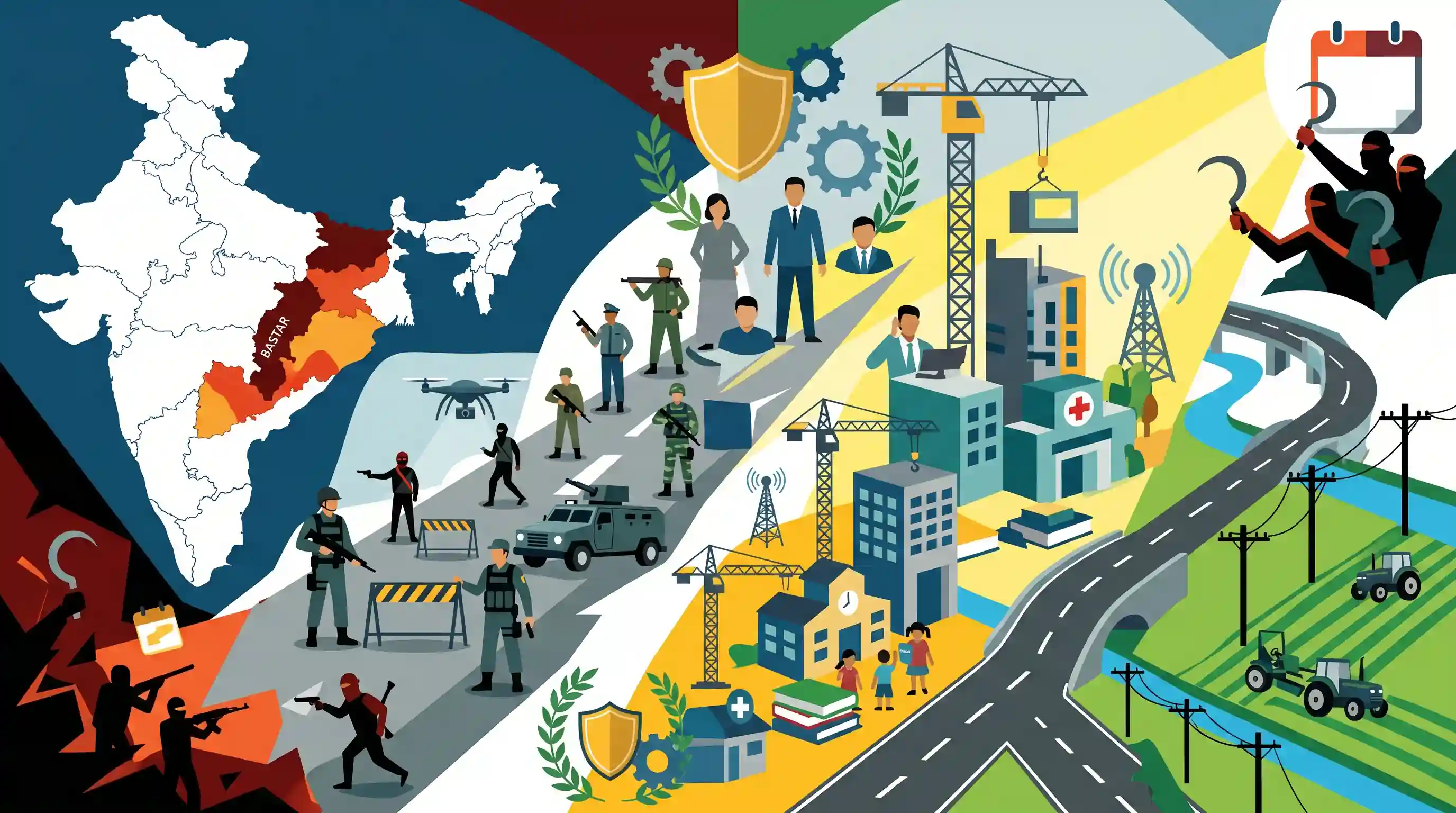
Union Home Minister Amit Shah informed the Lok Sabha that Left Wing Extremism (LWE), or Naxalism, has been almost entirely eliminated from Bastar, Chhattisgarh, and is on the verge of ending nationwide. This significant internal security milestone was highlighted just ahead of a set government deadline to eradicate the Maoist menace. The success reflects the effectiveness of the government's dual approach: intensifying security operations against armed insurgents while simultaneously addressing the development deficit in affected regions through infrastructure and welfare initiatives.
Key Points
- Union Home Minister Amit Shah stated in the Lok Sabha that Left Wing Extremism (LWE) has been nearly wiped out from Bastar, Chhattisgarh.
- The declaration signifies the imminent end of the Maoist threat in India, aligning with the central government's ambitious deadlines to eradicate LWE.
- The decline in Naxalism is attributed to a multi-pronged strategy involving aggressive security operations, improved intelligence, and focused socio-economic development in the 'Red Corridor'.
- The reduction of LWE violence underscores a major internal security achievement for the state and central security apparatus.
Important Terms
Left Wing Extremism (LWE)

An armed insurgency based on Marxist-Leninist-Maoist ideology aiming to overthrow the state. It originated in Naxalbari (1967) and primarily targets tribal and underdeveloped regions.
UPSC context
GS Paper 3 (Internal Security); focuses on linkages between development and extremism and the multi-pronged SAMADHAN strategy.
Maoists
Adherents of Mao Zedong's ideology who advocate for a 'protracted people's war' and violent revolution to capture state power, primarily through the CPI (Maoist) organization.
UPSC context
GS Paper 3 (Internal Security); tests understanding of non-state actors and ideological challenges to internal security.
Ministry of Home Affairs (MHA)
The nodal agency for internal security and domestic policy in India. It manages the Central Armed Police Forces and coordinates counter-insurgency operations with state governments.
UPSC context
GS Paper 2 (Governance) and GS Paper 3 (Security Forces); crucial for understanding the administrative architecture of national security.
Bastar
A tribal-dominated region in Chhattisgarh that served as the epicenter of Maoist insurgency. It is currently the focus of intensive security-led development to eliminate LWE.
UPSC context
GS Paper 3 (Internal Security); used as a key case study for geographical shrinkage of the 'Red Corridor' and development-led counter-insurgency.
Internal Security
The preservation of sovereign peace and order within national borders against internal threats like terrorism, communalism, and insurgencies.
UPSC context
GS Paper 3 core theme; tests the ability to analyze multifaceted threats and the state's institutional responses.
Lok Sabha
The lower house of India's Parliament (House of the People) where the Union Executive is held accountable for internal security policies and national development milestones.
UPSC context
GS Paper 2 (Parliament); relates to the executive's responsibility to report on national security milestones to the legislature.
Prelims Trap
"Left Wing Extremism has been entirely eliminated from India except in the state of Chhattisgarh."
Aspirants often assume LWE is now confined only to Chhattisgarh. While heavily contracted, it still officially affects around 38 districts across multiple states, including Jharkhand and Odisha.
Static Concepts Connected
What is the SAMADHAN doctrine used by security forces to counter Left Wing Extremism?
- S-A-M elements: Smart Leadership, Aggressive Strategy, and Motivation/Training of security personnel operating in hostile terrains.
- A-D-H elements: Actionable Intelligence, Dashboard-based Key Performance Indicators (KPIs), and Harnessing Technology like UAVs and trackers.
- A-N elements: Action plan tailored for each specific theater, and strictly ensuring No access to extremist financing.
What developmental pillars are used by the State to address the root causes of Naxalism?
- Aspirational Districts Programme: Rapid socio-economic improvement in 35 heavily LWE-affected districts to bridge deep-rooted governance deficits.
- Forest Rights recognition: Implementation of FRA 2006 to secure tribal land titles and minor forest produce rights, neutralizing major insurgency grievances.
- Security-civil synergy: Establishing heavily fortified Forward Operating Bases (FOBs) in former 'liberated zones' to restore civil administration delivery systems.
Cross-Topic Patterns
Infrastructure as an anti-insurgency tool
The Road Requirement Plan (RRP) and telecom projects in the Red Corridor link the 'Internal Security' syllabus directly to 'Infrastructure Development', proving roads can dismantle insurgent safe havens.
Federalism in Internal Security ops
Eradicating LWE requires synergy between Central CAPFs (like CRPF/CoBRA) and state specialized units (like Andhra's Greyhounds or Chhattisgarh's DRG), highlighting cooperative federalism in security.

Expect a 2026 Mains question assessing whether the SAMADHAN doctrine and infrastructure push have structurally defeated LWE or merely displaced it.
Linked PYQs · 3
Linked PYQs · 3
- 2022MainsGS3
Naxalism is a social, economic and developmental issue manifesting as a violent internal security threat. In this context, discuss the emerging issues and suggest a multilayered strategy to tackle the menace of Naxalism.
- 2018MainsGS3
Left Wing Extremism (LWE) is showing a downward trend, but still affects many parts of the country. Briefly explain the Government of India's approach to counter the challenges posed by LWE.
- 2015MainsGS3
The persisting drives of the Government for development of large industries in backward areas have resulted in isolating the tribal population and the farmers who face multiple displacements. With Malkangiri and Naxalbari foci, discuss the corrective strategies needed to win the Left Wing Extremism (LWE) doctrine affected citizens back into the mainstream of social and economic growth.
