Left Wing Extremism Nearly Eradicated from Bastar Says Home Ministry
Source:Indian Express ↗
Why It Matters
LWE has historically been one of India's biggest internal security challenges. Its near-elimination represents a major triumph for the state's security apparatus and underscores the importance of the two-pronged strategy of security operations followed by rapid developmental interventions in affected tribal regions.
Summary
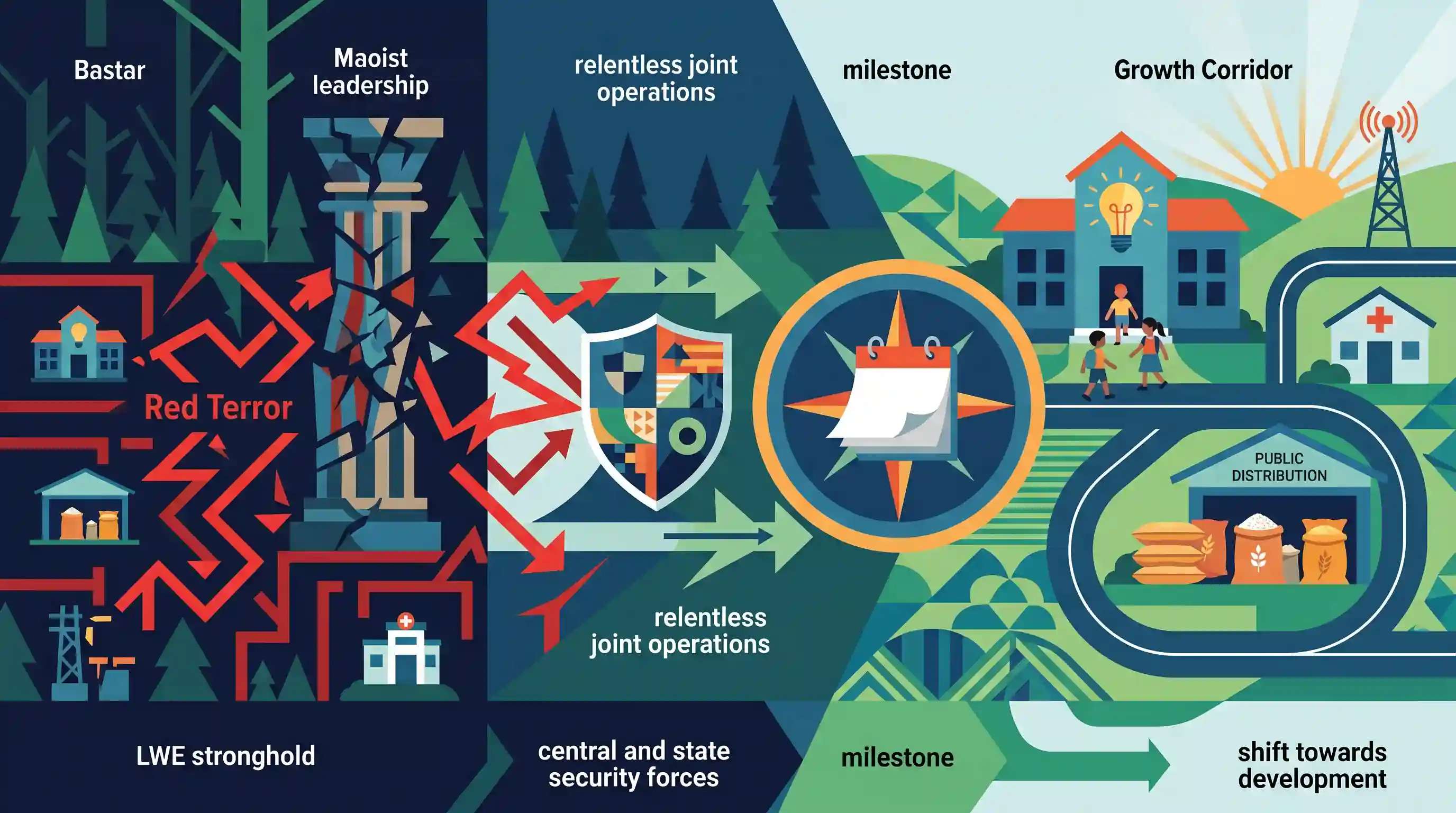
Union Home Minister Amit Shah informed the Lok Sabha that Left Wing Extremism (LWE) has been 'more or less wiped out' from its stronghold in Bastar, Chhattisgarh, just days ahead of the government's self-imposed March 31, 2026 deadline. This milestone was achieved through relentless joint operations by central and state security forces, successfully dismantling the Maoist leadership structure across several states. The significant reduction in violence is facilitating a shift towards development, enabling the establishment of basic infrastructure like schools and public distribution systems in remote tribal areas.
Key Points
- Union Home Minister Amit Shah declared the near-elimination of Left Wing Extremism (LWE) from Bastar ahead of the Centre's March 31, 2026 deadline.
- A coordinated offensive by central forces (CAPF, CRPF, COBRA) and state police (including DRG) effectively dismantled the Maoist central structure and Politburo across multiple states.
- The eradication of 'red terror' has allowed developmental initiatives—such as schools, ration shops, and Aadhaar enrollment—to penetrate deep into previously inaccessible areas.
- While the government highlights successful security operations, the opposition reiterates the need to address the underlying socio-economic drivers of Naxalism to ensure lasting peace.
Important Terms
CPI(Maoist)

A banned, far-left militant organization formed in 2004, aiming to overthrow the Indian state through armed rebellion. It is designated as a terrorist group under the Unlawful Activities (Prevention) Act (UAPA).
UPSC context
GS Paper III: Internal Security; analyzes the ideological roots and structural challenges of Left Wing Extremism (LWE) in India.
District Reserve Guard (DRG)
A specialized unit of the Chhattisgarh Police primarily composed of local tribal youth. Known as 'sons of the soil,' they provide critical local intelligence and terrain expertise for anti-Maoist operations.
UPSC context
GS Paper III: Security Forces; highlights the effectiveness of localized, community-integrated counter-insurgency strategies in Chhattisgarh.
COBRA
An elite specialized unit of the CRPF trained specifically for guerrilla tactics and jungle warfare. Raised in 2008, it is the primary strike force against Maoist insurgents in dense forested terrains.
UPSC context
GS Paper III: Security Forces; tests knowledge of specialized units and their specific mandates in asymmetric warfare.
CRPF
India's largest Central Armed Police Force, functioning under the Ministry of Home Affairs. It is the lead agency for internal security, riot control, and counter-insurgency operations against LWE.
UPSC context
GS Paper III: Security Forces and Agencies; primary force for managing internal security threats and maintaining law and order.
Central Armed Police Forces (CAPF)
A collective of seven specialized forces (CRPF, BSF, CISF, ITBP, SSB, NSG, AR) under the Ministry of Home Affairs, mandated to protect borders and assist states in maintaining internal security.
UPSC context
GS Paper III: Internal Security; focuses on the mandate and role of various security agencies in national stability.
Prelims Trap
The District Reserve Guard (DRG) is a specialized Central Armed Police Force (CAPF) deployed for anti-Naxal operations.
DRG is a state police force of Chhattisgarh, primarily comprising locally recruited tribal youth and surrendered Naxals, whereas COBRA falls under the central CRPF.
Static Concepts Connected
What are the core components of the MHA's SAMADHAN doctrine?
- Aggressive Strategy: Proactive and aggressive operations by joint security forces to dominate and reclaim LWE strongholds.
- Actionable Intelligence: Building local human intelligence networks and using technology (UAVs) for pinpoint counter-insurgency operations.
- Financial Choking: Systematically blocking Naxal terror financing networks, extortion channels, and money laundering routes.
How do PESA and FRA address the structural root causes of LWE?
- Governance Deficit: PESA empowers local Gram Sabhas in Scheduled Areas, reversing the historical political alienation of tribal communities.
- Resource Alienation: The Forest Rights Act (FRA) legally recognizes tribal land tenure, curbing the displacement-driven resentment that insurgents exploit.
Cross-Topic Patterns
Dandakaranya Geography & Security
The dense canopy and cross-state borders of the Dandakaranya plateau historically aided Naxals. Modern road and telecom penetration directly neutralized this geographic advantage.
Security vs. Tribal Development
The shift to the 'Hold and Build' phase directly links GS3 Internal Security to GS2 Governance, particularly the Aspirational Districts Programme and Eklavya Schools.

Expect a 2026 Mains question linking the 'Hold & Build' LWE phase to Aspirational Districts and PESA implementation in Dandakaranya.
Linked PYQs · 4
Linked PYQs · 4
- 2025MainsGS3
The Government of India recently stated that Left Wing Extremism (LWE) will be eliminated by 2026. What do you understand by LWE and how are the people affected by it? What measures have been taken by the government to eliminate LWE?
- 2022MainsGS3
Naxalism is a social, economic and developmental issue manifesting as a violent internal security threat. In this context, discuss the emerging issues and suggest a multilayered strategy to tackle the menace of Naxalism.
- 2018MainsGS3
Left Wing Extremism (LWE) is showing a downward trend, but still affects many parts of the country. Briefly explain the Government of India's approach to counter the challenges posed by LWE.
- 2015MainsGS3
The persisting drives of the Government for development of large industries in backward areas have resulted in isolating the tribal population and the farmers who face multiple displacements. With Malkangiri and Naxalbari foci, discuss the corrective strategies needed to win the Left Wing Extremism (LWE) doctrine affected citizens back into the mainstream of social and economic growth.
