Delimitation and Hindi heartland dominance shape Lok Sabha dynamics
Source:The Hindu ↗
Why It Matters
It underscores the core tension between democratic representation (one person, one vote) and federal equity (regional balance) in India. The impending 2026 delimitation will test the resilience of Indian federalism and is a highly probable topic for Mains GS2 (Polity) and Essay papers.
Summary
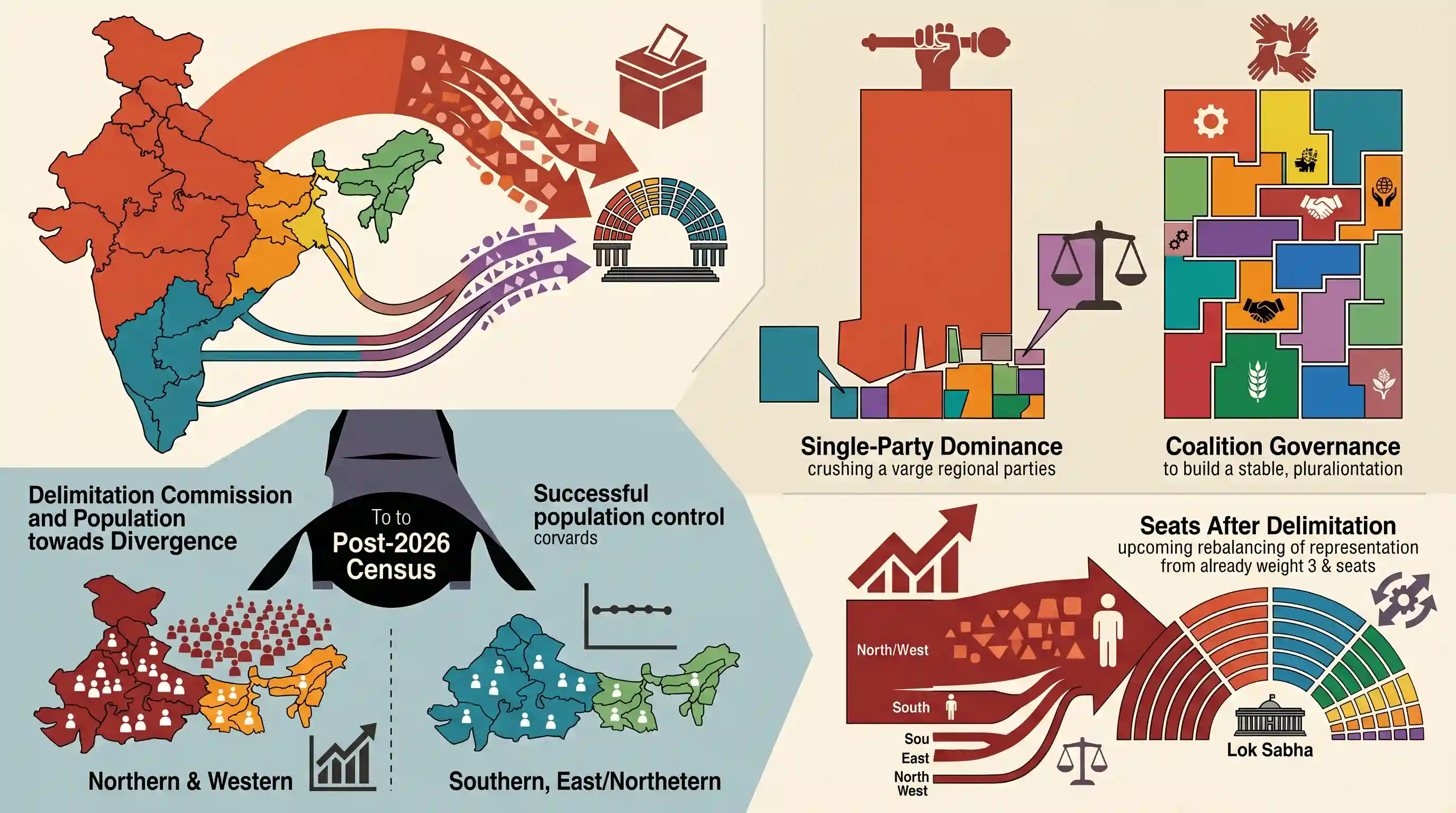
The article presents a data-driven analysis of the geographic distribution of Lok Sabha majorities since 1967, highlighting the persistent dominance of the Hindi heartland (North and West) in government formation. This geographic skew allows major national decisions to be taken without adequate representation from the South, East, and Northeast. While coalition governments historically offered more dispersed geographic representation by empowering regional parties, the current single-party dominance has revived concerns regarding regional marginalization. Furthermore, the analysis explores the impending delimitation of Lok Sabha constituencies post the 2026 Census, warning that it could exacerbate the North-South representational divide due to the demographic divergence between states that successfully controlled population growth and those that did not.
Key Points
- The Hindi heartland consistently contributes heavily to Lok Sabha majorities, frequently leaving the South, East, and Northeast underrepresented in the national government.
- Single-party dominant governments historically draw disproportionate power from specific regions, whereas coalition governments distribute geographic representation more evenly.
- Regional parties typically ally with weaker national parties to assert state autonomy and serve as a counterbalance to a national hegemon.
- The impending delimitation of constituencies post the 2026 Census poses a severe federal challenge: population-based reallocation risks penalizing Southern states for successful population control while rewarding high-growth Northern states.
- Major federal decisions can be executed by parliamentary majorities that completely lack representation from the affected peripheral regions, straining the federal structure.
Important Terms
Delimitation Commission

An independent high-powered body appointed by the President to redraw boundaries of Lok Sabha and State Assembly constituencies based on census data, ensuring the principle of "one vote, one value."
UPSC context
GS Paper II: Statutory/Regulatory bodies; Electoral reforms. Essential for understanding how demographic shifts translate into political representation.
Delimitation Act
Legislation mandated by Article 82, enacted by Parliament after a census to provide the legal framework for readjusting seats and redrawing territorial constituencies for the Lok Sabha.
UPSC context
GS Paper II: Indian Constitution—Parliamentary provisions. Relevant for the legislative process behind readjusting electoral boundaries.
Lok Sabha
The lower house of India's bicameral Parliament, representing the people through directly elected members. It currently has 543 constituencies, with seat allocation determined by state population ratios.
UPSC context
GS Paper II: Parliament and State Legislatures—Structure and functioning. The focal point of debates on regional representation and delimitation.
Hindi Heartland
A socio-political region comprising North and Central Indian states (e.g., Uttar Pradesh, Bihar) whose high seat count allows it to exercise disproportionate influence over national government formation.
UPSC context
GS Paper I & II: Regionalism and Federalism. Tests understanding of geographic skews in political power and internal security/governance.
Demographic Divergence
The widening gap in population growth rates between states (high in the North, lower in the South), which threatens to penalize states with successful family planning during delimitation.
UPSC context
GS Paper II & III: Federalism and Population issues. Crucial for discussing the "North-South divide" in policy and representation.
Federalism
A constitutional system dividing power between the Centre and States. Delimitation is a "federal" issue because it impacts the relative political bargaining power of different states.
UPSC context
GS Paper II: Basic structure; Issues and challenges pertaining to the federal structure. Core concept for regional disparity analysis.
84th Constitutional Amendment Act
The constitutional amendment that extended the freeze on the total number of Lok Sabha seats (set in 1971) until the first census after 2026.
UPSC context
GS Paper II: Constitutional Amendments. Explains the current representational status quo and the legal timeline for future changes.
Prelims Trap
"Delimitation Commission orders are subject to judicial review by the Supreme Court to prevent federal imbalance."
Under Article 329, courts are barred from interfering in electoral delimitation. Delimitation Commission orders have the force of law and cannot be questioned in any court.
Static Concepts Connected
What are the constitutional powers and limits of the Delimitation Commission?
- Constitutional mandate: Under Article 82, Parliament enacts a Delimitation Act after every Census to readjust constituency boundaries and seat allocations.
- Absolute authority: Its orders carry the force of law and are strictly immune from judicial review in any court across India.
- Legislative limits: Neither the Lok Sabha nor State Legislative Assemblies can effect modifications to the Commission's orders once laid before them.
How did the 42nd and 84th Amendments impact Lok Sabha delimitation?
- 42nd CAA (1976): Froze the state-wise allocation of Lok Sabha seats based on 1971 Census figures until the year 2000, incentivizing states to adopt family planning.
- 84th CAA (2001): Extended the freeze on the total number of Lok Sabha seats until the publication of the first Census taken after 2026.
- Internal redrawing: While total seats remained frozen, the 84th and 87th Amendments allowed redrawing of internal territorial constituency boundaries based on the 2001 Census.
Cross-Topic Patterns
Financial vs. Electoral Demographics
The 15th FC rewarded Southern states with a "Demographic Performance" weightage, a concept currently absent in electoral delimitation, which threatens to penalize those same states for successful population control.
Coalitions as a Federal Check
Regional parties in coalitions form a structural check against centralization. Analysing single-party dominance highlights how geography dictates national policy when peripheral states lack veto power in the Lok Sabha.

Expect a 2026 Mains question linking impending delimitation to asymmetric federalism, contrasting it with Finance Commission formulas.
Linked PYQs · 4
Linked PYQs · 4
- 2024PrelimsGS1
How many Delimitation Commissions have been constituted by the Government of India till December 2023?
- 2012PrelimsGS1
With reference to the Delimitation Commission, consider the following statements: 1. The orders of the Delimitation Commission cannot be challenged in a Court of Law. 2. When the orders of the Delimitation Commission are laid before the Lok Sabha or State Legislative Assembly, they cannot effect any modifications in the orders. Which of the statements given above is/are correct?
- 2022MainsGS2
“While the national political parties in India favour centralisation, the regional parties are in favour of State autonomy.” Comment.
- 2015MainsGS2
The concept of cooperative federalism has been increasingly emphasized in recent years. Highlight the drawbacks in the existing structure and the extent to which cooperative federalism would answer the shortcomings.
