Parliamentary Committee on One Nation One Election
Source:The Hindu ↗
ఇది ఎందుకు ముఖ్యం
The 'One Nation One Election' (ONOE) proposal is one of the most critical constitutional and federal debates in India. For UPSC, candidates must understand the legislative pathway (the Constitution 129th Amendment Bill), the role of Joint Parliamentary Committees in building consensus on complex issues, and the constitutional/federal implications under Article 368 regarding the alignment of assembly terms and state ratification.
సారాంశం
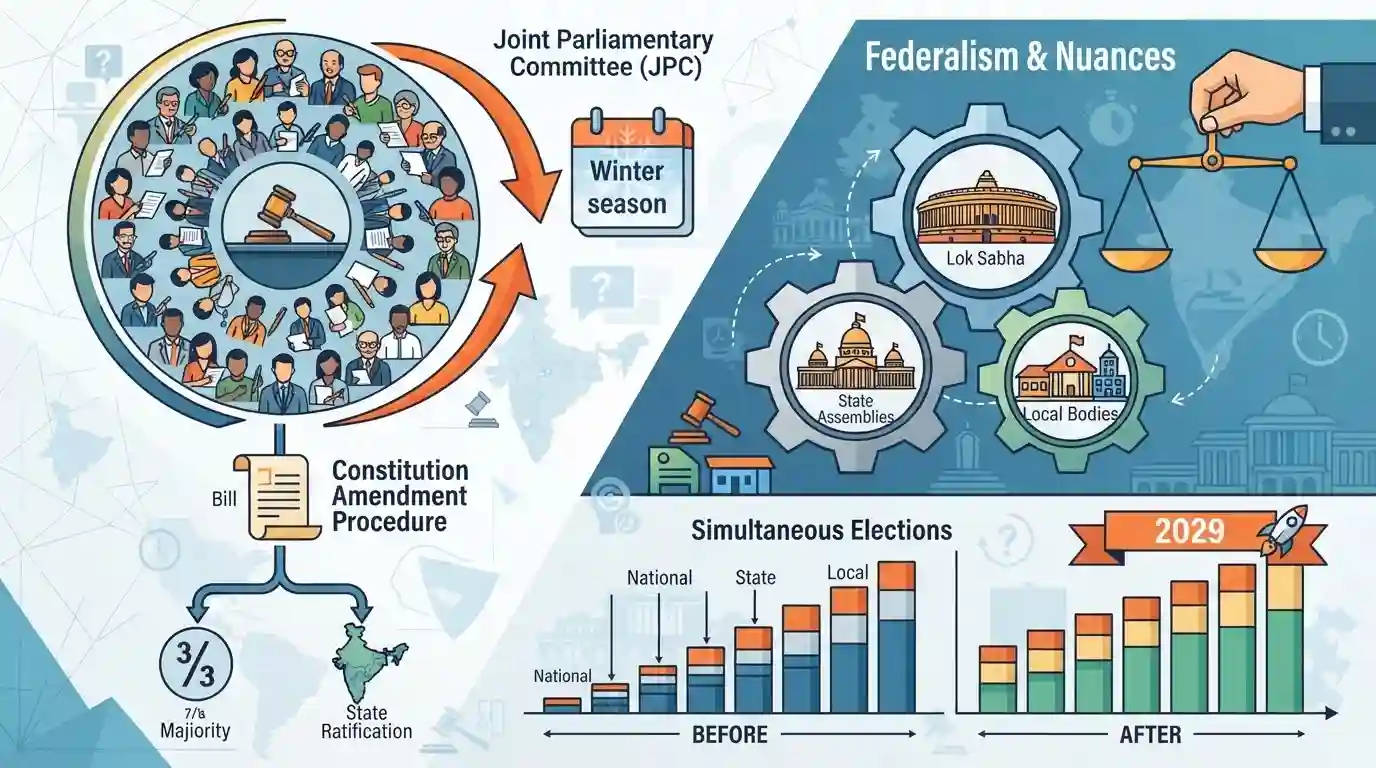
The Lok Sabha has extended the tenure of the 41-member Joint Parliamentary Committee (JPC) examining the Constitution (One Hundred and Twenty-Ninth Amendment) Bill, 2024, till the upcoming Winter Session. Chaired by P.P. Chaudhary, the committee is studying the legal, federal, and constitutional nuances of implementing the 'One Nation One Election' (ONOE) model. This major electoral reform aims to align the terms of the Lok Sabha, State Legislative Assemblies, and local bodies for simultaneous elections by 2029.
ముఖ్య అంశాలు
- The Lok Sabha granted an extension to the 41-member Joint Parliamentary Committee (JPC) examining the Constitution (One Hundred and Twenty-Ninth Amendment) Bill, 2024.
- The committee, chaired by BJP MP P.P. Chaudhary, now has until the first day of the last week of the Winter Session to submit its report.
- The resolution seeking the extension was passed in the Lok Sabha via a voice vote.
- The JPC's mandate is to examine the legal and constitutional aspects of the 'One Nation One Election' (ONOE) framework, which proposes simultaneous elections for the Lok Sabha, State Legislative Assemblies, and local bodies.
- The proposed implementation timeline for the simultaneous elections rollout is aimed at 2029, and the committee is undertaking nationwide consultations to address concerns.
ముఖ్యమైన పదాలు
Constitution (One Hundred and Twenty-Ninth Amendment) Bill, 2024

A constitutional amendment bill introduced to insert Article 82A and modify other articles, facilitating simultaneous elections to the Lok Sabha and all State Legislative Assemblies.
UPSC context
GS Paper II (Polity): Tests understanding of landmark electoral reforms, constitutional amendment procedures, and executive-legislative dynamics.
One Nation One Election framework
A governance proposal to synchronize India's election cycles, conducting simultaneous polls for the Lok Sabha, State Assemblies, and local bodies once every five years to reduce cost and disruption.
UPSC context
GS Paper II (Electoral Reforms): Analyzes impacts on cooperative federalism, democratic representation, developmental governance, and constitutional feasibility.
Joint Committee of Parliament
A temporary, ad-hoc committee comprising members from both the Lok Sabha and Rajya Sabha, constituted to scrutinize specific bills or investigate issues of national importance.
UPSC context
GS Paper II (Polity): Evaluates knowledge of legislative oversight mechanisms, the role of parliamentary committees, and democratic accountability.
ప్రిలిమ్స్ ఉచ్చు
A mid-term election necessitated by the premature dissolution of the Lok Sabha will always result in a fresh five-year term for the new House.
Under the proposed ONOE framework, mid-term elections will only serve the unexpired remainder of the five-year term to preserve the synchronized cycle.
అనుసంధానమైన స్థిర భావనలు
What is a Joint Parliamentary Committee (JPC) and how is it constituted?
- Definition & Composition: An ad-hoc committee set up for a specific purpose with members from both Houses, usually in a 2:1 ratio (Lok Sabha to Rajya Sabha).
- Creation Mechanism: Created either through a motion adopted by one House and agreed to by the other, or by the Presiding Officers of both Houses.
- Dissolution: It is temporary and stands dissolved once it completes its assigned task and submits its report to the Parliament.
What constitutional provisions govern the terms of the Lok Sabha and State Assemblies?
- Article 83(2): Provides that the Lok Sabha, unless sooner dissolved, shall continue for five years from the date appointed for its first meeting.
- Article 172(1): Prescribes an identical five-year term for State Legislative Assemblies, starting from their first meeting.
- Dissolution Powers: Allows the President to dissolve the Lok Sabha and the Governor to dissolve State Legislative Assemblies before the completion of five years.
అంతర-అంశ నమూనాలు
ONOE + Fiscal Federalism
Aligning local and state terms touches State List subjects. The demand for state ratification tests the boundaries of Article 368 and federal consent under GST-style consensus models.
JPCs + Executive Accountability
The revival of JPCs to scrutinize complex constitutional bills reflects a return to coalition-era consensus-building, balancing executive speed with deliberative lawmaking.

UPSC may frame a multi-statement question contrasting current Article 83/172 dissolution rules with the proposed 'unexpired term' clause.
అనుసంధాన PYQలు · 4
అనుసంధాన PYQలు · 4
- 2024MainsGS2
Examine the need for electoral reforms as suggested by various committees with particular reference to "one nation one election" principle.
- 2017MainsGS2
Simultaneous election to the Lok Sabha and the State Assemblies will limit the amount of time and money spent in electioneering but it will reduce the government's accountability to the people." Discuss.
- 2022PrelimsGS1
Consider the following statements: 1. A bill amending the Constitution requires a prior recommendation of the President of India. 2. When a Constitution Amendment Bill is presented to the President of India, it is obligatory for the President of India to give his/her assent. 3. A Constitution Amendment Bill must be passed by both the Lok Sabha and the Rajya Sabha by a special majority and there is no provision for joint sitting. Which of the statements given above are correct?
- 2025PrelimsGS1
Consider the following subjects under the Constitution of India : I. List I-Union List, in the Seventh Schedule II. Extent of the executive power of a State III. Conditions of the Governor's office For a constitutional amendment with respect to which of the above, ratification by the Legislatures of not less than one-half of the States is required before presenting the bill to the President of India for assent?
