Parliament Approves Extension of Presidents Rule in Manipur
Source:The Hindu ↗
Why It Matters
The ongoing crisis in Manipur serves as a critical case study for UPSC aspirants on the practical application and parliamentary scrutiny of Article 356 (President's Rule). It also highlights the complexities of internal security, ethnic insurgencies, and peace-building in North East India.
Summary
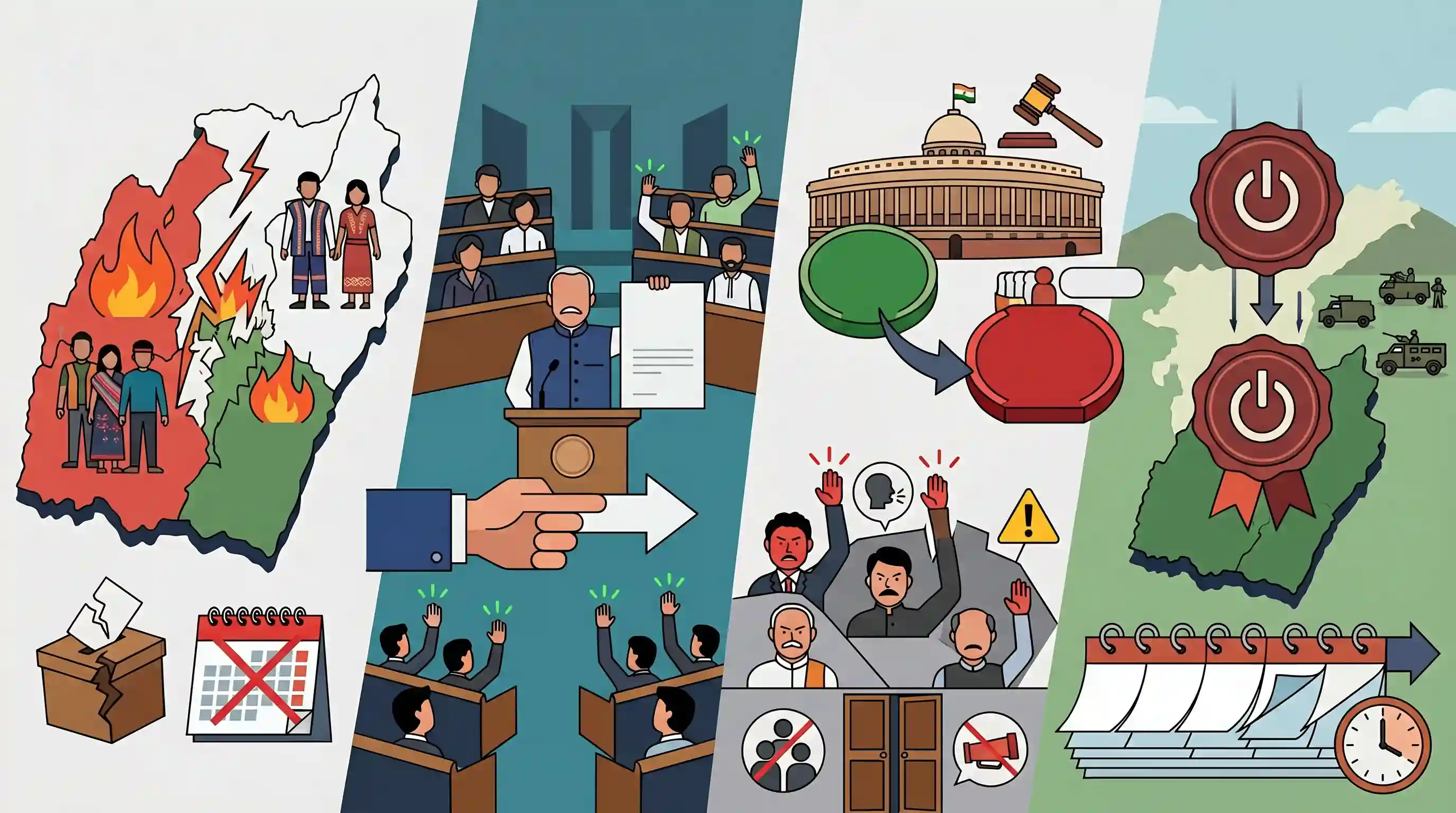
The Lok Sabha has approved a Statutory Resolution extending President's Rule in Manipur for an additional six months, starting June 11, 2026. The resolution, introduced by Minister of State for Home Affairs Nityanand Rai, was necessitated by the ongoing ethnic conflict between the Meitei and Kuki-Zo communities and the inability to conduct state assembly elections under the current volatile conditions. Opposition leaders criticized the Union government's handling of the crisis and the prolonged suspension of democratic governance. The resolution awaits passage in the Rajya Sabha to formally extend the provisions of Article 356 in the state.
Key Points
- The Lok Sabha passed a statutory resolution to extend President's Rule in Manipur for a further six months, effective June 11, 2026.
- Minister of State for Home Affairs Nityanand Rai moved the resolution, citing ongoing ethnic violence between Meitei and Kuki-Zo communities and the Election Commission's assessment that elections cannot currently be held.
- Opposition MPs, including Inner Manipur MP A. Bimol Akoijam (Congress) and Kakoli Ghosh Dastidar (TMC), vehemently opposed the extension, criticizing the Union government's failure to restore peace and democratic processes.
- The resolution now requires approval from the Rajya Sabha to fulfill the constitutional requirements under Article 356 for extending state emergency provisions.
- The continued imposition of President's Rule underscores the deep-seated law and order crisis and the breakdown of constitutional machinery in Manipur.
Important Terms
Article 356

Constitutional provision empowering the President to impose direct rule in a state if its 'constitutional machinery' fails. It is often termed 'State Emergency' or 'Constitutional Emergency'.
UPSC context
GS II: Centre-State Relations and Federalism. Tests understanding of emergency provisions and safeguards like the S.R. Bommai case (1994).
President's Rule
The administrative state where the elected state government is suspended and the Governor, as the President's representative, assumes executive authority on behalf of the Union.
UPSC context
GS II: Indian Constitution. Crucial for analyzing impacts on state autonomy and the legislative role of Parliament during emergencies.
Statutory Resolution
A formal proposal moved in Parliament specifically in pursuance of a provision in the Constitution or an Act of Parliament, such as for approving President's Rule.
UPSC context
GS II: Parliamentary Procedures. Tests knowledge of different types of motions and resolutions used for constitutional functions.
Rajya Sabha
The permanent upper house of Parliament that represents states. It must approve an extension of President's Rule by a simple majority, even if the Lok Sabha is dissolved.
UPSC context
GS II: Parliament. Tests the federal role and special powers of the upper house in maintaining constitutional continuity.
Election Commission of India (ECI)
Constitutional body responsible for certifying whether assembly elections can be held. Under Article 356(5), its certification is mandatory for extending President's Rule beyond one year.
UPSC context
GS II: Constitutional Bodies. Tests the ECI’s advisory role and its intersection with Article 356 and the 44th Amendment.
Prelims Trap
"President's Rule can be extended up to three years purely by repeated parliamentary resolutions every six months."
Post-44th Amendment, extending Article 356 beyond one year mandates either an active National Emergency or an Election Commission certification that holding state elections is impossible.
Static Concepts Connected
What conditions allow extending President's Rule beyond one year?
- 44th Amendment Limit: Enacted to prevent misuse, it restricted routine six-month extensions from exceeding a total of one year without specific preconditions.
- Emergency Condition: A National Emergency (Article 352) must be operating in the whole of India or specifically within that state.
- EC Certification: The Election Commission of India must certify that holding general elections to the state legislative assembly is currently difficult.
What special provisions does Article 371C grant to Manipur?
- Hill Areas Committee: The President can mandate the creation of a committee consisting of MLAs elected specifically from Manipur's designated Hill Areas.
- Governor's Responsibility: The Governor is entrusted with a special responsibility to ensure the proper functioning of this committee, reporting directly to the President.
- Union Oversight: The executive power of the Union extends to giving directions to the State regarding the administration of these Hill Areas.
Cross-Topic Patterns
Article 356 + Election Commission mandate
The Election Commission's administrative assessment of law-and-order directly dictates Parliament's constitutional timeline and authority for extending emergency provisions under Article 356.
Topography + Ethnic Security Dynamics
Manipur's 10% valley (Meitei) vs 90% hills (Kuki-Zo) demographic divide exemplifies how geographic terrain heavily dictates land rights, tribal administration (Schedule 6/Art 371C), and internal security crises.

Expect a 2026 Prelims statement mixing the 44th Amendment's EC certification rule for Art 356 with Art 371C's Hill Areas Committee.
Linked PYQs · 4
Linked PYQs · 4
- 2023MainsGS2
Account for the legal and political factors responsible for the reduced frequency of using Article 356 by the Union Governments since mid 1990s.
- 2018PrelimsGS1
If the President of India exercises his power as provided under Article 356 of the Constitution in respect of a particular State, then
- 2017MainsGS3
The North-East region of India has been infested with insurgency for a very long time. Analyze the major reasons for the survival of armed insurgency in this region.
- 2019MainsGS3
Cross-border movement of insurgents is only one of the several security challenges facing the policing of the border in North-East India. Examine the various challenges currently emanating across the India-Myanmar border. Also, discuss the steps to counter the challenges.
