Parliamentary Procedures and Motion of Thanks Debates in Lok Sabha
Source:The Hindu ↗
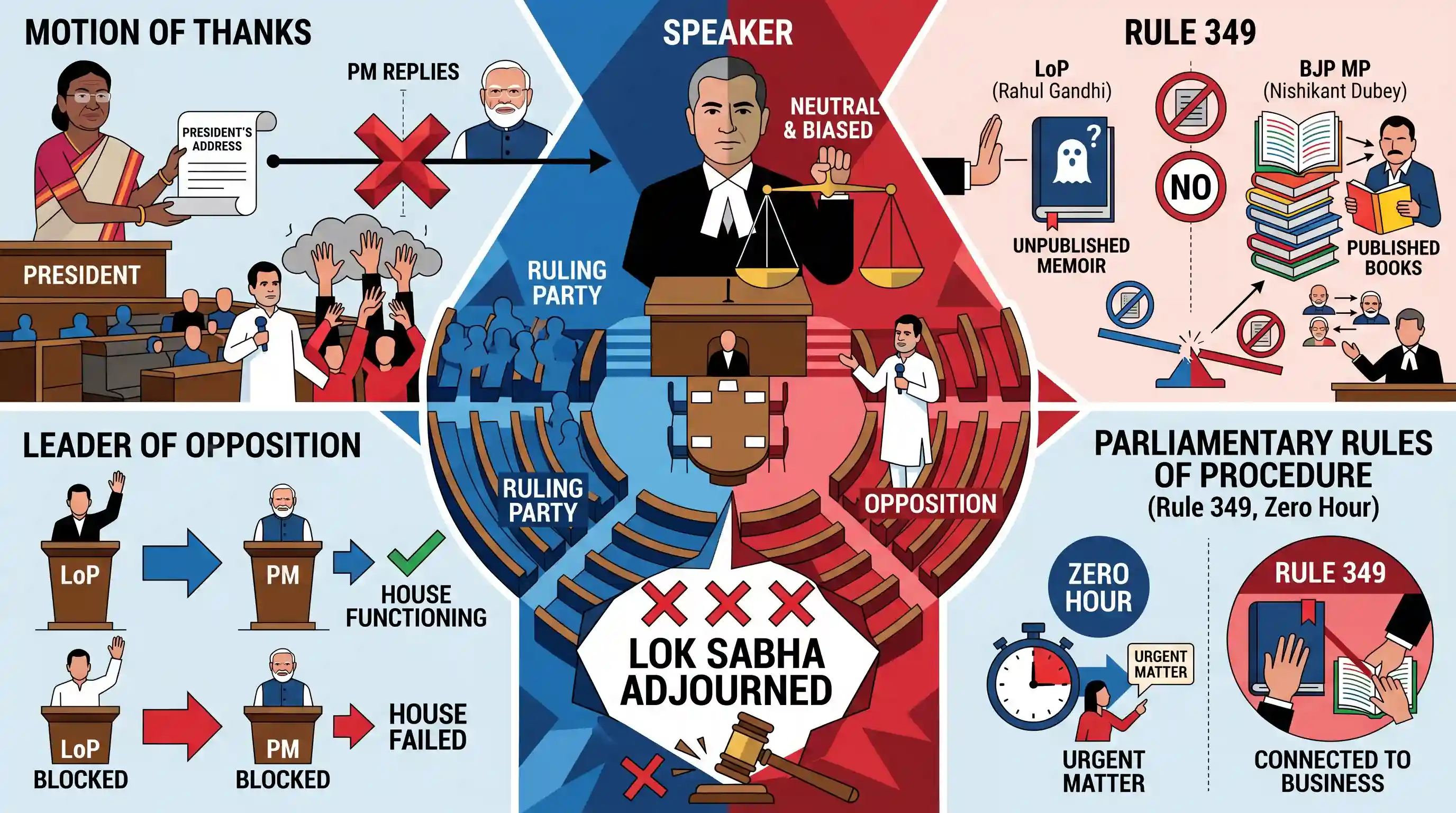
Why It Matters
Provides real-world examples of parliamentary mechanisms like the Motion of Thanks and Zero Hour. It highlights the critical debate on the impartiality of the Speaker and presiding officers in regulating debates, applying parliamentary rules uniformly, and managing disruptions to ensure productive legislative sessions.
Summary
Dramatic protests by the Opposition forced the adjournment of the Lok Sabha, preventing Prime Minister Narendra Modi's reply to the Motion of Thanks on the President's Address. The uproar was triggered by BJP MP Nishikant Dubey quoting from books to level allegations against former PMs, which the Opposition argued violated Rule 349. Congress leaders alleged double standards by the Speaker, pointing out that Leader of the Opposition Rahul Gandhi was recently blocked from quoting an unreleased memoir. Consequently, Congress demanded that the Prime Minister's reply be contingent on the Leader of the Opposition being allowed to speak first, reflecting ongoing tensions over parliamentary procedures, the impartiality of the Chair, and equitable debate allocation.
Key Points
- Opposition protests led to the adjournment of the Lok Sabha, preventing PM Modi from delivering his customary reply to the Motion of Thanks on the President's Address.
- The unrest was sparked when BJP MP Nishikant Dubey quoted from books making allegations against former PMs Jawaharlal Nehru and Indira Gandhi, which the Opposition claimed violated Rule 349.
- Congress members highlighted double standards by the Chair, noting that Leader of the Opposition Rahul Gandhi was previously barred by Speaker Om Birla from quoting an unreleased memoir on the 2020 India-China conflict.
- The Opposition demanded that the LoP be allowed to speak before the Prime Minister, citing a 2004 precedent where the BJP, then in Opposition, similarly blocked PM Manmohan Singh's reply to the Motion of Thanks.
Important Terms
Motion of Thanks

A formal parliamentary motion to debate the President's address. It outlines government policies and must be passed; failure signifies a loss of confidence in the government.
UPSC context
GS Paper II (Polity). Tests understanding of Article 87 and parliamentary accountability mechanisms.
Rule 349
A provision in the 'Rules of Procedure and Conduct of Business in Lok Sabha' detailing member conduct, including prohibitions on reading non-business material while the House is sitting.
UPSC context
GS Paper II (Parliamentary Conduct). Relevant for questions on parliamentary rules, decorum, and the Speaker's powers.
Zero Hour
An informal Indian parliamentary innovation where members raise matters of urgent public importance without prior notice. It begins at 12:00 noon immediately following Question Hour.
UPSC context
GS Paper II (Parliamentary Devices). A unique Indian feature often tested for its procedural informalities.
Leader of the Opposition
A statutory post held by the leader of the largest opposition party (with at least 10% seats). The role ensures accountability and provides an alternative vision in Parliament.
UPSC context
GS Paper II (Polity). Crucial for questions on checks and balances and the functioning of democracy.
Lok Sabha
The lower house of India's bicameral Parliament, composed of directly elected representatives. It is the primary chamber for holding the Council of Ministers responsible.
UPSC context
GS Paper II (Parliament). Fundamental for understanding India's legislative structure and executive responsibility.
Prelims Trap
"The Leader of the Opposition in Parliament is a Constitutional office."
The LoP is a statutory post governed by the 1977 Act and recognized by the rules of the House, not explicitly established by the Constitution.
Static Concepts Connected
What is the constitutional significance of the Motion of Thanks?
- Constitutional basis: Mandated under Article 87 for the President's address at the first session post-election and the first session of each year.
- Executive accountability: Its defeat in the Lok Sabha is treated as a loss of confidence, practically requiring the government to resign.
- Right of reply: By parliamentary convention, the PM or a designated Minister concludes the debate with a detailed reply defending executive policies.
How do Rules of Procedure govern MP conduct and Speaker powers?
- Rule 349 restrictions: Rule 349 regulates MP conduct, restricting members from quoting books or letters unless directly connected to the ongoing business of the House.
- Speaker's discretion: The Speaker holds broad discretionary power to interpret rules, determine document admissibility, and maintain order, sparking debates on institutional objectivity.
- UK vs. India: Unlike the UK's 'Once a Speaker, Always a Speaker' convention, Indian Speakers rarely resign from their parent party, complicating perceptions of neutrality.
Cross-Topic Patterns
LoP's role in statutory appointments
The Leader of Opposition's status links directly to GS2 governance, as the LoP sits on high-powered selection panels for the CBI, CVC, and the Election Commission.
Speaker's impartiality vs. 10th Schedule
Debates over the Speaker's procedural fairness in the House frequently mirror constitutional controversies regarding their quasi-judicial powers in anti-defection cases under the Tenth Schedule.

Expect a 2026 Prelims statement mixing the statutory backing of the LoP with the constitutional mandate of the Motion of Thanks (Art 87).
Linked PYQs · 3
Linked PYQs · 3
- 2020MainsGS2
Once a Speaker, Always a Speaker' ! Do you think this practice should be adopted to impart objectivity to the office of the Speaker of Lok Sabha ? What could be its implications for the robust functioning of parliamentary business in India?
- 2023MainsGS2
Discuss the role of Presiding Officers of state legislatures in maintaining order and impartiality in conducting legislative work and in facilitating best democratic practices.
- 2019MainsGS2
Individual Parliamentarian's role as the national law maker is on a decline, which in turn, has adversely impacted the quality of debates and their outcome. Discuss.
