Lok Sabha Ratification of Presidents Rule in Ethnic Strife Manipur
Source:The Hindu ↗
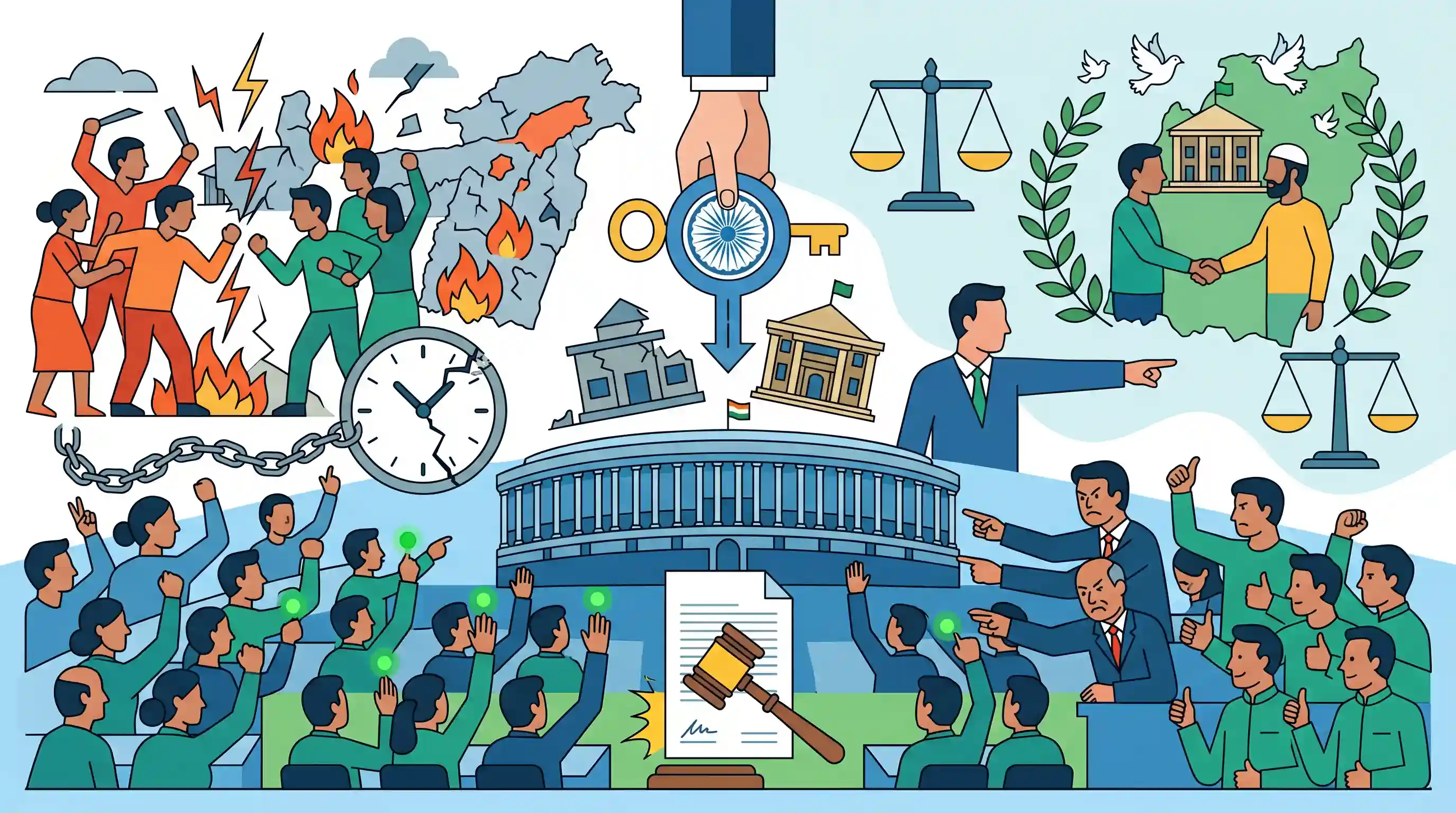
Why It Matters
Provides a contemporary, high-profile example of the invocation of Article 356 due to internal disturbances and ethnic conflict. It is highly relevant for GS Paper 2 (Polity: Emergency Provisions, Parliament) and GS Paper 3 (Internal Security: Challenges in the Northeast).
Summary
The Lok Sabha has formally adopted a Statutory Resolution confirming the imposition of President’s Rule in Manipur under Article 356(1). The Central intervention, initiated on February 13, 2025, was necessitated by the prolonged and devastating ethnic conflict between the Meitei and Kuki communities that has gripped the state since May 2023. While opposition parties supported the resolution as a necessary constitutional step, they sharply criticized the Union government's handling of the protracted crisis and urged the immediate restoration of peace, stability, and democratic governance in the state.
Key Points
- The Lok Sabha adopted a Statutory Resolution on April 3, 2025, confirming the imposition of President's Rule in Manipur.
- President's Rule was originally invoked in the state on February 13, 2025, under Article 356(1) of the Constitution due to a severe breakdown of constitutional machinery.
- The Central intervention follows prolonged, severe ethnic violence between the Meitei and Kuki communities that began in May 2023.
- Opposition leaders supported the constitutional measure but heavily criticized the Union government for its prolonged failure to contain the crisis, demanding swift restoration of an elected government and regional stability.
Important Terms
Article 356

Empowers the President to impose direct central rule in a state if they are satisfied that the state government cannot function according to constitutional provisions.
UPSC context
GS Paper II (Polity); tests understanding of emergency provisions, federalism, and the Union's power over states.
Statutory Resolution
A formal parliamentary instrument used to approve or extend a Presidential proclamation of emergency, requiring a simple majority in both Houses within two months.
UPSC context
GS Paper II (Governance/Polity); tests knowledge of legislative procedures and parliamentary oversight of the executive.
President's Rule
The suspension of state government and direct administration by the Union through the Governor, also known as a 'State Emergency' or 'Constitutional Emergency.'
UPSC context
GS Paper II (Polity); central topic regarding federal tensions, judicial review, and the office of the Governor.
Failure of Constitutional Machinery
The legal threshold for Article 356, referring to a state's inability to govern per the Constitution due to political instability, lawlessness, or non-compliance with Union directives.
UPSC context
GS Paper II (Polity); tests the conceptual clarity of grounds for declaring a state emergency.
S.R. Bommai v. Union of India
A landmark 1994 Supreme Court judgment that made the proclamation of President's Rule subject to judicial review and restricted its arbitrary use by the Centre.
UPSC context
GS Paper II (Polity); essential for discussing judicial activism, federalism, and safeguards against political misuse of power.
Meitei-Kuki Conflict
The 2023-2025 violent ethnic clashes in Manipur involving land rights, ST status demands, and illegal migration, leading to massive displacement and administrative breakdown.
UPSC context
GS Paper III (Internal Security); tests knowledge of ethnic diversity, insurgencies, and security management in Northeast India.
Internal Security in Northeast India
Challenges including ethnic insurgencies, cross-border smuggling, and tribal tensions in India's border states, often managed through central paramilitary forces and special laws.
UPSC context
GS Paper III (Security); core syllabus area covering linkages between development and spread of extremism.
Prelims Trap
President's Rule under Article 356 can only be imposed upon receiving a formal report from the State Governor.
Article 356 explicitly allows the President to act "on receipt of a report from the Governor of a State or otherwise"—meaning even without a report.
Static Concepts Connected
What are the constitutional conditions for approving and extending President's Rule?
- Initial Approval: Must be approved by both Houses within two months of issue by a simple majority.
- Standard Extension: Once approved, it continues for 6 months, extendable up to a maximum of 3 years with repeated approvals.
- Beyond 1 Year (44th Amendment): To extend beyond 1 year, a National Emergency must be operating or the Election Commission must certify difficulties in holding elections.
How did the S.R. Bommai judgment (1994) curb the arbitrary use of Article 356?
- Judicial Review: The Presidential proclamation is subject to judicial review; courts can examine if the material cause was relevant or malafide.
- Assembly Dissolution: The State Assembly should only be dissolved after Parliament approves the proclamation; until then, it remains in suspended animation.
- Secularism: Violating the secular feature of the Constitution (basic structure) is a valid ground for imposition.
Cross-Topic Patterns
Border Security + ST Inclusion Friction
Manipur's crisis merges border security management (Free Movement Regime with Myanmar) with socio-legal friction over Scheduled Tribe (ST) criteria and land rights in hill areas.
Article 355 (Duty) vs Article 356 (Rule)
Before invoking Article 356, the Centre’s constitutional duty to protect states against internal disturbance (Article 355) is heavily debated, making the 355-to-356 transition a prime GS2 theme.

Expect a multi-statement Prelims question contrasting approval timelines and extension constraints of Art 352 vs Art 356 post-44th Amendment.
Linked PYQs · 5
Linked PYQs · 5
- 2023MainsGS2
Account for the legal and political factors responsible for the reduced frequency of using Article 356 by the Union Governments since mid 1990s.
- 2025MainsGS3
What are the major challenges to internal security and peace process in the North-Eastern States? Map the various peace accords and agreements initiated by the government in the past decade.
- 2018PrelimsGS1
If the President of India exercises his power as provided under Article 356 of the Constitution in respect of a particular State, then
- 2019MainsGS3
Cross-border movement of insurgents is only one of the several security challenges facing the policing of the border in North-East India. Examine the various challenges currently emanating across the India-Myanmar border. Also, discuss the steps to counter the challenges.
- 2017MainsGS3
The North-East region of India has been infested with insurgency for a very long time. Analyze the major reasons for the survival of armed insurgency in this region.
