SHANTI Bill and Private Sector Participation in Nuclear Energy
Source:The Hindu ↗
Why It Matters
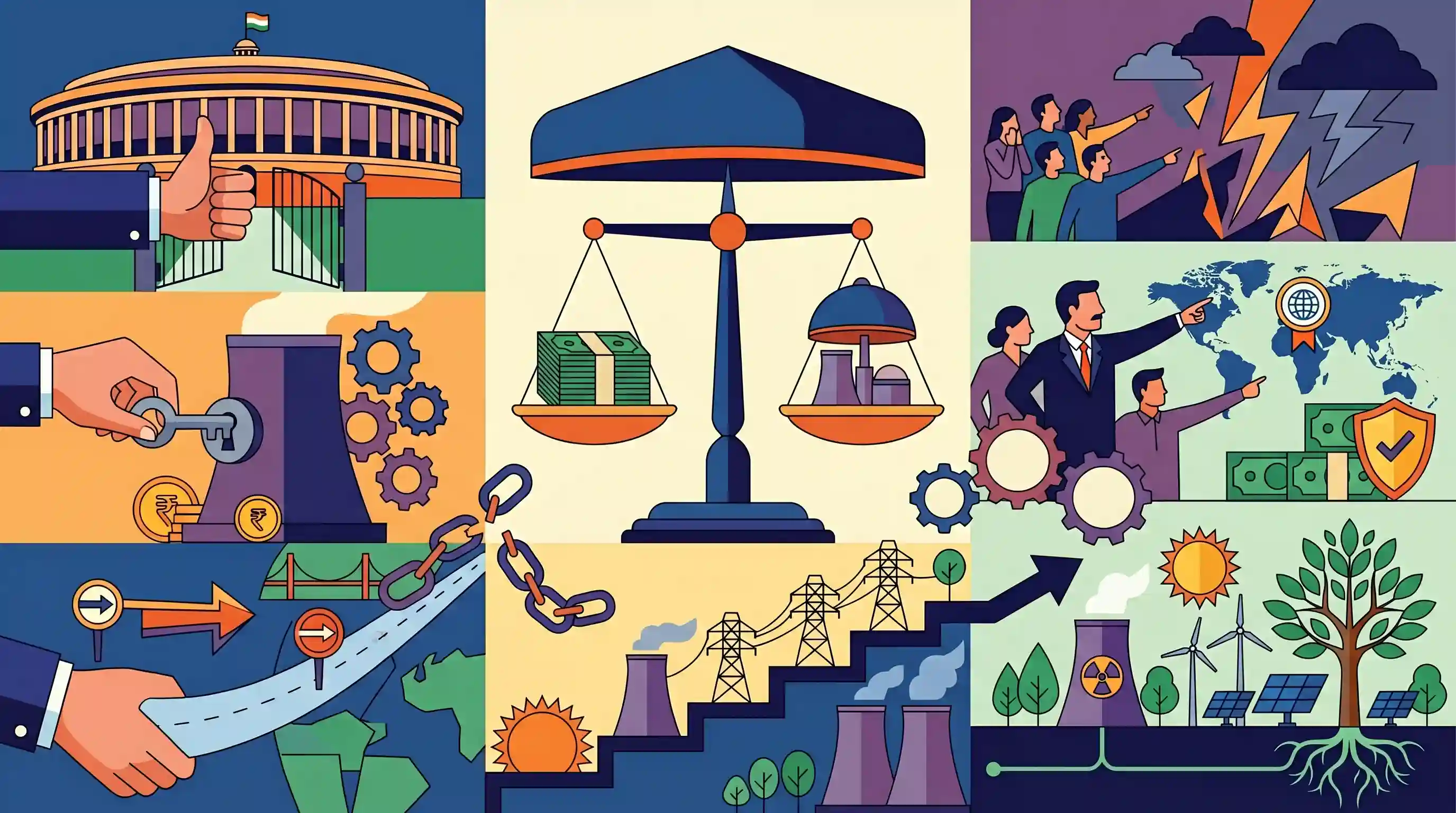
The SHANTI Bill represents a monumental shift in India's nuclear policy. By removing supplier liability, India is aligning its domestic laws with international conventions (like the CSC), resolving a 15-year deadlock that stunted foreign investment. This is critical for GS-3 (Energy, Environment, and Technology) and GS-2 (Government Policies), as it highlights the balance between attracting private capital for clean energy transitions and managing catastrophic risks.
Summary
The Lok Sabha has cleared the Sustainable Harnessing and Advancement of Nuclear Energy for Transforming India (SHANTI) Bill, 2025, a landmark legislation designed to open the nuclear energy sector to private investment. A major feature of the Bill is the removal of the supplier liability clause from the Civil Liability for Nuclear Damage Act of 2010, historically a major hurdle for foreign investment following the India-U.S. civil nuclear deal. The legislation caps the operator's maximum liability at ₹3,000 crore, a point of contention for the Opposition who compared it to the massive costs of the Fukushima and Chernobyl disasters. The government defended the cap, emphasizing alignment with the Convention on Supplementary Compensation for Nuclear Damage (CSC) and the availability of secondary insurance pools. The move is seen as crucial for scaling India's nuclear capacity to 100 GW by 2047 and meeting its 2070 net-zero targets.
Key Points
- The Lok Sabha passed the SHANTI Bill, 2025, which aims to facilitate private sector participation in India's nuclear energy sector.
- The legislation seeks to scale India's nuclear power capacity from the current 8.8 GW to 100 GW by 2047, contributing to the 2070 net-zero emission goals.
- Crucially, the Bill amends the Civil Liability for Nuclear Damage Act, 2010 by removing the controversial supplier liability clause, shifting the sole financial responsibility for accidents to the operator.
- Opposition leaders criticized the cap on operator liability at ₹3,000 crore, highlighting that cleanup costs for disasters like Fukushima were exponentially higher.
- The government countered that the ₹3,000 crore limit aligns with international standards, with additional coverage provided by the Nuclear Liability Fund, an insurance pool, and the Convention on Supplementary Compensation for Nuclear Damage (CSC).
Important Terms
SHANTI Bill, 2025

A 2025 law liberalizing India's nuclear sector by allowing private participation and foreign investment, while removing supplier liability to align with global standards and meet 2047 capacity goals.
UPSC context
GS Paper 3: Energy and Infrastructure; tests knowledge of landmark legislative reforms for energy security and economic indigenization.
Civil Liability for Nuclear Damage Act (CLNDA), 2010
Legislation providing a framework for compensation in nuclear accidents, previously controversial for Section 17(b) which allowed legal recourse against equipment suppliers, a major deterrent for foreign firms.
UPSC context
GS Paper 3: Environment and Energy; significant for understanding the legal-regulatory hurdles in India's civil nuclear energy growth.
Convention on Supplementary Compensation for Nuclear Damage (CSC)
An international treaty establishing a uniform global legal regime for nuclear accident compensation, emphasizing the 'channelling' of liability exclusively to the plant operator.
UPSC context
GS Paper 2: International Treaties; essential for India's integration into the global nuclear order and international law alignment.
India-U.S. Civil Nuclear Deal
A 2008 landmark agreement (123 Agreement) that ended India's nuclear isolation, allowing it to engage in global nuclear commerce despite being a non-signatory to the NPT.
UPSC context
GS Paper 2: Bilateral Relations; a watershed event in Indian diplomacy and strategic autonomy.
Bharat Small Modular Reactors (BSMR) Mission
A strategic initiative to design and deploy small-scale, modular nuclear reactors (e.g., BSMR-200) to provide flexible, clean energy for industrial hubs and remote regions.
UPSC context
GS Paper 3: Science & Technology; tests awareness of indigenous technological advancements and clean energy transition strategies.
Supplier Liability
A legal provision allowing operators to sue equipment manufacturers for damages post-accident; its removal in 2025 aimed to attract global technology partners like Westinghouse and GE.
UPSC context
GS Paper 3: Economy/Energy; a critical concept in FDI, risk management, and international technology transfer negotiations.
Nuclear Power Corporation of India Limited (NPCIL)
A central Public Sector Undertaking under the Department of Atomic Energy, which held a monopoly on nuclear power plant operation until the 2025 reforms.
UPSC context
GS Paper 3: Infrastructure; key entity for executing India's three-stage nuclear power program.
Prelims Trap
"The SHANTI Bill holds foreign technology suppliers strictly liable for nuclear damage in India."
This is the exact opposite of the Bill's core purpose. The SHANTI Bill explicitly removes the 2010 'supplier liability' clause to establish exclusive operator liability, aligning with global norms.
Static Concepts Connected
What is the Convention on Supplementary Compensation for Nuclear Damage (CSC)?
- Global Framework: An international treaty adopted in 1997 and managed by the IAEA to establish a global framework for nuclear liability and compensation.
- Exclusive Operator Liability: It mandates that liability for nuclear damage falls exclusively on the operator of the nuclear installation, indemnifying technology suppliers.
- India's Status: India ratified the CSC in 2016. The new SHANTI Bill aligns India's domestic law with this treaty by removing supplier liability.
What was the controversial 'Right of Recourse' in the CLND Act, 2010?
- Supplier Liability: Under Section 17(b), the operator (NPCIL) could sue foreign or domestic suppliers if an accident resulted from defective equipment or sub-standard services.
- Investment Deadlock: This unique provision deviated from global indemnification norms, severely deterring foreign vendors (US, France) and stalling the progress of the 2008 Indo-US civil nuclear deal.
Cross-Topic Patterns
Small Modular Reactors (SMRs) + Privatization
Private capital unlocked by the SHANTI Bill will likely focus on the Bharat Small Modular Reactors mission, making SMR technology and its decentralized grid integration a high-probability UPSC target.
Baseload Power + Panchamrit Goals
Meeting the 2070 net-zero 'Panchamrit' target requires firm baseload power to complement intermittent solar/wind. The proposed 100 GW nuclear capacity directly addresses this critical grid-stability gap.

Expect a 2026 multi-statement question linking the SHANTI Bill's exclusive operator liability, CSC obligations, and SMR technology.
Linked PYQs · 4
Linked PYQs · 4
- 2025MainsGS3
How can India achieve energy independence through clean technology by 2047? How can biotechnology can play a crucial role in this endeavour?
- 2018MainsGS3
“Access to affordable, reliable, sustainable and modern energy is the sine qua non to achieve Sustainable Development Goals (SDGs).” Comment on the progress made in India in this regard.
- 2018PrelimsGS1
In the Indian context, what is the implication of ratifying the 'Additional Protocol' with the 'International Atomic Energy Agency (IAEA)'?
- 2018PrelimsGS1
What is/are the consequence/consequences of a country becoming the member of the 'Nuclear Suppliers Group'? 1. It will have access to the latest and most efficient nuclear technologies. 2. It automatically becomes a member of "The Treaty on the Non-Proliferation of Nuclear Weapons (NPT)". Which of the statements given above is/are correct?
