निजी क्षेत्र के प्रवेश के लिए शांति बिल लोकसभा से पास
स्रोत:द हिंदू ↗
क्यों मायने रखता है
The SHANTI Bill represents a paradigm shift in India's nuclear policy, transitioning from strict state monopoly and stringent supplier liability to private participation and relaxed liability norms. This is critical for UPSC aspirants understanding the trade-offs between clean energy expansion (SMRs, net-zero goals) and disaster accountability.
सारांश
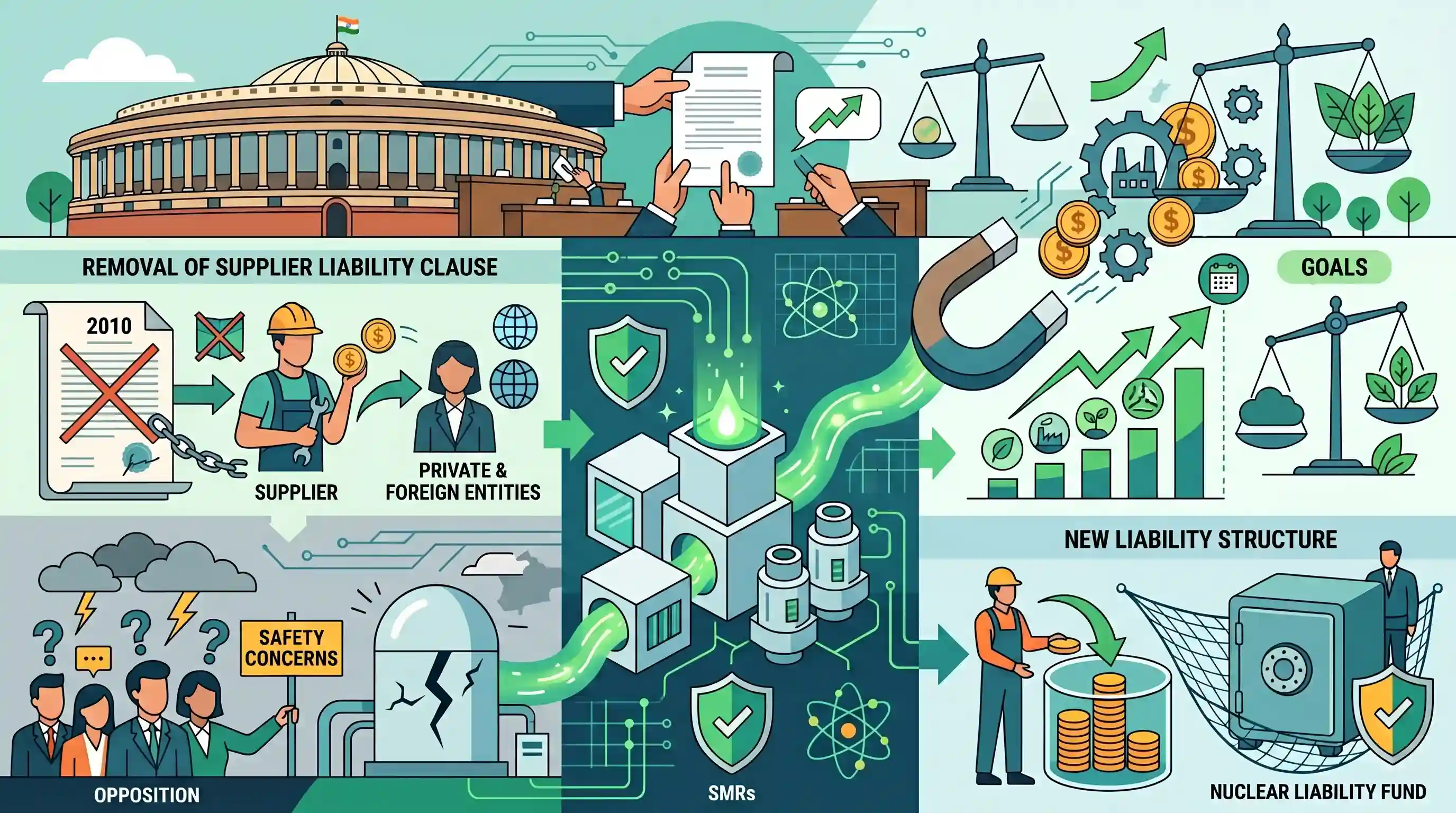
The Lok Sabha has cleared the Sustainable Harnessing and Advancement of Nuclear Energy for Transforming India (SHANTI) Bill, 2025, marking a major policy shift to allow private sector participation in the nuclear domain. The Bill sparked debate due to its removal of a supplier liability clause present in the 2010 Civil Liability for Nuclear Damage Act, a move the Opposition claims benefits private and foreign entities while compromising safety. The government defended the amendment, arguing that modern Small Modular Reactors (SMRs) are safer and that easing supplier liability is essential to attract the private investment needed to boost India's nuclear capacity to 100 GW by 2047 and meet its 2070 net-zero targets. Operator liability is now capped at ₹3,000 crore, backed by a Nuclear Liability Fund.
मुख्य बिंदु
- The Lok Sabha passed the SHANTI Bill, 2025 to enable private sector participation and foreign investment in India's nuclear energy sector.
- The Bill removes a crucial clause from the Civil Liability for Nuclear Damage Act, 2010, effectively exempting equipment suppliers from liability in the event of a nuclear accident.
- Opposition parties argued the liability waiver caters to private conglomerates and foreign (American) companies at the expense of public safety.
- The Government justified the move by citing technological advancements like Small Modular Reactors (SMRs), which carry lower catastrophe risks, and the need to attract investment.
- The Bill caps operator liability at ₹3,000 crore, with any excess damages to be covered by a newly established Nuclear Liability Fund and the international CSC framework.
- The legislation aligns with India's goals to scale nuclear capacity from 8.8 GW to 100 GW by 2047 and achieve net-zero emissions by 2070.
महत्वपूर्ण शब्द
SHANTI Bill, 2025

A 2025 legislation replacing previous nuclear laws to allow private sector participation in India's nuclear energy, aiming for 100 GW capacity by 2047.
UPSC context
GS II (Government Policies); GS III (Energy & S&T). Tests understanding of legislative shifts in strategic sectors and energy security.
परमाणु क्षति के लिए सिविल उत्तरदायित्व अधिनियम (CLNDA), 2010
The 2010 law (repealed by SHANTI) that introduced 'no-fault liability' and the controversial 'Right of Recourse' against equipment suppliers in case of nuclear accidents.
UPSC context
GS II/III. Key for understanding India's liability regime and past roadblocks to foreign/private investment in nuclear energy.
स्मॉल मॉड्युलर रिएक्टर्स (SMRs)
Advanced nuclear reactors with power capacity up to 300 MW(e) per unit, designed for factory-based manufacturing and easier deployment in varied locations.
UPSC context
GS III (Science & Technology). Represents the technical shift toward decentralised, safer nuclear power generation.
आपूर्तिकर्ता का दायित्व
The legal provision (Section 17 of CLNDA) allowing operators to claim damages from equipment manufacturers; its removal in 2025 aims to attract global private investment.
UPSC context
GS II (Governance). A critical point of debate regarding corporate accountability versus ease of doing business in high-risk sectors.
कन्वेंशन ऑन सप्लीमेंट्री कंपनसेशन (CSC)
A 1997 international treaty (ratified by India in 2016) establishing a global regime for nuclear liability, typically channeling all liability solely to the operator.
UPSC context
GS II (International Treaties). Tests India's compliance with global standards in the nuclear domain.
Nuclear Liability Fund
सरकार द्वारा बनाए रखा गया एक समर्पित वित्तीय कोष, जिसका उद्देश्य ऑपरेटर की देयता सीमा (liability cap) से अधिक होने वाली परमाणु क्षति के लिए मुआवजा प्रदान करना है।
UPSC context
GS III (Disaster Management/Infrastructure). Relevant for understanding risk-sharing mechanisms in the nuclear industry.
प्रारंभिक ट्रैप
"The SHANTI Bill exempts nuclear operators from all civil liability."
The Bill exempts equipment suppliers from liability, but strictly channels liability to the operator, doubling their cap to ₹3,000 crore backed by a Nuclear Liability Fund.
संबंधित अवधारणाएँ
What is the Convention on Supplementary Compensation for Nuclear Damage (CSC)?
- Global framework: अंतर्राष्ट्रीय सार्वजनिक निधि के माध्यम से परमाणु क्षति के लिए उपलब्ध मुआवजे को बढ़ाने हेतु एक वैश्विक रूपरेखा स्थापित करता है।
- देयता का सारणीकरण: परमाणु प्रतिष्ठान के ऑपरेटर पर पूर्ण और अनन्य उत्तरदायित्व (absolute and exclusive liability) केंद्रित करता है, तथा सामान्यतः आपूर्तिकर्ताओं को इससे छूट प्रदान करता है।
- भारत की स्थिति: India ratified the CSC in 2016; the SHANTI Bill's removal of supplier liability finally aligns Indian law with CSC norms.
How do Small Modular Reactors (SMRs) differ from conventional nuclear reactors?
- Lower capacity: SMRs generate up to 300 MW(e) per module, which is about one-third the capacity of traditional large-scale reactors.
- Modularity: They are factory-assembled and transportable as complete units, drastically reducing on-site construction time and capital costs.
- Passive safety: They rely on physical phenomena like gravity and natural circulation to shut down safely without human intervention or external power.
अंतर-विषय पैटर्न
SMRs + 2070 Net-Zero targets
SMR deployment is critical for baseload power as India scales up intermittent renewables and phases down coal to meet its 2070 net-zero emission goals.
FDI + Strategic Sector Privatisation
Opening nuclear generation to private/foreign entities marks a major departure from the Atomic Energy Act's strict state monopoly, necessitating parallel FDI policy revisions.

SHANTI विधेयक पर Prelims में एक बहु-कथनीय (multi-statement) प्रश्न की अपेक्षा करें, जो ऑपरेटर बनाम आपूर्तिकर्ता उत्तरदायित्व (operator vs. supplier liability), CSC मानकों और SMR तकनीक के बीच अंतर पर आधारित हो।
संबद्ध PYQ · 4
संबद्ध PYQ · 4
- 2025MainsGS3
How can India achieve energy independence through clean technology by 2047? How can biotechnology can play a crucial role in this endeavour?
- 2017MainsGS3
Give an account of the growth and development of nuclear science and technology in India. What is the advantage of fast breeder reactor programme in India?
- 2014MainsGS3
Explain how Private Public Partnership arrangements, in long gestation infrastructure projects, can transfer unsustainable liabilities to the future. What arrangements need to be put in place to ensure that successive generations' capacities are not compromised?
- 2018PrelimsGS1
In the Indian context, what is the implication of ratifying the 'Additional Protocol' with the 'International Atomic Energy Agency (IAEA)'?
