Parliamentary Disruptions and Electoral Roll Revision Debates
Source:The Hindu ↗
Why It Matters
Frequent Parliamentary disruptions affect legislative productivity and highlight the vital role of Presiding Officers in managing House proceedings. The specific demand for debating electoral roll revisions brings focus to the transparent conduct of elections and related reforms under the Representation of the People Act.
Summary
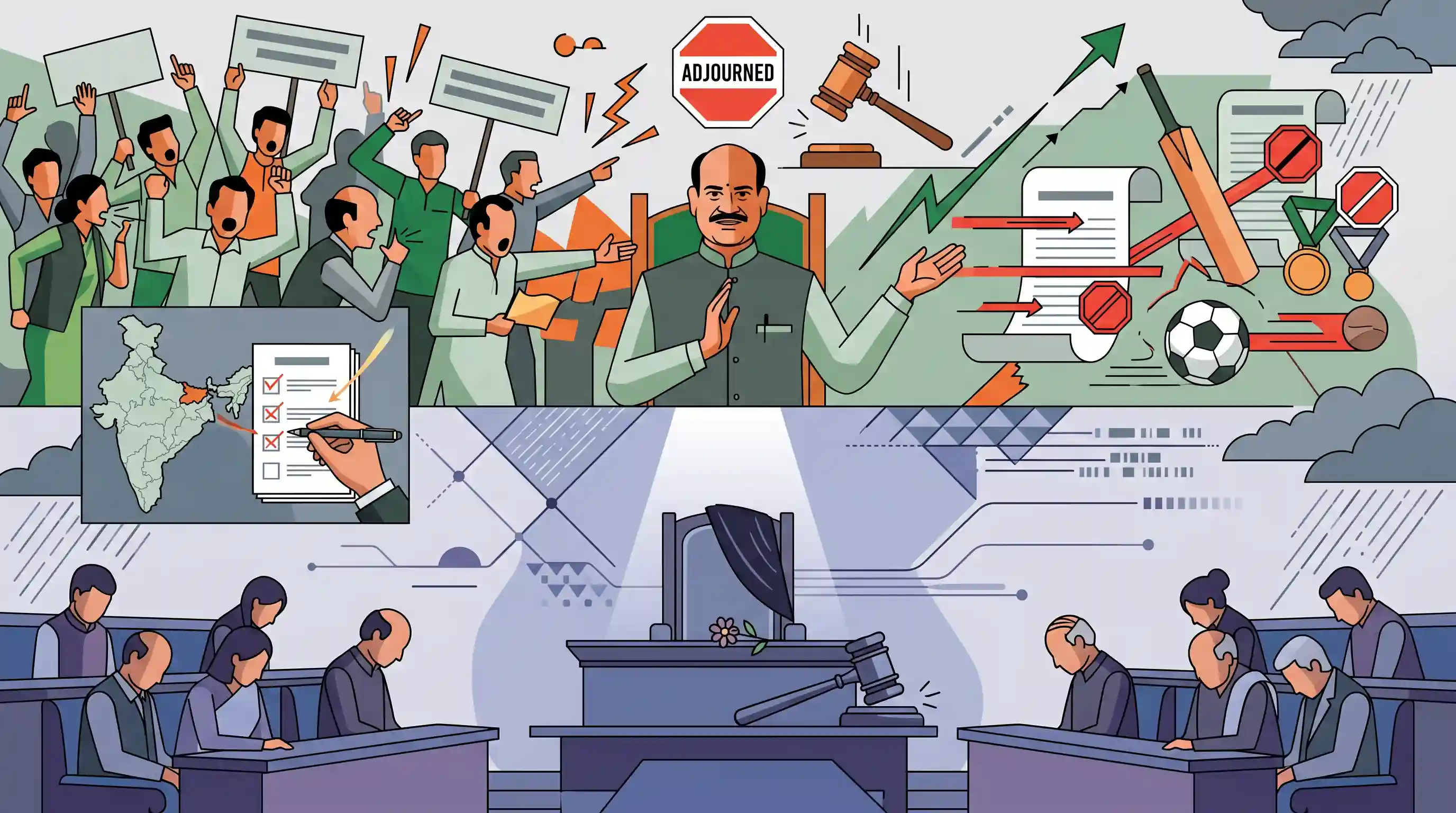
Both Houses of Parliament faced adjournments during the Monsoon session. The Lok Sabha was disrupted by Opposition MPs demanding a debate on the Special Intensive Revision (SIR) of electoral rolls in Bihar, stalling the passage of key sports Bills despite mediation efforts by Speaker Om Birla. Meanwhile, the Rajya Sabha was adjourned to mourn the death of sitting member Shibu Soren.
Key Points
- The Lok Sabha was repeatedly adjourned as Opposition members demanded a discussion on the Special Intensive Revision (SIR) of electoral rolls in Bihar.
- Speaker Om Birla attempted to resolve the deadlock by meeting with floor leaders, but the Opposition remained firm on debating electoral reforms.
- Due to the disruptions, no legislative business, including two key sports Bills, could be passed in the Lok Sabha.
- The Rajya Sabha was adjourned for the day as a mark of respect following the passing of sitting member Shibu Soren.
Important Terms
Special Intensive Revision (SIR)

A thorough house-to-house enumeration by the Election Commission to update electoral rolls under Section 21(3) of RPA 1950, ensuring accuracy by adding new voters and removing duplicates or deceased entries.
UPSC context
GS Paper II: Elections and Representation of People’s Act. Essential for understanding electoral purity and the Election Commission’s discretionary powers.
Representation of the People Act, 1950
A landmark statute governing the allocation of seats, delimitation of constituencies, and the preparation of electoral rolls for Parliament and State Legislatures.
UPSC context
GS Paper II: Salient features of the RPA. It provides the legal framework for the voter registration process.
Lok Sabha
The directly elected lower house of India’s Parliament. It represents the people and has primary authority over financial legislation and the accountability of the Council of Ministers.
UPSC context
GS Paper II: Parliament—structure and functioning. A core component of the legislative and governance system.
Rajya Sabha
The permanent upper house of Parliament representing States and UTs. It acts as a revisory chamber and ensures federal balance, with one-third of members retiring every two years.
UPSC context
GS Paper II: Parliament and State Legislatures. Tests knowledge of the federal structure and the second chamber's powers.
Opposition
Political parties not in power that scrutinize government policies. The Leader of the Opposition (LoP) is a statutory post vital for parliamentary oversight and high-level appointments.
UPSC context
GS Paper II: Functioning of Parliament. Focuses on accountability mechanisms and the role of dissent in democracy.
Adjournment
A procedural move that suspends the business of a sitting for a specific time, as decided by the presiding officer, to manage disruptions or for other administrative reasons.
UPSC context
GS Paper II: Conduct of Business in Parliament. Tests precision in distinguishing between adjournment, prorogation, and dissolution.
Prelims Trap
"The mandate for Special Intensive Revision (SIR) of electoral rolls stems from the Representation of the People Act, 1951."
Preparation and revision of electoral rolls are governed by the RPA 1950. The RPA 1951 deals with the conduct of elections, corrupt practices, and post-election disputes.
Static Concepts Connected
How does Special Intensive Revision (SIR) differ from Summary Revision?
- Summary Revision: Primarily updates existing rolls on an annual basis using designated draft publications without mandatory door-to-door verification.
- Intensive Revision: Involves comprehensive, house-to-house enumeration by Booth Level Officers (BLOs) to completely overhaul rolls and correct mass errors.
- Statutory Backing: The Election Commission directs these revisions under the discretionary powers granted by Section 21 of the Representation of the People Act, 1950.
What is the parliamentary convention regarding obituary references and adjournments?
- Sitting Members: It is an established convention in both Houses to adjourn for the entire day following obituary references for a deceased sitting member.
- Convention status: This practice is a well-established parliamentary tradition acting as a mark of respect, not a Constitutional mandate or strict rule of procedure.
- Presiding Authority: The Presiding Officers (Speaker of Lok Sabha / Chairman of Rajya Sabha) hold the sole authority to adjourn the sitting.
Cross-Topic Patterns
SIR, Delimitation & Census delays
Demands for intensive electoral roll revisions reflect political anxieties tied to the delayed decadal census and the impending unfreezing of Lok Sabha constituencies post-2026.
Decline of Deliberative Legislature
Repeated disruptions over regional issues stall national legislation, tying into Mains themes on the declining productivity of Parliament and the bypassing of parliamentary standing committees.

Expect a 2026 Prelims statement swapping RPA 1950 (electoral rolls, SIR) with RPA 1951 (conduct of elections) to test statutory clarity.
Linked PYQs · 3
Linked PYQs · 3
- 2020MainsGS2
Once a Speaker, Always a Speaker' ! Do you think this practice should be adopted to impart objectivity to the office of the Speaker of Lok Sabha ? What could be its implications for the robust functioning of parliamentary business in India?
- 2019MainsGS2
Individual Parliamentarian's role as the national law maker is on a decline, which in turn, has adversely impacted the quality of debates and their outcome. Discuss.
- 2024MainsGS2
Examine the need for electoral reforms as suggested by various committees with particular reference to "one nation one election" principle.
