बजट सत्र के नियमों को लेकर विपक्ष के विरोध के बीच लोकसभा स्थगित
स्रोत:द हिंदू ↗
क्यों मायने रखता है
The incident brings crucial GS-2 syllabus areas into focus, particularly the powers of the Speaker, rules regarding the conduct of parliamentary business (like Rule 360), the significance of the Leader of the Opposition, and the constitutional mechanism for the removal of the Speaker.
सारांश
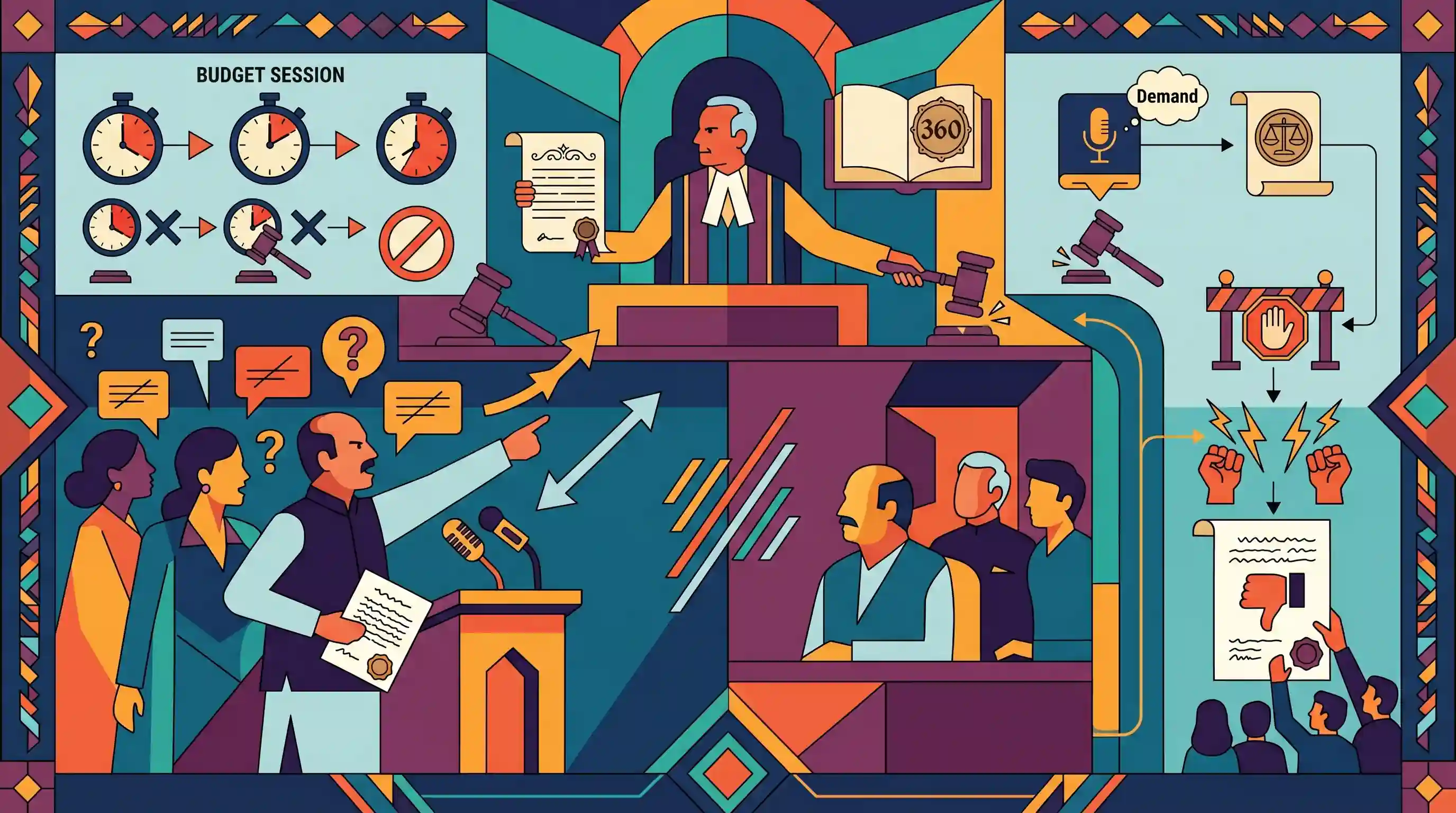
The Lok Sabha was repeatedly adjourned during the Budget session due to a standoff between the government and the opposition. The disruption was triggered by Leader of the Opposition Rahul Gandhi's demand to speak before the commencement of the Union Budget discussion. Speaker Om Birla denied the request, citing parliamentary rules (Rule 360) and conventions. Consequently, the opposition escalated the protest and submitted a notice for a no-confidence motion against the Speaker.
मुख्य बिंदु
- Leader of the Opposition Rahul Gandhi demanded to speak prior to the Union Budget discussion, leading to multiple adjournments of the Lok Sabha.
- Speaker Om Birla refused the demand citing Rule 360, stating that according to parliamentary convention, Budget discussions take precedence.
- Opposition leaders argued against this by citing precedence where the LoP was allowed to speak during the Motion of Thanks to the President's Address.
- गतिरोध और निरंतर व्यवधानों के बीच, विपक्षी गठबंधन ने अध्यक्ष ओम बिरला के खिलाफ अविश्वास प्रस्ताव का नोटिस दाखिल किया।
महत्वपूर्ण शब्द
Union Budget

The Annual Financial Statement of the government's estimated receipts and expenditure (Article 112). It passes through six stages in Parliament, including general discussion and voting on demands for grants.
UPSC context
GS II/III: Tests knowledge of constitutional financial procedures and parliamentary control over public finance.
Speaker of the Lok Sabha
The presiding officer of the Lok Sabha (Articles 93-96), responsible for maintaining order, interpreting rules of procedure, and deciding the admissibility of motions and questions.
UPSC context
GS II: Tests understanding of the presiding officer's discretionary powers and neutrality in legislative functioning.
Leader of the Opposition (LoP)
A statutory post (1977 Act) held by the leader of the largest opposition party having at least one-tenth of the House's total strength; equivalent in rank to a Cabinet Minister.
UPSC context
GS II: Tests understanding of the role of the opposition in providing democratic accountability and a 'Shadow Cabinet'.
Rule 360 (Rules of Procedure)
A provision in the Lok Sabha Rules of Procedure specifying that members must rise to request the Speaker's permission to speak and must resume their seat when the Speaker rises.
UPSC context
GS II: Tests awareness of specific parliamentary rules that govern the conduct and order of business during debates.
Resolution for Removal of Speaker
A constitutional procedure under Article 94(c) to remove the Speaker by a resolution passed by a majority of all the then members of the Lok Sabha, following a 14-day notice.
UPSC context
GS II: Tests knowledge of constitutional checks and balances and procedures for ensuring the accountability of presiding officers.
Adjournment
The suspension of a parliamentary sitting for a specified period (hours, days, or weeks), usually exercised by the Presiding Officer to maintain order or conclude the day's business.
UPSC context
GS II: Tests distinction between various tools for suspending House sittings (adjournment vs. prorogation vs. dissolution).
प्रारंभिक ट्रैप
"When a resolution for removal is under consideration, the Speaker retains only a casting vote."
Article 96 explicitly states the Speaker can vote in the first instance during their removal resolution, but loses the casting vote in a tie.
संबंधित अवधारणाएँ
What is the process for the removal of the Lok Sabha Speaker?
- Prior notice: The Constitution mandates a 14-day advance notice; additionally, Lok Sabha rules require the support of at least 50 MPs to admit the motion.
- Effective majority: Under Article 94(c), the resolution must be passed by an 'effective majority' (a majority of all the then members of the House).
- Voting rights: Under Article 96, the Speaker cannot preside but can participate in proceedings and vote in the first instance.
What is the constitutional and statutory status of the Leader of Opposition (LoP)?
- Statutory origin: It is a statutory post deriving recognition from the Salary and Allowances of Leaders of Opposition in Parliament Act, 1977. It is not in the original Constitution.
- 10% quorum rule: By convention and parliamentary rules, the LoP must belong to the largest opposition party having at least one-tenth of the total strength of the House.
अंतर-विषय पैटर्न
LoP's role in statutory appointments
The LoP's formal recognition enables their participation in high-profile selection committees, linking parliamentary rules directly to the functioning of key statutory bodies like the CBI, CVC, and NHRC.
Parliamentary privileges vs. disruption
Frequent adjournments and rule disputes highlight the growing friction between the Opposition's right to voice dissent and the Speaker's constitutional mandate to regulate House proceedings under Article 118.

Expect a multi-statement Prelims question contrasting the Speaker's voting rights and 'effective majority' removal with that of the Chairman.
संबद्ध PYQ · 4
संबद्ध PYQ · 4
- 2020MainsGS2
Once a Speaker, Always a Speaker' ! Do you think this practice should be adopted to impart objectivity to the office of the Speaker of Lok Sabha ? What could be its implications for the robust functioning of parliamentary business in India?
- 2024PrelimsGS1
With reference to the Speaker of the Lok Sabha, consider the following statements : While any resolution for the removal of the Speaker of the Lok Sabha is under consideration 1. He/She shall not preside. 2. He/She shall not have the right to speak. 3. He/She shall not be entitled to vote on the resolution in the first instance. Which of the statements given above is/are correct?
- 2021MainsGS2
To what extent, in your view, the Parliament is able to ensure accountability of the executive in India?
- 2020PrelimsGS1
Consider the following statements: 1. The President of India can summon a session of the Parliament at such place as he/she thinks fit. 2. The Constitution of India provides for three sessions of the Parliament in a year, but it is not mandatory to conduct all three sessions. 3. There is no minimum number of days that the Parliament is required to meet in a year. Which of the statements given above is/are correct?
