Gubernatorial Role in Government Formation and Floor Tests
Source:Indian Express ↗
Why It Matters
Highlights the recurring friction between the Governor's office and state political parties during hung assemblies, underscoring the importance of constitutional precedents (like the Bommai case) that mandate floor tests to prevent the misuse of gubernatorial discretionary powers.
Summary
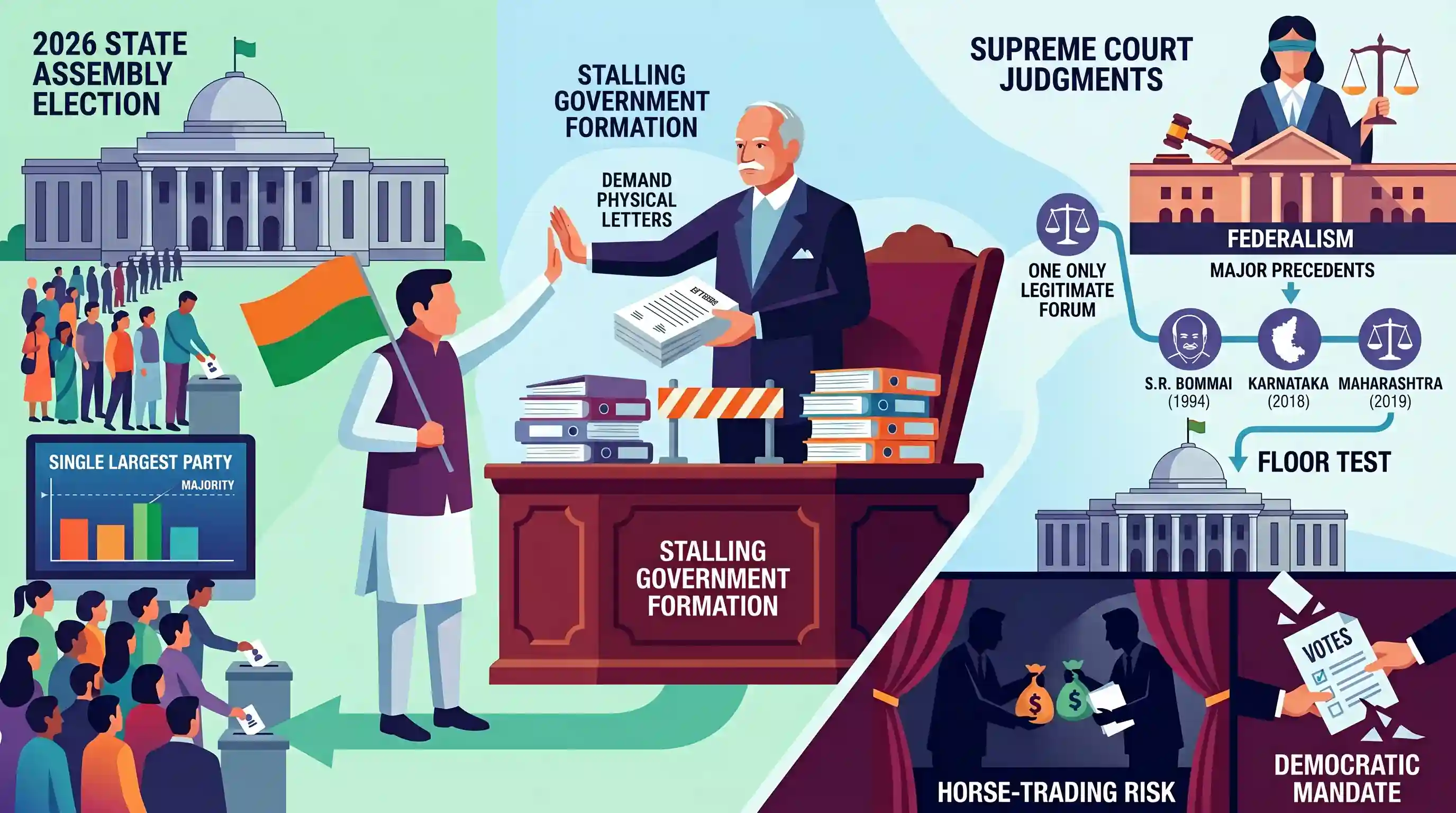
The editorial criticizes Tamil Nadu Governor R.V. Arlekar's decision to stall government formation after the 2026 assembly elections, where the TVK party emerged as the single-largest party but fell slightly short of a clear majority. By demanding physical letters of support rather than mandating an immediate floor test, the Governor's actions violate established Supreme Court precedents originating from the landmark S.R. Bommai case (1994). The Supreme Court has consistently held across multiple instances (such as Karnataka in 2018 and Maharashtra in 2019) that the only legitimate forum for proving a majority is the floor of the legislature. The article argues that such arbitrary delays by the Governor's office risk encouraging horse-trading and undermine the democratic mandate of the electorate.
Key Points
- Following the 2026 Tamil Nadu Assembly elections, TVK emerged as the single-largest party but slightly short of a majority, prompting Governor R.V. Arlekar to delay the government formation invite.
- The Governor demanded physical letters of support with signatures from MLAs, rather than following the norm of calling for a floor test.
- The Supreme Court, established most notably in the S.R. Bommai case, has repeatedly ruled that a majority must be tested on the floor of the legislative assembly, not in the Governor's office.
- Demanding signatures behind closed doors can inadvertently encourage horse-trading and opaque political bargaining, contravening democratic transparency.
- The editorial argues that the Governor's partisan delay oversteps constitutional bounds and undermines the clear, though slightly ambiguous, popular mandate.
Important Terms
S.R. Bommai vs Union of India (1994)

Landmark 1994 Supreme Court judgment ruling that a government's majority must be proved only on the floor of the House, preventing arbitrary dismissals of state governments.
UPSC context
GS II: Federalism/Governance. Essential for understanding judicial checks on the Governor's power and the limits of Article 356.
Article 163
Constitutional provision mandating a Council of Ministers to aid and advise the Governor, except in specific matters where the Governor exercises constitutional or situational discretion.
UPSC context
GS II: State Executive. Tests knowledge of the constitutional limits on the Governor’s discretion and the parliamentary nature of state governments.
Article 164
Stipulates that the Chief Minister is appointed by the Governor and that the Council of Ministers is collectively responsible to the state’s Legislative Assembly.
UPSC context
GS II: State Executive. Crucial for understanding the appointment process of the CM and the principle of collective responsibility.
Floor Test
A constitutional mechanism used to determine if the Chief Minister or government commands the confidence of the Legislative Assembly through a formal vote in the House.
UPSC context
GS II: State Legislature. A core mechanism for ensuring executive accountability and upholding the democratic mandate in a hung assembly.
Situational Discretion
Powers used by the Governor independently of the Council of Ministers, such as selecting a Chief Minister during a hung assembly or recommending President’s Rule.
UPSC context
GS II: Governor's Office. Relevant for analyzing tensions between appointed heads and elected governments during fractured mandates.
Tamilaga Vettri Kazhagam (TVK)
A regional political party in Tamil Nadu founded by actor Vijay in 2024, advocating for social justice, secularism, and egalitarianism within the state's political landscape.
UPSC context
GS II: Political Parties. Illustrates the role of regional parties and actor-led movements in state politics and government formation.
Prelims Trap
The Constitution explicitly outlines the sequential order the Governor must follow to invite parties in a hung assembly.
The Constitution is silent on this order. The sequence (pre-poll alliance, single-largest party, etc.) is a convention recommended by the Sarkaria Commission.
Static Concepts Connected
What is the Governor's 'situational discretion' under the Constitution?
- CM Appointment:: Inviting a leader to form the government when no party has a clear majority (Hung Assembly).
- Dismissal of CoM:: Dismissing the Council of Ministers if it cannot prove majority on the floor of the House.
- Assembly Dissolution:: Dissolving the legislative assembly if a Chief Minister who has lost the trust vote advises it.
What are the key directives from S.R. Bommai (1994) on majority tests?
- Floor Test Supremacy:: The majority of a government must be tested on the floor of the House, not by the Governor's subjective assessment in Raj Bhavan.
- Judicial Review:: The Governor's decision-making process regarding government formation and dismissal is not immune and is open to judicial review.
Cross-Topic Patterns
Floor Tests + Anti-Defection (10th Schedule)
Delays in convening a floor test often trigger Tenth Schedule maneuvers, where factions attempt to disqualify rival MLAs to artificially lower the house's majority mark before the trust vote.
Gubernatorial Discretion + Centre-State Commissions
Questions on the Governor frequently merge explicit constitutional articles with the uncodified conventions recommended by the Sarkaria and Punchhi commissions regarding government formation.

Expect a multi-statement Prelims question mixing constitutional text on the Governor's discretion (Art 163/164) with Sarkaria conventions.
Linked PYQs · 2
Linked PYQs · 2
- 2014PrelimsGS1
Which of the following are the discretionary powers given to the Governor of a State? 1. Sending a report to the President of India for imposing the President's rule 2. Appointing the Ministers 3. Reserving certain bills passed by the State Legislature for consideration of the President of India 4. Making the rules to conduct the business of the State Government Select the correct answer using the code given below.
- 2025PrelimsGS1
Consider the following statements : I. The Constitution of India explicitly mentions that in certain spheres the Governor of a State acts in his/her own discretion. II. The President of India can, of his/her own, reserve a bill passed by a State Legislature for his/her consideration without it being forwarded by the Governor of the State concerned. Which of the statements given above is/are correct?
