Climate Change Induced Threats to Loggerhead Turtles
Source:The Hindu ↗
Why It Matters
Provides a highly specific, scientific example of how interconnected climate variables (sea level rise, ambient warming, extreme weather) compound to threaten marine species, making it an excellent case study for Mains answers on biodiversity loss and climate change impacts.
Summary
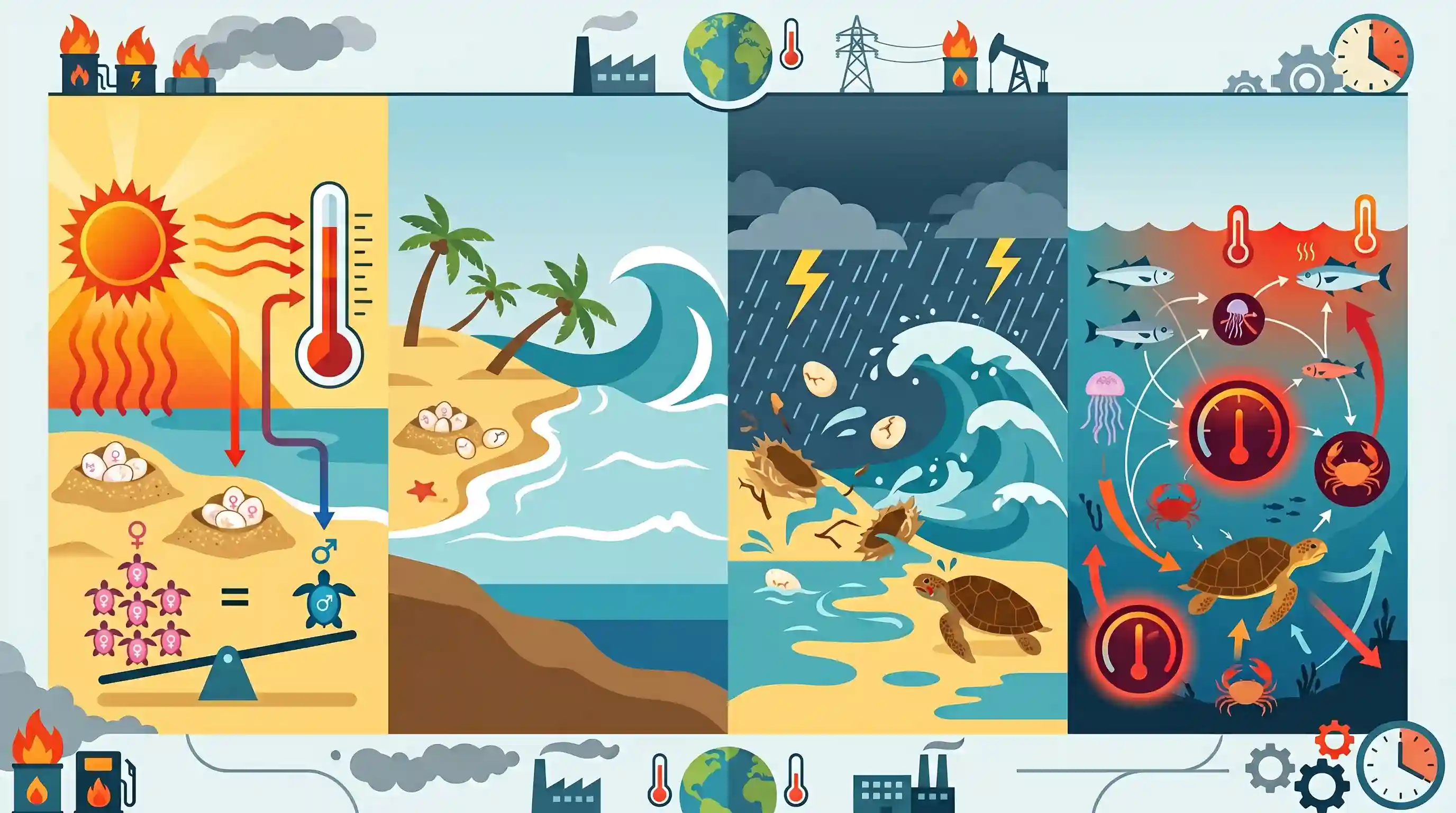
Climate change severely imperils loggerhead turtles through a four-pronged threat. First, rising global temperatures skew the species' sex ratio toward females due to temperature-dependent sex determination. Second, sea-level rise inundates and erodes their critical nesting beaches. Third, an increase in extreme weather events and storm surges physically destroys turtle nests. Finally, overall ocean warming alters marine ecosystems, negatively impacting the turtles' food webs and migratory patterns. These multifaceted disruptions underline the acute vulnerability of marine biodiversity to anthropogenic climate shifts.
Key Points
- Loggerhead turtles face a unique 'four-pronged threat' resulting directly from human-induced climate change, jeopardizing their survival and population dynamics.
- Temperature-dependent sex determination (TSD) in turtles means that warming sand temperatures incubate a disproportionate number of females, leading to skewed sex ratios and reproductive bottlenecks.
- Accelerated sea-level rise causes coastal erosion and inundation, destroying critical low-lying nesting beaches essential for turtle reproduction.
- Extreme weather events, such as intense cyclones and storm surges, physically wash away or drown turtle nests along the coasts.
- Ocean warming and acidification alter marine food webs, shifting the distribution of prey and disrupting the traditional migratory and foraging routes of loggerhead turtles.
Important Terms
Loggerhead Turtle

A migratory marine turtle species (Caretta caretta) known for its large head and powerful jaws. Globally categorized as "Vulnerable" by the IUCN, though certain subpopulations are "Critically Endangered."
UPSC context
GS-3 (Biodiversity). Tests knowledge of species status, nesting habitats, and vulnerability to environmental changes in Prelims.
Temperature-Dependent Sex Determination (TSD)
A biological mechanism where the sex of offspring is determined by environmental temperatures during incubation. In sea turtles, warmer sand typically produces females, while cooler sand produces males.
UPSC context
GS-3 (Science/Environment). Relevant for understanding biological responses to global warming and sex-ratio imbalances in wildlife.
IUCN Red List
The world's most comprehensive inventory of the global conservation status of species. Managed by the IUCN, it provides data to guide conservation policy and funding priorities.
UPSC context
GS-3 (Environment). A critical tool for Prelims questions on conservation categories and international protection frameworks for biodiversity.
Intergovernmental Panel on Climate Change (IPCC)
The UN body responsible for assessing the science of climate change. Its Assessment Reports (AR) provide the global consensus on climate impacts, adaptation, and mitigation strategies.
UPSC context
GS-3 (Environment/Mains). Key for quoting scientific consensus in essays and answers on global warming and marine ecosystems.
Anthropogenic Climate Change
Significant shifts in Earth's climate driven by human actions, particularly fossil fuel combustion, deforestation, and industrial processes that increase greenhouse gas concentrations in the atmosphere.
UPSC context
GS-3 (Environment). Fundamental concept for analyzing human impact on biodiversity, sea-level rise, and sustainable development.
Prelims Trap
"All five marine turtle species found in Indian waters have nesting sites on the Indian coast."
While Loggerheads are found in Indian waters, they are the only one of the five marine turtle species that do not have recorded nesting sites on Indian shores.
Static Concepts Connected
What is Temperature-Dependent Sex Determination (TSD) in reptiles?
- Mechanism: The incubation temperature of the egg dictates the biological sex of the hatchling, entirely bypassing genetic sex determination.
- Climate Vulnerability: Rising global sand temperatures lead to highly skewed sex ratios, often resulting in all-female clutches and causing a reproductive bottleneck.
- Species Affected: This phenomenon is primarily observed in marine turtles, crocodilians, tuataras, and some species of lizards.
Which marine turtles are found in Indian waters and what is their protection status?
- Five Species: Olive Ridley, Green, Hawksbill, Leatherback, and Loggerhead turtles are found in Indian waters.
- WPA 1972 Status: All five species are listed under Schedule I of the Wildlife (Protection) Act, 1972, granting them absolute protection.
- Nesting Exception: Loggerhead is the only species out of the five that does not have recorded nesting sites on the Indian mainland or island territories.
Cross-Topic Patterns
Geomagnetism, Migrations, and Magnetoreception
Loggerheads use Earth's geomagnetic field for oceanic navigation. UPSC often links animal navigation (magnetoreception) to static geography topics like geomagnetism, magnetic pole shifts, and the biological impacts of solar storms.
Coastal Erosion vs. Marine Biodiversity
The inundation of nesting beaches directly connects marine species conservation to CRZ (Coastal Regulation Zone) norms and IPCC projections on sea-level rise and extreme cyclone frequency in the Indian Ocean.

Expect a multi-statement prelims question combining Loggerhead nesting exceptions in India, magnetoreception, and TSD vulnerabilities.
Linked PYQs · 4
Linked PYQs · 4
- 2002PrelimsGS1
The sea coast of which one of the following states has become famous as a nesting place for the giant Olive Ridley turtles from South America?
- 2017PrelimsGS1
In India, if a species of tortoise is declared protected under Schedule I of the Wildlife (Protection) Act, 1972, what does it imply?
- 2023MainsGS3
The Intergovernmental Panel on Climate Change (IPCC) has predicted a global sea level rise of about one metre by AD 2100. What would be its impact in India and the other countries in the Indian Ocean region?
- 2022MainsGS3
Discuss global warming and mention its effects on the global climate. Explain the control measures to bring down the level of greenhouse gases which cause global warming, in the light of the Kyoto Protocol, 1997.
