India and China Agree on Additional Border Personnel Meeting Points
Source:The Hindu ↗
Why It Matters
This article illustrates the practical application of Confidence Building Measures (CBMs) along the LAC and highlights the strategic and logistical challenges of policing the India-China border. It sheds light on how localized tactical disagreements, geographical passes, and coordination between border guarding forces (ITBP) and the military (Indian Army) shape national security policy.
Summary
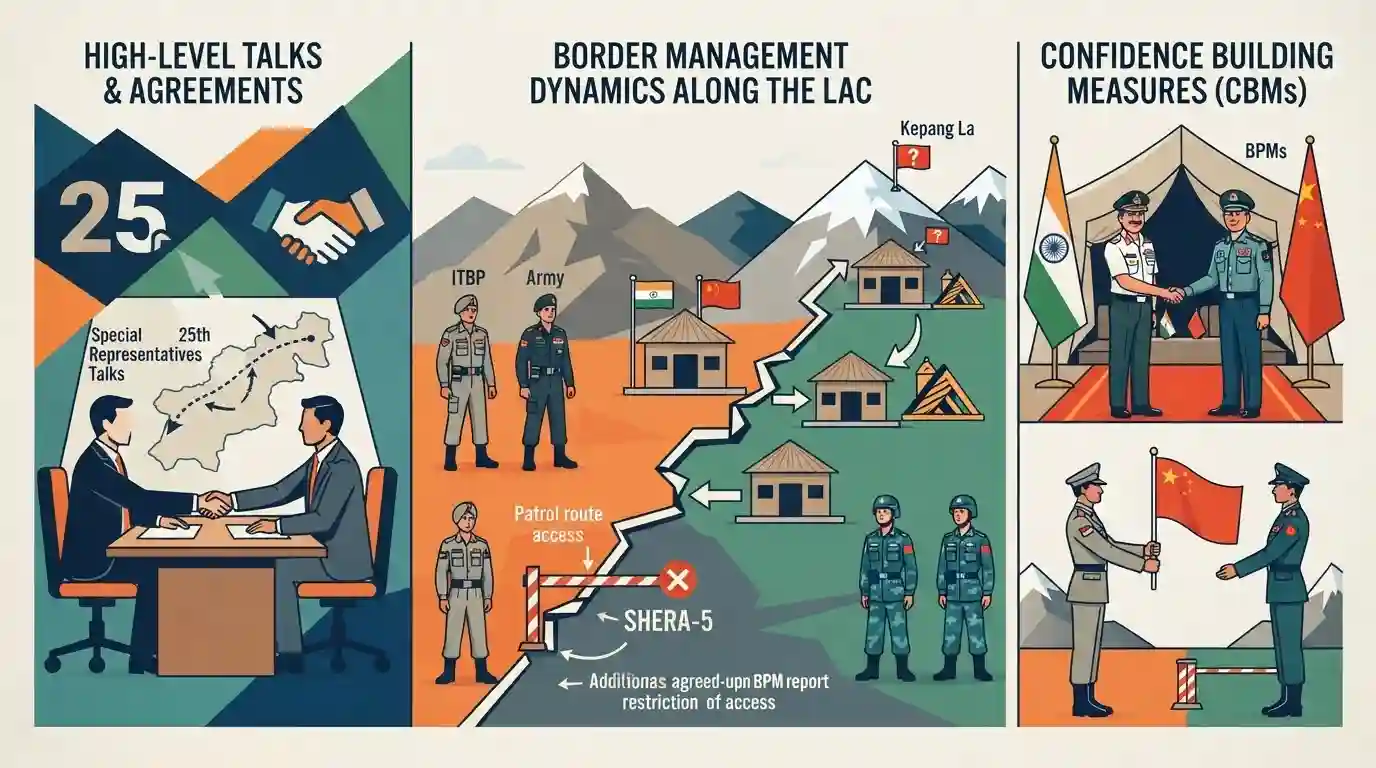
Following the 25th round of Special Representatives (SR) talks, India and China have agreed in principle to establish two additional Border Personnel Meeting (BPM) points along the Line of Actual Control (LAC) to bolster ground-level communications, although their exact locations remain unannounced. While Kepang La in Arunachal Pradesh has emerged as a likely candidate, local regional reports highlight ongoing tactical challenges and Chinese incursions, particularly the restriction of access to the Shera-5 patrolling point. The development underscores the complex dynamics of border management, handled primarily by the ITBP and Indian Army, and the vital role of BPMs as Confidence Building Measures (CBMs).
Key Points
- Following the 25th round of talks between India's National Security Adviser Ajit Doval and China's Foreign Minister Wang Yi, the two nations agreed to establish two additional Border Personnel Meeting (BPM) points along the LAC, though their exact locations are yet to be announced.
- Currently, five active BPM points facilitate ground-level flag meetings to resolve local frictions: Chushul and Daulat Beg Oldie (Ladakh), Nathu La (Sikkim), and Bum La and Kibithu (Arunachal Pradesh).
- Kepang La in Arunachal Pradesh's Upper Siang district is a strong contender for a new BPM point; it is a site of local Buddhist religious significance and was historically used by Chinese troops during the 1962 war. At least two informal local commander meetings have occurred there recently.
- A fact-finding report by the People's Party of Arunachal (PPA) flagged persistent Chinese incursions in the Taksing area of Upper Subansiri district, noting that Indian patrol teams have faced gaps in accessing Shera-5 Point since a face-off in 2023.
- While the Indo-Tibetan Border Police (ITBP) is the primary force tasked with guarding the India-China border, operational and security decisions in the disputed sectors are tightly coordinated with and often determined by the Indian Army.
Important Terms
Special Representatives (SR) talks on the Boundary Question

A high-level bilateral diplomatic mechanism established in 2003 between India and China to explore a political framework for resolving their boundary dispute and managing border-related crises.
UPSC context
GS Paper II: Bilateral relations and institutional diplomatic frameworks for boundary dispute resolution.
Indo-Tibetan Border Police (ITBP)
A Central Armed Police Force (CAPF) of India raised in 1962, primarily responsible for guarding the 3,488 km India-China border (Line of Actual Control) in high-altitude Himalayan terrains.
UPSC context
GS Paper III: Border management, security forces, and internal security challenges on the northern frontier.
Border Personnel Meetings (BPMs)
Designated contact locations along the Line of Actual Control (LAC) where Indian and Chinese militaries hold ceremonial and practical meetings to resolve local border disputes and build mutual confidence.
UPSC context
GS Paper III: Defense cooperation, local conflict resolution mechanisms, and confidence-building measures.
Line of Actual Control (LAC)
The notional demarcation line separating Indian-controlled territory from Chinese-controlled territory, divided into Western, Middle, and Eastern sectors, which remains mutually undemarcated and disputed.
UPSC context
GS Paper II & III: International relations, sovereignty, and tactical challenges in border dispute management.
Arunachal Scouts
A specialized mountain infantry regiment of the Indian Army trained in high-altitude warfare, recruited primarily from the local populace of Arunachal Pradesh to guard the strategic eastern LAC.
UPSC context
GS Paper III: Special forces, local recruitment strategies, and mountain warfare capabilities along the LAC.
Prelims Trap
The Indo-Tibetan Border Police (ITBP) operates under the Ministry of Defence during peacetime along the Line of Actual Control.
ITBP is a Central Armed Police Force (CAPF) and always functions under the Ministry of Home Affairs (MHA), despite close operational coordination with the Army on the LAC.
Static Concepts Connected
What is the "One Border, One Force" principle for India's borders?
- Origin and Purpose: Recommended by the Group of Ministers in 2001 (post-Kargil Review Committee) to resolve jurisdictional overlap and dual-control conflicts among border forces.
- ITBP Mandate: ITBP was designated the sole guarding force for the entire 3,488-km Indo-China border, replacing the Assam Rifles in Sikkim and Arunachal Pradesh.
- Administrative Control: As a Central Armed Police Force (CAPF), ITBP functions under the administrative control of the Ministry of Home Affairs (MHA).
What are the primary bilateral mechanisms for managing the India-China boundary dispute?
- Special Representatives (SR): Established in 2003, this high-level political channel led by National Security Advisers seeks a strategic framework for a boundary settlement.
- WMCC Mechanism: The Working Mechanism for Consultation and Coordination (established 2012) maintains communication and handles real-time border tension resolution.
- Key Accords: The 1993 and 1996 agreements laid the bedrock for maintaining peace and implementing military Confidence Building Measures (CBMs) along the LAC.
Cross-Topic Patterns
Water Security + Territorial Disputes
Kepang La's proximity to the Brahmaputra entry point links tactical border management directly to India's transboundary water security challenges and upstream dam controversies with China.
Border Tourism + National Security
Initiatives like 'Rann Bhoomi Darshan' leverage civil tourism at strategic passes to assert territorial sovereignty and support border-area development.

Mapping of LAC passes (Kepang La, Bum La) paired with the 'One Border, One Force' mandate of ITBP is a high-probability MCQ target.
Linked PYQs · 2
Linked PYQs · 2
- 2024MainsGS3
India has a long and troubled border with China and Pakistan fraught with contentious issues. Examine the conflicting issues and security challenges along the border. Also give out the development being undertaken in these areas under the Border Area Development Programme (BADP) and Border Infrastructure and Management (BIM) Scheme.
- 2020MainsGS3
Analyze internal security threats and transborder crimes along Myanmar, Bangladesh and Pakistan borders including Line of Control (LoC). Also discuss the role played by various security forces in this regard.
