AP local body polls face race for funds and compliance
Source:The Hindu ↗
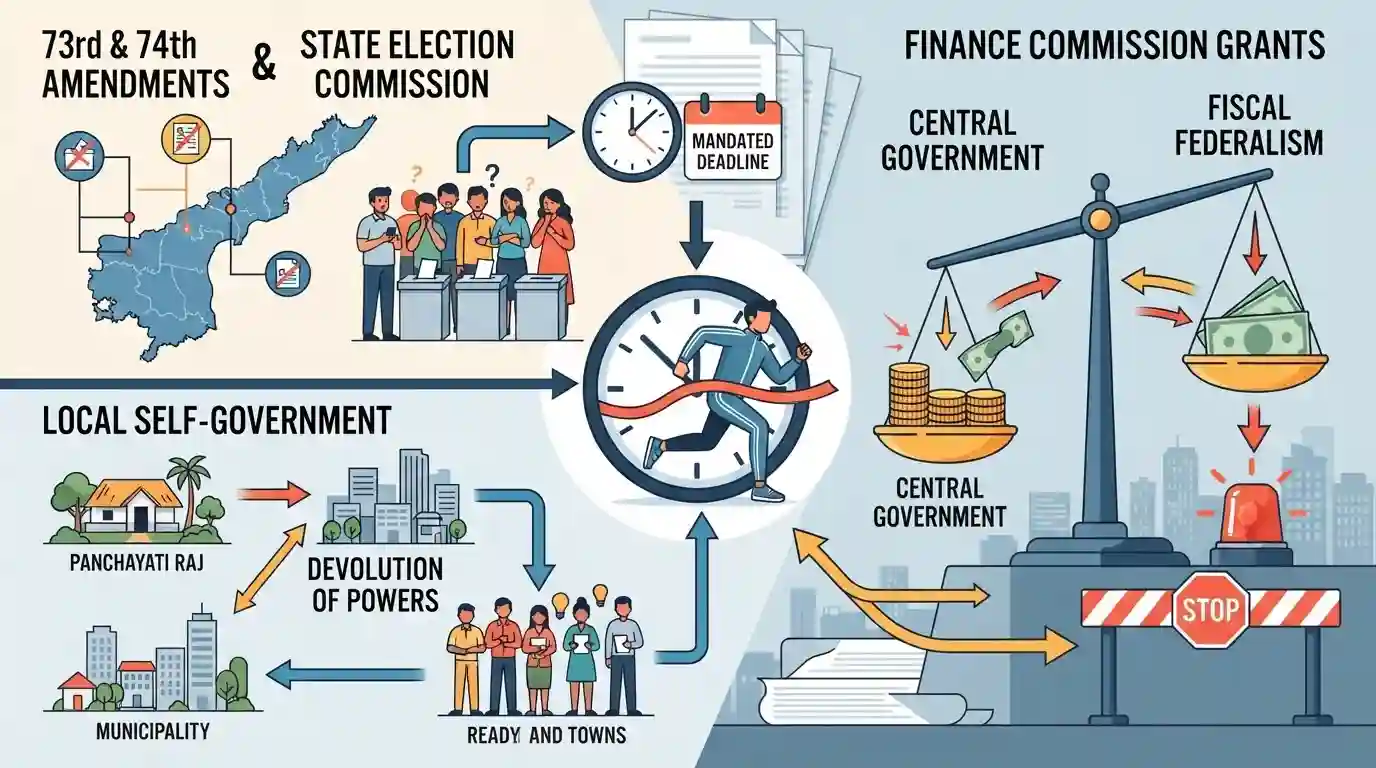
Why It Matters
Highlights the constitutional obligations states have regarding local body elections and the direct financial consequences (loss of Finance Commission grants) of failing to facilitate democratic decentralization.
Summary
Andhra Pradesh is in a critical race against time to conduct its local body polls to secure vital central funds and comply with constitutional mandates. The 73rd and 74th Amendments mandate regular elections for Panchayati Raj Institutions and Urban Local Bodies. Delaying these elections risks forfeiting substantial grants from the Finance Commission, which are contingent upon having elected grassroots representatives in place, thus highlighting the intersection of democratic decentralization and fiscal federalism.
Key Points
- The State of Andhra Pradesh faces an urgent need to conduct local body elections to ensure compliance with the 73rd and 74th Constitutional Amendments.
- Failure to hold timely elections jeopardizes the release of significant developmental grants recommended by the Central Finance Commission, which strictly conditions fund devolution on the existence of elected local bodies.
- The State Election Commission is constitutionally mandated under Articles 243K and 243ZA to conduct regular elections to Panchayats and Municipalities every five years.
- The delay underscores the broader tension between state administrative readiness and the constitutional imperatives of grassroots democratic decentralization and fiscal federalism.
Important Terms
73rd Constitutional Amendment Act

The 1992 Act that granted constitutional status to Panchayati Raj Institutions, adding Part IX and the 11th Schedule. It mandates regular elections, seat reservations, and grassroots democratic decentralization in rural areas.
UPSC context
Crucial for APPSC Paper-II (Polity) regarding rural local governance, devolution of powers, and democratic decentralization.
74th Constitutional Amendment Act
The 1992 Act providing constitutional recognition to Urban Local Bodies. It added Part IX-A and the 12th Schedule, mandating regular municipal elections, urban planning committees, and the devolution of funds.
UPSC context
Vital for APPSC Paper-II (Polity) questions on urban self-governance, municipal administration, and local fiscal autonomy.
State Election Commission
A constitutional authority formed under Articles 243K and 243ZA, responsible for the superintendence, direction, and control of electoral rolls and the conduct of elections to rural and urban local bodies.
UPSC context
Tested in APPSC Polity regarding constitutional bodies, their autonomy, and their role in ensuring democratic grassroots representation.
Finance Commission of India
A constitutional body under Article 280 that defines center-state financial relations. It recommends how Union tax revenues are shared and suggests grants-in-aid to augment state funds for local bodies.
UPSC context
Essential for APPSC Paper-III (Economy) topics on fiscal federalism, center-state financial relations, and local body funding.
Panchayati Raj Institutions
A three-tier system of rural local self-government in India—comprising village, intermediate, and district levels—empowered to prepare and implement plans for economic development and social justice.
UPSC context
Core APPSC topic for rural development, participatory planning, and grassroots democratic empowerment in Andhra Pradesh.
Urban Local Bodies
Democratically elected governance institutions for urban areas, including Nagar Panchayats, Municipal Councils, and Municipal Corporations. They are responsible for urban planning, civic amenities, and local administration.
UPSC context
Relevant for APPSC questions on urban governance, municipal finance, and addressing urbanization challenges.
Prelims Trap
Delaying local body polls allows the Union to withhold the state's entire share of devolved central taxes.
The Finance Commission only withholds the specific grants-in-aid earmarked for local bodies, not the state's overall constitutional tax devolution from the divisible pool.
Static Concepts Connected
What are the key Constitutional bodies for Local Self-Government?
- State Election Commission: Mandated by Art 243K (Panchayats) & 243ZA (Municipalities). Appointed by Governor, but removed only in the manner of a High Court judge.
- State Finance Commission: Mandated by Art 243I (Panchayats) & 243Y (Municipalities). Constituted by Governor every 5 years to recommend tax distribution and grants-in-aid.
What are the constitutional timelines for local body elections?
- Fixed Five-Year Term: Established by Article 243E, every Panchayat/Municipality has a fixed five-year term from its first meeting.
- Six-Month Rule: Elections must be held before the 5-year term expires, or within 6 months if dissolved prematurely.
- Remainder Term: A local body reconstituted after premature dissolution operates only for the remainder of the original term.
Cross-Topic Patterns
Fiscal federalism vs State fiscal health
Delaying polls cuts off CFC local grants, severely straining state budgets. States are then forced to rely on borrowings or general revenue to sustain rural infrastructure, increasing fiscal deficit pressures.
SEC independence and State government friction
Friction over poll scheduling and SEC resource allocation often highlights the vulnerability of the SEC's functional autonomy, a recurring theme in constitutional law and governance questions.

Expect a multi-statement question linking Article 243K (SEC), Article 243I (SFC), and Finance Commission conditions for local grants.
Linked PYQs · 3
Linked PYQs · 3
- 2024APPSC_PRELIMSGS1
Which of the following source/sources of revenue qualifies/qualify for being given to the Panchayats? I. The tax proceeds that are assigned to the States from the Centre may be again re-distributed to the Panchayats as recommended by the Central Finance Commission. II. Loans from the State Government. III. Under Article 243-I of the Constitution of India, the State Government is empowered to devolve its own funds to the Panchayats even in the absence of the State Finance Commission's recommendations. IV. Internal Resource Generation is facilitated only in the case of Panchayats situated in Scheduled Areas as per the Fifth Schedule. Select the correct answer using the codes given below:
- 2023APPSC_PRELIMSGS1
Which of the following statements is correct with respect to the State Finance Commission ? I. It is required to appoint a State Finance Commission once in five years. II. It recommends the determination of taxes, duties, tolls and fees assigned to the Panchayats and Municipalities. III. Article 243 deals with constitution of finance commission to review financial position of Panchayats. Choose the correct answer using the codes given below :
- 2023APPSC_PRELIMSGS1
Which of the bodies recommends the distribution of the net proceeds of taxes to be shared between the Centre and the States, and allocation between the States, the respective shares of such proceeds?
