Kerala local bodies urged to integrate ecological conservation
Source:The Hindu ↗
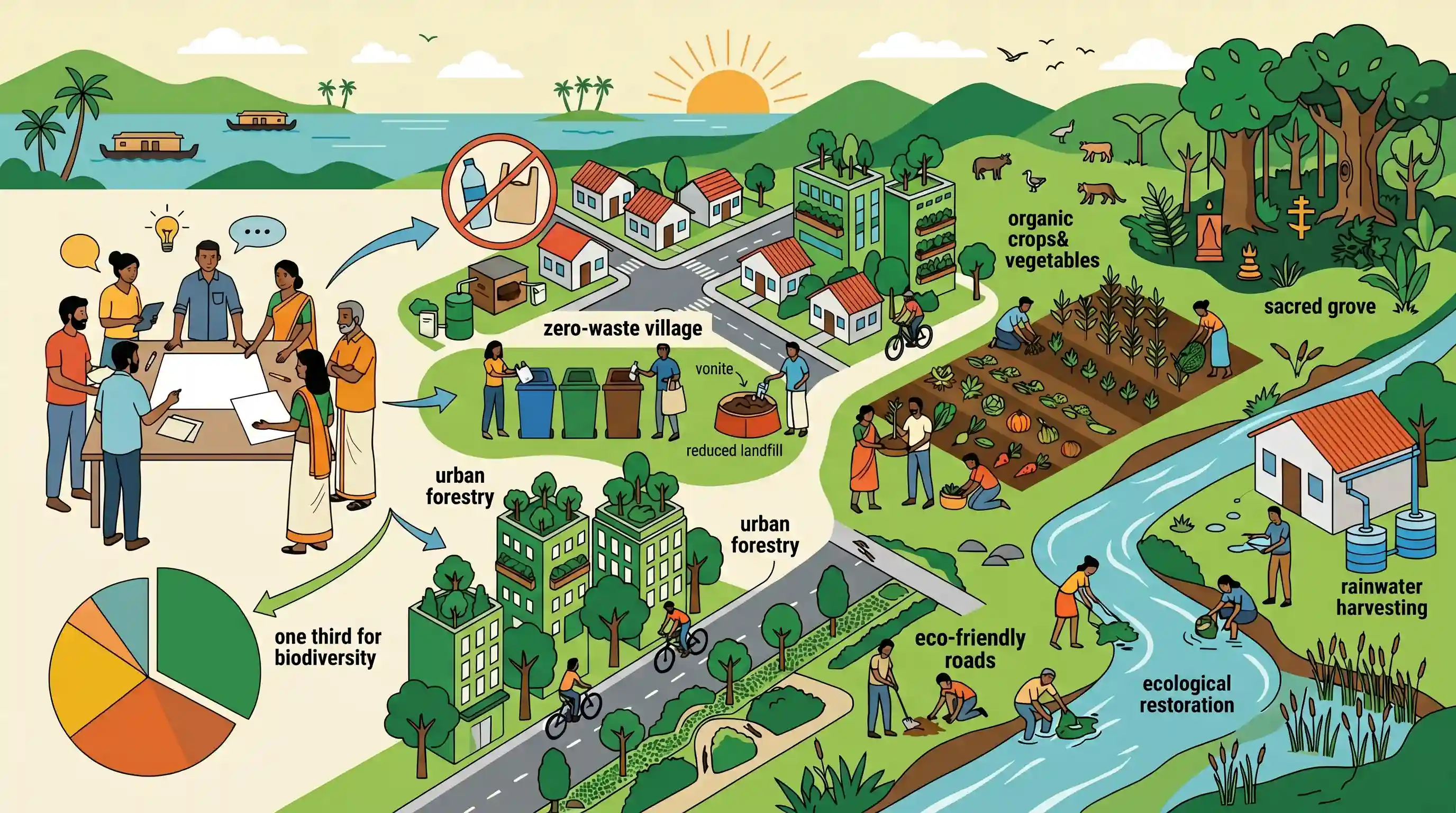
Why It Matters
Demonstrates the practical intersection of local governance (73rd and 74th Amendments) with grassroots environmental conservation. It provides actionable examples for Mains answers on sustainable development, solid waste management, and community-led biodiversity conservation.
Summary
The National Green Corps (NGC) has urged local self-government institutions in Kerala to embed environmental conservation into their grassroots planning. The initiative advocates for reserving one-third of available land for biodiversity, developing eco-friendly road infrastructure, and creating 'zero-waste' villages through decentralized waste management and plastic reduction. Additionally, it promotes urban forestry, sacred groves, and organic farming while suggesting the integration of ecological restoration projects—like wastewater treatment and rainwater harvesting—with employment guarantee programmes. This underscores the critical role of decentralized governance in achieving sustainable development.
Key Points
- Local self-government institutions (LSGIs) in Kerala are urged to integrate environmental sustainability into local planning and project execution.
- Proposals include setting aside one-third of project land as 'green zones' for biodiversity conservation and habitat protection.
- Emphasis on eco-friendly infrastructure, such as planting shade trees along roads and minimizing construction material usage through proper soil testing.
- Advocacy for 'zero-waste' villages by banning single-use plastics, promoting cloth bags, and establishing decentralized waste management like biogas and compost units.
- Promotion of urban forestry, sacred groves, medicinal gardens, and integrating environmental protection works (rainwater harvesting, wastewater treatment) with employment guarantee schemes.
Important Terms
National Green Corps (NGC)

A nationwide initiative by the Ministry of Environment, Forest and Climate Change (MoEF&CC) to impart environmental knowledge to school children through action-oriented "Eco-clubs."
UPSC context
Relevant for GS Paper 3 (Environment); tests knowledge of government initiatives for environmental education and community-led conservation.
Local Self-Government Institutions (LSGIs)
Elected bodies at the village, block, and district levels (Panchayats) and urban areas (Municipalities) that provide grassroots governance and implement developmental schemes.
UPSC context
Core topic for GS Paper 2 (Polity); tests the 73rd and 74th Amendments and the devolution of power.
Decentralized Planning
The process of formulating development plans at the grassroots level (district/village) with active public participation, rather than through a centralized top-down approach.
UPSC context
Important for GS Paper 2 (Governance) and Paper 3 (Economy); emphasizes local resource mobilization and participatory democracy.
Employment Guarantee Programmes
Social security schemes, like MGNREGA, that provide a legal right to manual work to enhance livelihood security, often integrated with building durable rural assets.
UPSC context
Crucial for GS Paper 2 (Social Justice) and Paper 3 (Economy); focuses on poverty alleviation and rural asset creation.
Urban Forestry
The management of trees and green resources in urban areas to provide ecological benefits like air purification, cooling, and biodiversity support.
UPSC context
Emerging theme in GS Paper 3 (Environment/Disaster Management); addresses urban heat islands and Sustainable Development Goal 11.
Sustainable Development
Development that meets present needs without compromising the ability of future generations to meet theirs, balancing economic growth, social equity, and environmental protection.
UPSC context
Foundational concept for GS Paper 3 (Environment/Economy); central to debates on balancing industrial growth with ecological conservation.
Prelims Trap
"The National Green Corps is a statutory body established under the Environment (Protection) Act, 1986."
The NGC is not a statutory body. It is a Central Sector scheme under the MoEFCC that establishes 'Eco-clubs' in schools. Aspirants often confuse it with the National Green Tribunal.
Static Concepts Connected
Which Constitutional entries empower local bodies for environmental management?
- 11th Schedule: Empowers Panchayats with control over ecologically critical subjects like social forestry, minor forest produce, soil conservation, and watershed development.
- 12th Schedule: Explicitly mandates Urban Local Bodies to handle public health, sanitation conservancy, and solid waste management.
What is the ecological and legal status of sacred groves in India?
- In-situ conservation: They are traditional, community-protected biodiversity repositories representing ancient practices of nature worship (e.g., Kavus in Kerala, Orans in Rajasthan).
- Community Reserves: Under the Wildlife (Protection) Amendment Act 2002, these community-conserved areas can be legally designated and protected as Community Reserves.
Cross-Topic Patterns
MGNREGA's shift to climate resilience
Integrating ecological restoration with MGNREGA bridges rural employment and climate adaptation, utilizing dedicated funds for Natural Resource Management (NRM) to build resilient infrastructure.
Decentralized EPR and solid waste execution
While Extended Producer Responsibility (EPR) targets macro-level plastic producers, local bodies bear the constitutional mandate and financial burden for the actual collection and solid waste management.

Expect a 2026 multi-statement question linking MGNREGA’s Natural Resource Management mandate to the 11th/12th Schedule subjects.
Linked PYQs · 3
Linked PYQs · 3
- 2018MainsGS3
What are the impediments in disposing the huge quantities of discarded solid wastes which are continuously being generated? How do we remove safely the toxic wastes that have been accumulating in our habitable environment?
- 2015MainsGS2
In absence of a well-educated and organized local level government system, 'Panchayats' and 'Samitis' have remained mainly political institutions and not effective instruments of governance. Critically discuss.
- 2024MainsGS3
What role do environmental NGOs and activists play in influencing Environmental Impact Assessment (EIA) outcomes for major projects in India? Cite four examples with all important details.
