Lithium-Ion Battery Recycling Potential in India by 2030
Source:The Hindu ↗
Why It Matters
Battery recycling and critical mineral supply chain resilience sit at the intersection of GS3's focus on Environment (e-waste), Science & Technology (EVs and battery tech), and Economy (circular economy). The topic is increasingly important due to India's push for EV adoption and the geopolitical need to secure critical minerals for national economic security.
Summary
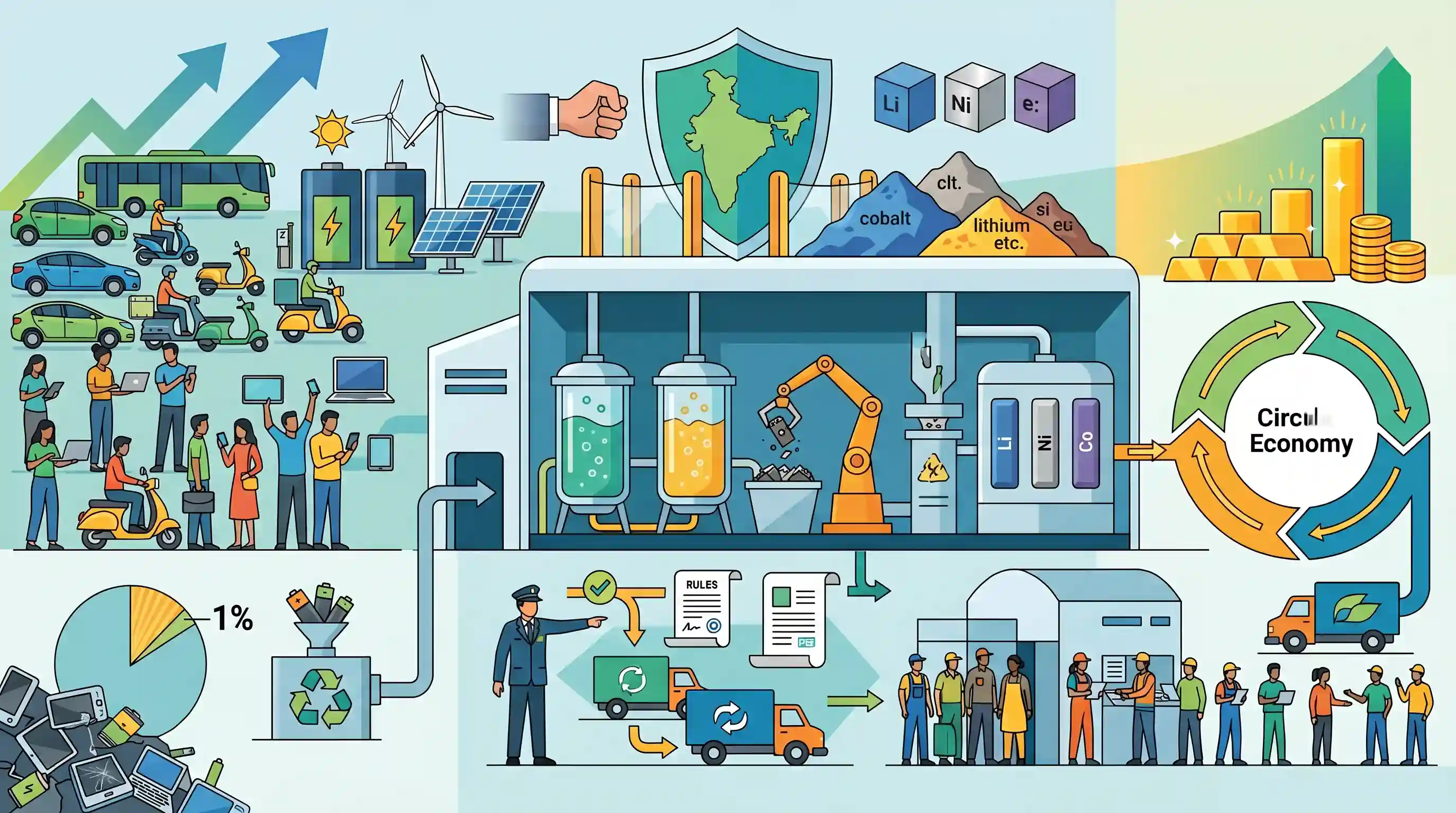
A joint report by the India Cellular and Electronics Association (ICEA) and Accenture estimates that India's lithium-ion battery recycling market could become a $3.5 billion industry by 2030, though currently, only 1% of end-of-life batteries are recycled into usable materials. Expanding the circular economy through recycling is critical for addressing the soaring demand for electric vehicles (EVs), consumer electronics, and energy storage, while reducing ecological footprints. Furthermore, scaling domestic battery recycling serves a strategic geopolitical purpose by securing critical supply chains against trade restrictions on rare earth elements by dominant exporters like China. Establishing robust hydrometallurgical capabilities, integrating the informal sector, and enforcing Extended Producer Responsibility (EPR) under the Battery Waste Management Rules 2022 are essential to realize this economic and environmental potential.
Key Points
- A joint report by ICEA and Accenture estimates India's lithium-ion battery recycling market could reach $3.5 billion by 2030, though currently only 1% of end-of-life batteries are formally recycled into usable materials.
- Fostering a circular economy for batteries is critical to meet the exponential demand growth from electric vehicles (EVs), consumer electronics, and renewable energy storage.
- Recycling critical minerals like lithium, cobalt, and nickel helps secure domestic supply chains and reduces import dependence, particularly amidst geopolitical constraints like China's export restrictions on rare earth elements.
- The sector's growth requires formalizing the current informal e-waste recycling operations, building domestic hydrometallurgical capacities, and creating robust reverse logistics.
- Effective implementation of the Battery Waste Management Rules 2022, centering on the Extended Producer Responsibility (EPR) framework, is essential for a structured transition.
Important Terms
Battery Waste Management Rules, 2022

Environmental regulations mandated by MoEFCC to ensure sustainable handling of all battery types (EV, portable, industrial) through mandatory recycling and material recovery targets of 70-90%.
UPSC context
GS Paper 3 (Environment); critical for e-waste governance and achieving resource efficiency in the EV sector.
Extended Producer Responsibility (EPR)
A policy principle holding producers responsible for the entire lifecycle of their products, specifically mandating them to manage post-consumer collection, recycling, and environmentally sound disposal.
UPSC context
GS Paper 3 (Environment); core mechanism for waste management and the 'polluter pays' principle.
Circular Economy
A regenerative economic model that replaces the linear 'take-make-dispose' system with a closed-loop process focusing on resource efficiency, reuse, refurbishment, and high-value recycling.
UPSC context
GS Paper 3 (Economy/Environment); essential for sustainable industrial growth and meeting India's Net Zero commitments.
Critical Minerals
A group of 30 minerals (e.g., Lithium, Cobalt) vital for clean energy, electronics, and defense, characterized by high import dependency and significant supply chain vulnerabilities.
UPSC context
GS Paper 1 (Geography/Resources) and Paper 3 (Energy Security); focuses on strategic autonomy and resource localization.
India Cellular and Electronics Association (ICEA)
The apex industry body representing India's electronics manufacturing sector; it advocates for policies like the PLI scheme and targets $300 billion in electronics production by 2030.
UPSC context
GS Paper 3 (Economy/Industry); represents the private sector's role in the 'Make in India' and electronics ecosystems.
Central Pollution Control Board (CPCB)
The statutory body under MoEFCC responsible for implementing environmental laws and managing the centralized portal for EPR registration, credit issuance, and compliance auditing.
UPSC context
GS Paper 2 (Statutory Bodies) and Paper 3 (Pollution); the primary enforcement agency for waste management rules.
Prelims Trap
Lithium, Cobalt, and Nickel recovered from EV batteries are classified as Rare Earth Elements (REEs).
Lithium, cobalt, and nickel are Critical Minerals, but they are NOT part of the 17 Rare Earth Elements (REEs). UPSC often tests this exact distinction.
Static Concepts Connected
What are the key features of the Battery Waste Management Rules, 2022?
- EPR Applicability: Extended Producer Responsibility (EPR) mandates producers to collect and recycle/refurbish waste batteries. It covers all battery types (EV, portable, industrial).
- Minimum Recovery Targets: Mandates a minimum percentage of recovery of materials from collected batteries, strictly prohibiting disposal in landfills or incineration.
- EPR Certificates: Introduces a centralized online portal for the exchange of EPR certificates between producers and recyclers/refurbishers to ensure transparency.
How do Critical Minerals differ from Rare Earth Elements (REEs)?
- Critical Minerals: A broad classification of minerals essential for modern technology and national security, prone to supply chain disruptions (e.g., Lithium, Cobalt).
- Rare Earths: A specific group of 17 metallic elements on the periodic table (15 lanthanides + scandium + yttrium) crucial for magnets.
- The Intersection: All REEs are considered critical minerals, but not all critical minerals (like Lithium, Nickel) are Rare Earth Elements.
Cross-Topic Patterns
Minerals Security Partnership + Circular Economy
India's induction into the US-led Minerals Security Partnership (MSP) aligns perfectly with this domestic recycling push to build China-independent critical mineral supply chains.
Informal sector formalization in Green Transitions
Integrating informal waste-pickers into formal, highly technical hydrometallurgical processing networks highlights the 'just transition' socio-economic challenge in India's green economy.

Expect a multi-statement Prelims question mixing Battery Waste Rules 2022 EPR targets, Li-ion composition, and critical mineral dependency.
Linked PYQs · 4
Linked PYQs · 4
- 2023MainsGS3
The adoption of electric vehicles is rapidly growing worldwide. How do electric vehicles contribute to reducing carbon emissions and what are the key benefits they offer compared to traditional combustion engine vehicles?
- 2025PrelimsGS1
In the context of electric vehicle batteries, consider the following elements : I. Cobalt II. Graphite III. Lithium IV. Nickel How many of the above usually make up battery cathodes?
- 2024PrelimsGS1
Consider the following: 1. Battery storage 2. Biomass generators 3. Fuel cells 4. Rooftop solar photovoltaic units How many of the above are considered "Distributed Energy Resources"?
- 2025PrelimsGS1
Consider the following types of vehicles : I. Full battery electric vehicles II. Hydrogen fuel cell vehicles III. Fuel cell-electric hybrid vehicles How many of the above are considered as alternative powertrain vehicles?
