Lipulekh Pass border trade amid Nepal boundary disputes
Source:clarityupsc ↗
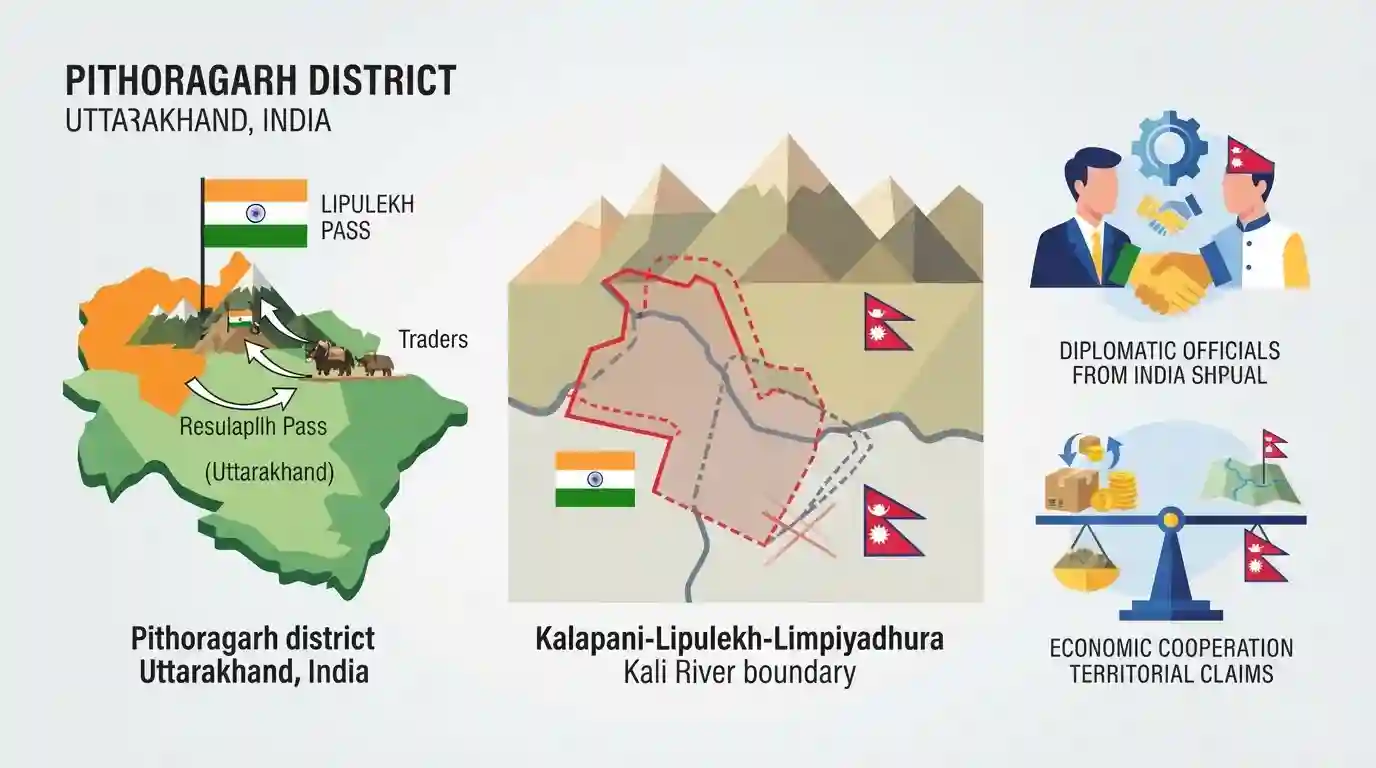
Why It Matters
Lipulekh Pass is a vital geographical and strategic tri-junction involving India, China, and Nepal, making it a critical topic for state and national civil services exams focusing on international borders, territorial claims, and regional geopolitics.
Summary
The article discusses the resumption and context of border trade through the Lipulekh Pass in Uttarakhand's Pithoragarh district against the backdrop of the ongoing territorial and boundary dispute between India and Nepal regarding the Kalapani-Lipulekh-Limpiyadhura region.
Key Points
- Border trade and transit routes through the Lipulekh Pass located in Pithoragarh district, Uttarakhand, have witnessed significant developments amid ongoing boundary disputes with Nepal.
- Lipulekh Pass is a tri-junction area near India, China, and Tibet, serving as an important historical trade route and pilgrimage path to Kailash Mansarovar.
- Nepal has raised objections regarding the territory, claiming Kalapani, Lipulekh, and Limpiyadhura based on historical interpretations of the Treaty of Sugauli (1816).
- India maintains its administrative sovereignty over the area, emphasizing strategic and infrastructural importance while balancing bilateral relations with Nepal.
Important Terms
Treaty of Sugauli

A treaty signed in 1816 between the East India Company and Nepal that established the Kali River as Nepal's western boundary, forming the basis of the modern India-Nepal territorial dispute over the Kalapani-Lipulekh region.
UPSC context
Important for UKPSC International Relations and Uttarakhand Geography/History, testing the historical origins of border disputes with neighboring countries.
Government of India
The federal executive authority of India, responsible for national administration, foreign policy, and border infrastructure management, including projects in Uttarakhand's strategic Pithoragarh border region.
UPSC context
Relevant for Indian Polity and Governance as well as bilateral diplomacy in UKPSC exams.
Government of Nepal
The governing body of Nepal, which manages national administration and has raised diplomatic and constitutional objections regarding India's activities and border trade through the disputed Lipulekh Pass.
UPSC context
Tests candidate awareness of bilateral relations, territorial claims, and Himalayan diplomacy in UKPSC International Relations.
Static Concepts Connected
What are the key geographical features and historical significance of the Lipulekh Pass?
- Location & Tri-junction: It is a high-altitude mountain pass situated in Uttarakhand's Pithoragarh district at the India-China (Tibet) border.
- Pilgrimage & Trade: It serves as a traditional trade route and a crucial transit corridor for the Kailash Mansarovar Yatra.
- Geopolitical Context: It is part of the disputed Kalapani region claimed by Nepal based on the 1816 Treaty of Sugauli.
Cross-Topic Patterns
Treaty of Sugauli and Himalayan Territorial Claims
The Treaty of Sugauli (1816) forms the foundation of modern Indo-Nepal boundary disputes while also marking the consolidation of British paramountcy in Himalayan geopolitics.
Uttarakhand Passes: Strategic Defense vs. Border Trade
High-altitude passes in Uttarakhand like Lipulekh, Niti, and Mana are critical for both border trade infrastructure and strategic military posture.

Expect a multi-statement question on the Kali River's source, Treaty of Sugauli, and the geography of the Lipulekh tri-junction.
Linked PYQs · 2
Linked PYQs · 2
- 2024UKPSC_PRELIMSGS1
'Untadhura Pass' is situated near which one of the following glaciers of Uttarakhand ?
- 2016UKPSC_PRELIMSGS1
The "Kailash Sacred Landscape Conservation and Development Initiative" (KSLCDI) is a collaboration among which three nations?
