Constitutional Validity Challenged on Linking Quota with Delimitation
Source:The Hindu ↗
Why It Matters
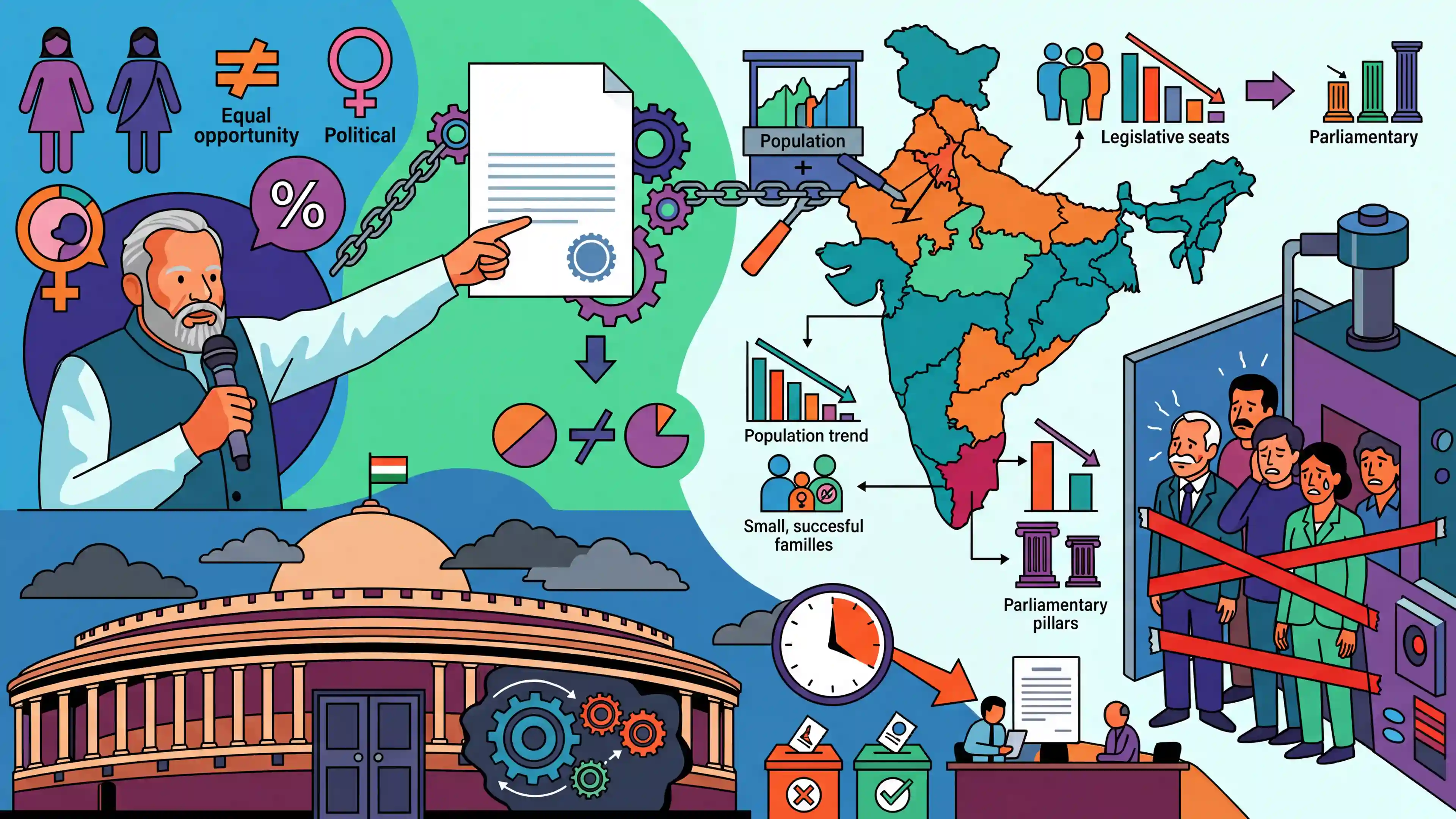
The article highlights a critical intersection of federalism, electoral representation, and women's empowerment. The debate over linking women's reservation with delimitation raises significant constitutional questions about whether states that have successfully managed population growth should face reduced political representation, posing a challenge to India's federal balance.
Summary
CPI(M) leader G. Ramakrishnan has strongly opposed the Constitution (131st Amendment) Bill, 2026, which links the implementation of women's reservation to the delimitation of constituencies. He termed the move unconstitutional, arguing that it penalizes Southern States like Tamil Nadu by potentially reducing their parliamentary representation as a consequence of their successful population control efforts. Ramakrishnan claimed the linkage was a deliberate political strategy to corner the opposition and criticized the lack of transparency in passing the bill during a special Lok Sabha session amidst ongoing elections.
Key Points
- CPI(M) leader G. Ramakrishnan criticized the Constitution (131st Amendment) Bill, 2026, describing the linkage between women's reservation and delimitation as unconstitutional and undemocratic.
- He argued that this linkage unfairly penalizes Southern States like Tamil Nadu, which might see a reduction in their political representation despite successfully implementing population control measures.
- Ramakrishnan alleged that the government intentionally paired these issues to force opposition parties to reject the bill, thereby creating electoral leverage in states like West Bengal and Tamil Nadu.
- He also raised concerns about the lack of transparency in convening a special Lok Sabha session during the elections and questioned the delay in implementing the unanimously passed Women's Reservation Act, 2023.
Important Terms
Constitution (131st Amendment) Bill, 2026

A legislative proposal seeking to expand Lok Sabha seats to 850 and operationalize 33% women's reservation using the 2011 Census, bypassing the post-2026 census requirement.
UPSC context
GS Paper II: Parliament and State Legislatures. Tests knowledge of constitutional amendments and legislative efforts toward electoral reform.
Delimitation
The statutory process of redrawing boundaries of parliamentary and assembly constituencies based on the latest census to ensure seats are proportional to population changes.
UPSC context
GS Paper II: Representation of People’s Act. Crucial for understanding electoral fairness and the "one person, one vote" principle.
Nari Shakti Vandan Adhiniyam
The 106th Constitutional Amendment Act (2023) reserving one-third of seats for women in the Lok Sabha and State Legislative Assemblies for a 15-year period.
UPSC context
GS Paper II: Social Justice and Governance. Tests understanding of gender-based affirmative action in political representation.
Federalism (North-South Divide)
Political tension arising from population-based seat reallocation, where Southern states fear delimitation penalizes successful population control by reducing their relative parliamentary representation.
UPSC context
GS Paper II: Issues and challenges pertaining to the federal structure. Tests analysis of regional disparities and inter-state equity.
Lok Sabha
The directly elected lower house of India’s Parliament, whose size and constituency boundaries are currently frozen based on the 1971 census until post-2026.
UPSC context
GS Paper II: Structure and functioning of the Union Legislature. Fundamental to understanding India's parliamentary democracy.
Prelims Trap
Orders of the Delimitation Commission can be challenged in the Supreme Court if they alter federal representation.
Article 329(a) explicitly bars judicial interference. Delimitation Commission orders have the force of law and cannot be questioned in any court.
Static Concepts Connected
How does the Constitution govern the delimitation of constituencies?
- Article 82: Mandates Parliament to enact a Delimitation Act post-census to readjust the allocation of Lok Sabha seats and territorial boundaries.
- Seat Freeze: The 42nd and 84th Amendments froze state-wise Lok Sabha seat allocation until the first census post-2026 to reward population control.
- Judicial Bar: Under Article 329(a), Delimitation Commission orders are final, hold the force of law, and cannot be challenged in any court.
What are the core provisions of the Women's Reservation Act, 2023?
- 1/3rd Quota: Reserves one-third of seats for women in the Lok Sabha, State Legislative Assemblies, and the NCT of Delhi.
- SC/ST Inclusion: Provides horizontal reservation by reserving one-third of the seats already allocated for SCs and STs for women from those communities.
- Implementation Trigger: Implementation is legally contingent upon a delimitation exercise based on the first census published after the Act's commencement.
Cross-Topic Patterns
Federalism vs. Demographic Dividend
Southern states face a 'demographic penalty' where their success in population control could reduce their proportional Lok Sabha representation in post-2026 delimitation.
Fiscal vs. Political Federalism
The tension over population weightage mirrors Finance Commission debates, linking the impending delimitation directly to ongoing inter-state disputes over tax devolution.

The interplay of Article 82, the 84th Amendment freeze, and Article 329(a) judicial bar is highly probable for Prelims 2026.
Linked PYQs · 2
Linked PYQs · 2
- 2023MainsGS2
Discuss the contribution of civil society groups for women's effective and meaningful participation and representation in state legislatures in India.
- 2022MainsGS2
“While the national political parties in India favour centralisation, the regional parties are in favour of State autonomy.” Comment.
