Linguistic Reorganization of States and Internal Security Implications
Source:Indian Express ↗
Why It Matters
A sitting Governor publicly criticizing the foundational basis of India's state boundaries—linguistic and ethnic reorganization—reignites critical UPSC themes surrounding post-Independence consolidation, sub-nationalism, and the structural causes of internal security challenges in the Northeast.
Summary
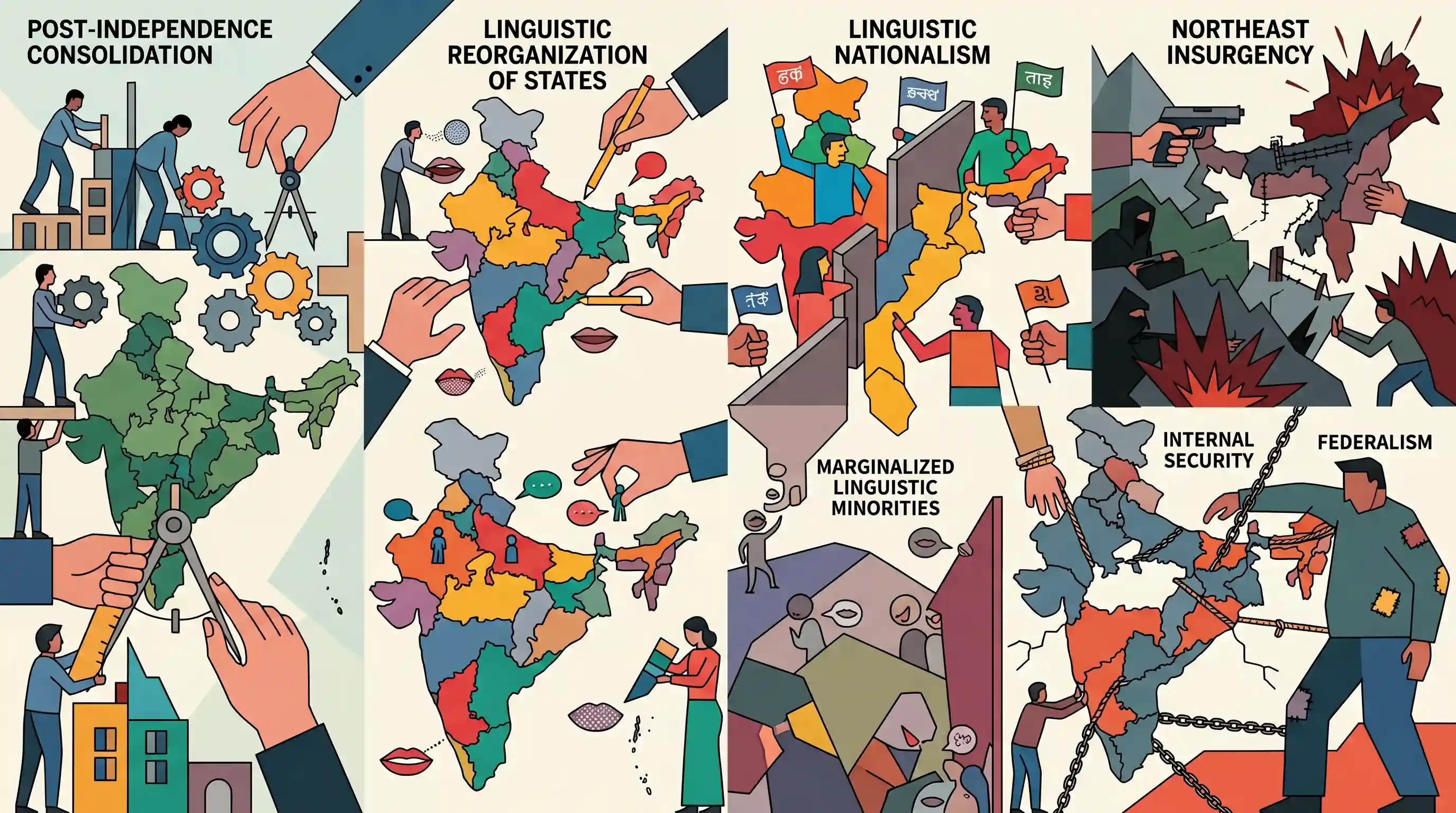
Tamil Nadu Governor R.N. Ravi strongly critiqued the post-Independence linguistic and ethnic reorganization of Indian states, arguing that it fueled 'linguistic nationalism', marginalized linguistic minorities, and sparked decades of armed insurgency in the Northeast.
Key Points
- Tamil Nadu Governor R.N. Ravi criticized the post-Independence linguistic division of states, stating it marginalized linguistic minorities into 'second-class citizens'.
- He asserted that the creation of 'ethnicity-based states' in the Northeast (such as Nagaland, Mizoram, and Meghalaya) acted as a 'fission reaction', fracturing society and spawning numerous armed insurgent groups.
- Ravi claimed that the 5,000-year-old consciousness of 'Bharat rashtra' was weakened after Independence due to the rise of 'linguistic nationalism'.
- He credited the post-2014 infrastructure push—including new airports, digital connectivity, and railways—for significantly reducing violence and normalizing the Northeast region.
Important Terms
Linguistic Reorganization of States

The 1956 process of redrawing Indian state boundaries based on shared languages to improve administrative efficiency and cultural cohesion, primarily through the States Reorganisation Act.
UPSC context
GS1 (Post-Independence Consolidation) and GS2 (Federalism); tests knowledge of administrative reforms and national integration.
Operation Sindoor
A 2025 tri-service military offensive targeting terrorist infrastructure in Pakistan/PoJK, cited by officials as a model for achieving political objectives through swift, precision-based military means.
UPSC context
GS3 (Internal Security); tests understanding of counter-terrorism doctrines and strategic military evolution.
Rashtriya Raksha University (RRU)
An Institution of National Importance under the Ministry of Home Affairs specializing in national security, policing, and internal security education and research.
UPSC context
GS2 (Governance) and GS3 (Internal Security); relevant for institutions strengthening India's security architecture.
States Reorganisation Act, 1956
A landmark 1956 legislation that abolished Part A, B, C, and D state classifications, creating 14 states and 6 union territories based on linguistic principles.
UPSC context
GS1 (Post-Independence); core topic for understanding India's administrative evolution and regionalism.
States Reorganisation Commission (SRC)
A three-member panel (Fazl Ali, H.N. Kunzru, K.M. Panikkar) that recommended reorganizing states to balance linguistic aspirations with national unity and administrative viability.
UPSC context
GS1 (Post-Independence Consolidation); critical for tracing the origins of modern Indian states.
Prelims Trap
The Fazl Ali Commission accepted the 'one language, one state' theory.
While the 1953 Commission broadly accepted language as a basis for state creation, it explicitly rejected the absolute 'one language, one state' principle to preserve national unity.
Static Concepts Connected
What were the stances of early state reorganization commissions on language?
- Dar Commission (1948): Rejected language as the primary basis for state reorganization, heavily favouring administrative convenience instead.
- JVP Committee (1948): Formally rejected language as the basis for reorganization, prioritizing national security, unity, and economic prosperity.
- Fazl Ali Commission (1953): Broadly accepted language as a basis for reorganization but prioritized the preservation and strengthening of India's unity and security above all else.
What are the constitutional safeguards for linguistic minorities?
- Article 29: Protects the fundamental right of any section of citizens to conserve their distinct language, script, or culture.
- Article 350A: Directs every state and local authority to provide adequate facilities for instruction in the mother-tongue at the primary stage of education.
- Article 350B: Added by the 7th Constitutional Amendment (1956) to establish a Special Officer to investigate matters relating to linguistic minority safeguards.
Cross-Topic Patterns
State reorganization and overlapping insurgencies
The 1971 NE Reorganisation Act intended to grant political autonomy but inadvertently triggered overlapping territorial claims and inter-tribal insurgencies competing for exclusive recognized homelands.
Infrastructure as a counter-insurgency tool
The state relies on a 'Development as Counter-Insurgency' strategy (e.g., PM-DevINE) to address economic alienation, integrating the Northeast with the mainland and sharply reducing extremist violence.

Expect a multi-statement Prelims question mixing Fazl Ali Commission's exact recommendations with Article 350B and NE reorganization acts.
Linked PYQs · 2
Linked PYQs · 2
- 2022MainsGS1
The political and administrative reorganization of states and territories has been a continuous ongoing process since the mid-nineteenth century. Discuss with examples.
- 2017MainsGS3
The North-East region of India has been infested with insurgency for a very long time. Analyze the major reasons for the survival of armed insurgency in this region.
