India tech strategy navigates risks in Pax Silica alliance
Source:The Hindu ↗
Why It Matters
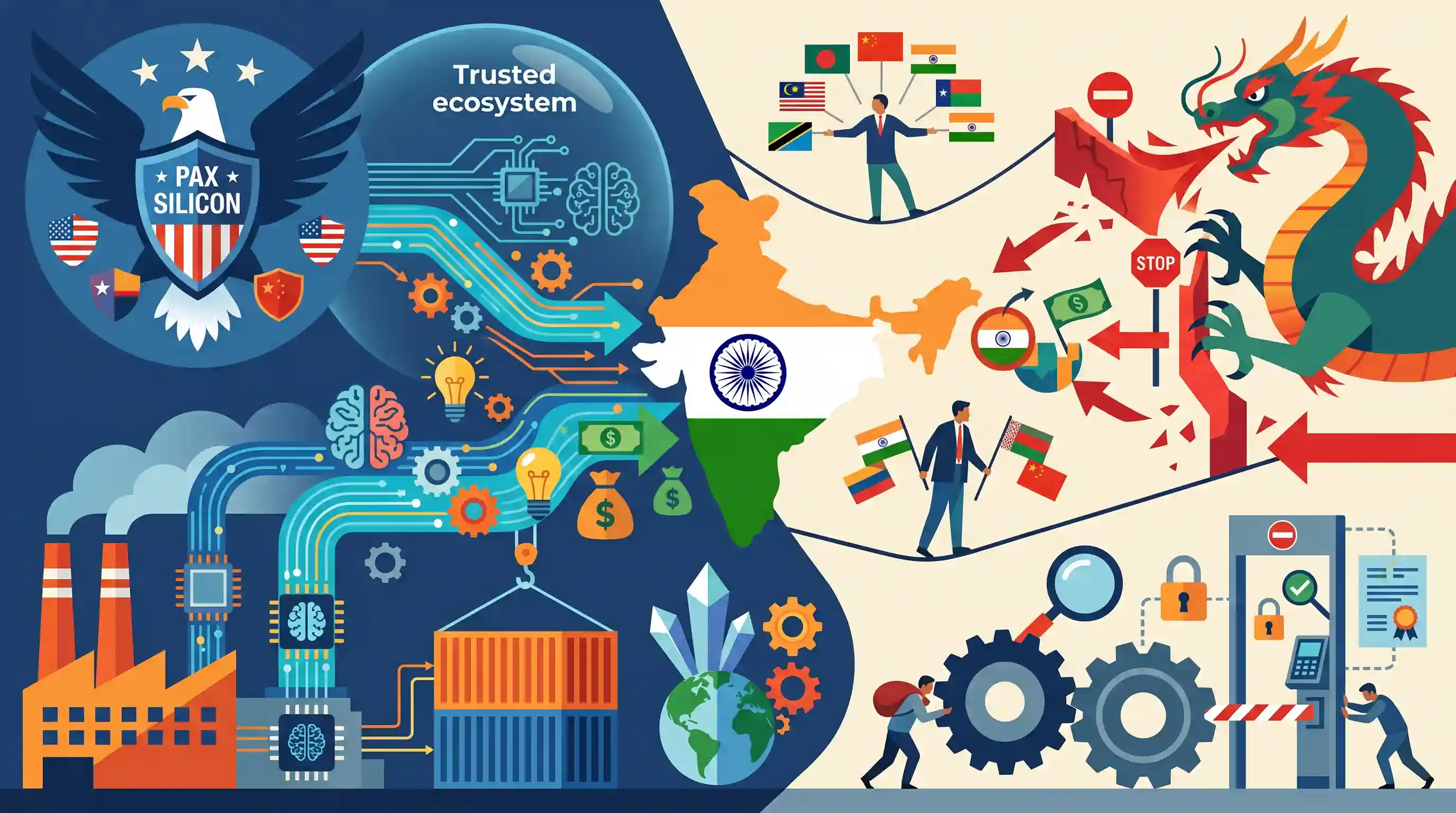
The article captures the contemporary foreign policy dilemma India faces—balancing the need for critical tech capabilities and supply chain security via Western alliances against the risks of Chinese retaliation and the compromise of its strategic autonomy (issue-based alignments) in favor of bloc politics.
Summary
India's inclusion in the U.S.-led "Pax Silica" alliance marks a strategic step toward securing its technological future by building resilient supply chains for Artificial Intelligence (AI) and critical minerals. While this aligns with domestic goals like the India Semiconductor and IndiaAI Missions and offers benefits such as technology transfer and investment, it carries significant risks. Joining a Western-dominated "trusted ecosystem" may invite economic retaliation from China and contradict India's traditional preference for "issue-based alignments" over rigid alliances. Furthermore, stricter export controls and security audits could burden smaller domestic firms attempting to join global value chains.
Key Points
- The Pax Silica alliance is a U.S.-led initiative focused on securing AI infrastructure and critical mineral supply chains outside of China's dominance.
- India's membership complements its domestic industrial initiatives, including the India Semiconductor, IndiaAI, and National Critical Mineral Missions.
- Benefits for India include access to raw materials, advanced tech, foreign investment, and an opportunity to shape global democratic tech standards.
- Risks involve potential economic retaliation from China, such as trade friction and pressure on upstream inputs like active pharmaceutical ingredients and minerals.
- The alliance's demand for "trusted ecosystems" and rigid export controls challenges India's traditional foreign policy of maintaining "issue-based alignments."
Important Terms
Pax Silica alliance

A U.S.-led strategic alliance launched in late 2025 to secure the "silicon stack"—from critical mineral mining to semiconductor manufacturing and AI deployment—among trusted partners to reduce dependencies on adversaries.
UPSC context
GS II (International Relations) & GS III (Science & Tech); tests understanding of technology-led geopolitics and supply chain resilience.
India Semiconductor Mission (ISM)
A multi-billion dollar mission launched in 2021 to build a domestic semiconductor and display ecosystem, providing fiscal support (up to 50%) for fabrication facilities and design firms.
UPSC context
GS III (Economy & Science); critical for self-reliance (Atmanirbhar Bharat) in high-tech manufacturing and electronics.
IndiaAI Mission
A central initiative with an outlay of over ₹10,000 crore to establish AI compute infrastructure (10,000+ GPUs), develop indigenous foundational models, and foster a "safe and trusted" AI ecosystem.
UPSC context
GS III (Science & Technology); assesses knowledge of emerging tech policy, data sovereignty, and AI-led economic growth.
National Critical Mineral Mission (NCMM)
A government mission launched in 2025 to secure a self-reliant supply of 30 minerals (e.g., lithium, cobalt) vital for clean energy, electronics, and defense industries.
UPSC context
GS I (Resources) & GS III (Energy Security); tests resource diplomacy and transition to green technologies.
Prelims Trap
"Pax Silica is a legally binding multilateral UN treaty regulating Artificial Intelligence and semiconductors."
It is not a UN treaty or legally binding. It is a U.S.-led informal "minilateral" alliance aimed at friend-shoring semiconductor and critical mineral supply chains away from China.
Static Concepts Connected
What defines a "critical mineral" under India's current policy framework?
- Core Definition: Minerals essential for modern economic growth, national security, and green technology, but which face high risks of supply chain disruption.
- India's Official List: In 2023, the Ministry of Mines released India's first official list identifying 30 critical minerals, including lithium, cobalt, and silicon.
- Supply Concentration: Extraction and processing are highly monopolized globally (often dominated by China), prompting policies like the National Critical Mineral Mission.
What are the fundamental pillars of the India Semiconductor Mission (ISM)?
- Nodal Structure: It operates as an independent business division within the Digital India Corporation under the Ministry of Electronics and IT (MeitY).
- Financial Outlay: It is backed by a ₹76,000 crore incentive scheme designed to attract global investments and offset initial infrastructure disabilities.
- Holistic Ecosystem: It moves beyond mere assembly, targeting a comprehensive ecosystem including Fab units, display manufacturing, ATMP (Assembly/Testing), and domestic chip design.
Cross-Topic Patterns
Tech decoupling vs API dependency
Joining US-led tech alliances exposes India to economic retaliation from China. This heavily threatens the pharma sector, which relies on Chinese imports for over 70% of its Active Pharmaceutical Ingredients (APIs).
Export controls vs MSME growth
Stricter US-aligned security audits and export controls demanded by "trusted ecosystems" may inadvertently burden domestic MSMEs, raising compliance costs and locking them out of emerging global tech value chains.

Expect a multi-statement question in 2026 interlinking tech minilaterals (Pax Silica), critical mineral monopolies, and India's ISM.
Linked PYQs · 4
Linked PYQs · 4
- 2024MainsGS2
‘The West is fostering India as an alternative to reduce dependence on China's supply chain and as a strategic ally to counter China's political and economic dominance.’ Explain this statement with examples.
- 2019MainsGS2
‘What introduces friction into the ties between India and the United States is that Washington is still unable to find for India a position in its global strategy, which would satisfy India's national self-esteem and ambitions.’ Explain with suitable examples.
- 2023MainsGS3
Introduce the concept of Artificial Intelligence (AI). How does Al help clinical diagnosis? Do you perceive any threat to privacy of the individual in the use of Al in healthcare?
- 2025MainsGS3
Mineral resources are fundamental to the country's economy and these are exploited by mining. Why is mining considered an environmental hazard? Explain the remedial measures required to reduce the environmental hazard due to mining.
