India and Pax Silica Alliance Geopolitics of Technology Supply Chains
Source:The Hindu ↗
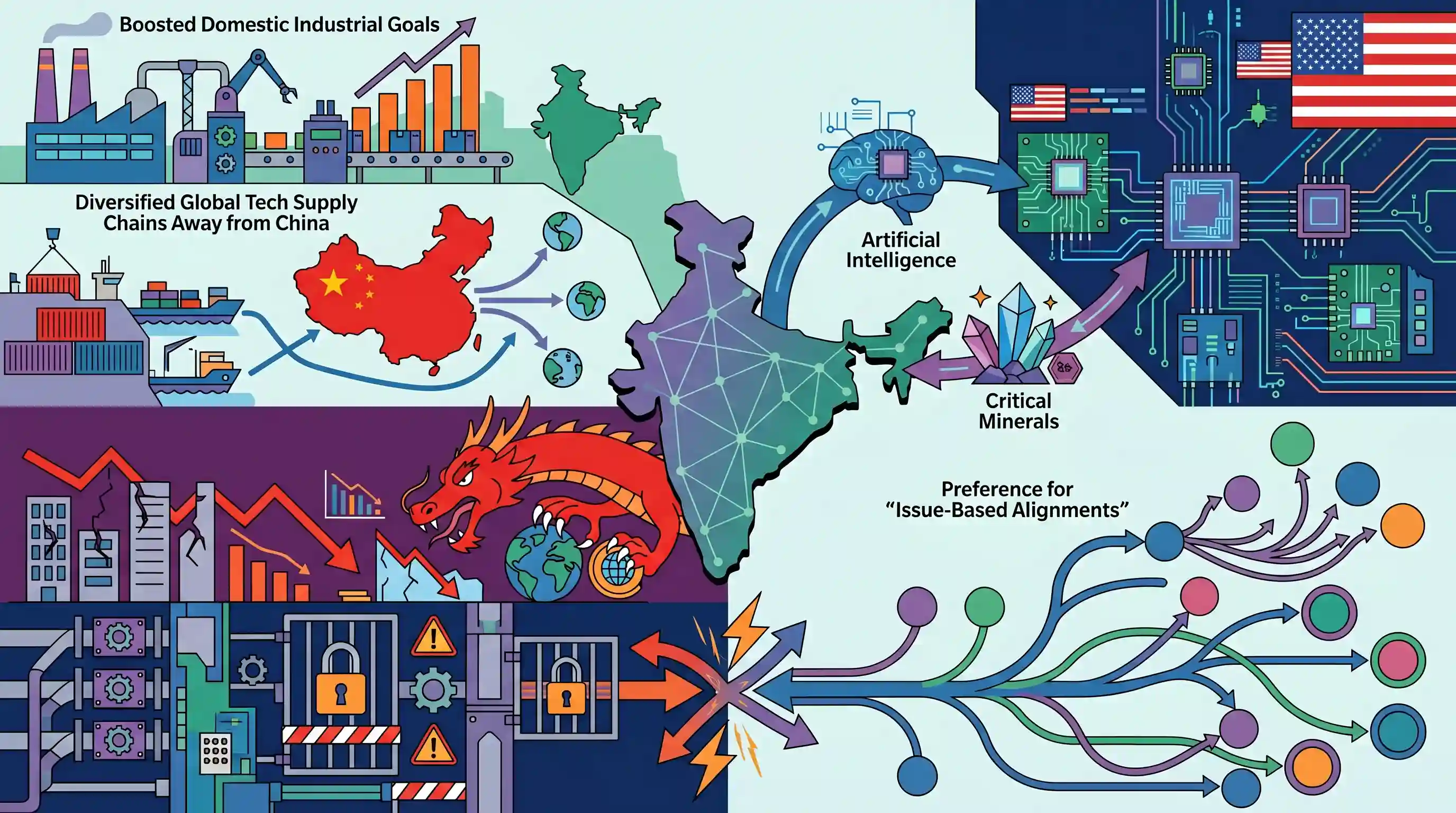
Why It Matters
Understanding the intersection of geopolitics and emerging technologies is crucial for UPSC candidates. The article highlights India's strategic calculations in joining technology alliances, the push for supply chain diversification (China+1 strategy), and the delicate balance between international tech guardrails and domestic strategic autonomy.
Summary
India's decision to join the U.S.-led Pax Silica alliance represents a strategic maneuver to secure its technological future in Artificial Intelligence and critical minerals. While this alignment promises to boost domestic industrial goals and help diversify global tech supply chains away from China, it also brings significant challenges. India must balance the benefits of attracting investment and technology against the risks of Chinese economic retaliation and the potential clash between the alliance's strict export controls and New Delhi's preference for 'issue-based alignments'.
Key Points
- The Pax Silica alliance is a U.S.-led strategic coalition focused on securing the infrastructure for Artificial Intelligence (AI) and critical minerals.
- India's entry into the alliance aims to secure raw materials and advanced equipment, complementing domestic initiatives like the India Semiconductor Mission and IndiaAI Mission.
- India offers the massive market demand and engineering talent needed to financially justify diversifying global technology supply chains away from China.
- Joining the bloc risks potential economic retaliation from China, such as trade frictions or pressure on upstream inputs like critical minerals and active pharmaceutical ingredients (APIs).
- The alliance\'s focus on \'trusted ecosystems\' and strict export controls may conflict with India\'s traditional preference for strategic autonomy and \'issue-based alignments\'.
Important Terms
Pax Silica alliance

A U.S.-led multilateral framework aiming to secure the global "Silicon Stack"—semiconductors, AI infrastructure, and critical minerals—through trusted partnerships, reducing reliance on China-centric supply chains.
UPSC context
GS-II: Bilateral/Global groupings; GS-III: Tech/Security. Tests knowledge of tech-geopolitics and India's alignment with Western-led supply chains.
India Semiconductor Mission
An independent business division under MeitY launched in 2021 to build a sustainable semiconductor and display ecosystem, positioning India as a global hub for electronics manufacturing and design.
UPSC context
GS-III: Economy/S&T. Tests understanding of industrial policy, electronics manufacturing, and strategies for achieving technological sovereignty.
IndiaAI Mission
A national-level initiative approved in 2024 to bolster India's AI ecosystem through public-private partnerships, focusing on compute infrastructure, sovereign AI capabilities, datasets, and high-tech skill development.
UPSC context
GS-III: Science and Technology. Relevant for questions on AI governance, national digital infrastructure, and India’s "Sovereign AI" strategy.
National Critical Mineral Mission
A government mission established in 2024 to ensure the secure supply of minerals essential for clean energy and defense by boosting domestic exploration, overseas acquisition, and recycling.
UPSC context
GS-I: Mineral Resources; GS-III: Energy Security. Tests knowledge of critical minerals' role in the green energy transition.
Prelims Trap
Pax Silica is a UN-mandated global regulatory framework for Artificial Intelligence and semiconductors.
Pax Silica is an informal, U.S.-led geopolitical coalition to secure AI and chip supply chains away from China, not a UN or WTO framework.
Static Concepts Connected
What characterizes India's current semiconductor manufacturing ecosystem?
- Design dominance: India accounts for approximately 20% of the world's semiconductor design workforce, making it a crucial global R&D hub.
- Fabrication deficit: India historically lacked capital-intensive commercial foundries, relying almost entirely on imports (from Taiwan, China, US) for actual fabricated wafers.
- ATMP focus: The India Semiconductor Mission heavily incentivizes Assembly, Testing, Marking, and Packaging (ATMP/OSAT) facilities as an entry point into the hardware supply chain.
How does India classify and regulate its critical mineral resources?
- Official classification: The Ministry of Mines has officially notified a list of 30 critical minerals (including Lithium, Cobalt, and Titanium) vital for economic and strategic security.
- Legislative reforms: Recent amendments to the MMDR Act permitted private sector mining for atomic and deep-seated minerals, rationalizing royalty rates to spur domestic exploration.
- Processing bottleneck: Despite domestic reserves, India lacks processing technologies, relying on Chinese refineries. Joining frameworks like the Minerals Security Partnership (MSP) aims to bypass this bottleneck.
Cross-Topic Patterns
Pharma APIs + Critical Minerals dependency
China's dominance as an upstream supplier heavily links India's geopolitical vulnerability in tech hardware (minerals, chips) with its vulnerability in bulk drug manufacturing (APIs).
Strategic Autonomy vs. Western Tech Blocs
Joining Western 'trusted ecosystem' alliances often mandates strict export controls, which directly tests India's traditional foreign policy doctrine of strategic autonomy and flexible, issue-based alignments.

Expect a multi-statement question in 2026 linking U.S.-led tech blocs (Pax Silica, MSP) with India's Semiconductor Mission.
Linked PYQs · 3
Linked PYQs · 3
- 2024MainsGS2
‘The West is fostering India as an alternative to reduce dependence on China's supply chain and as a strategic ally to counter China's political and economic dominance.’ Explain this statement with examples.
- 2025MainsGS3
India aims to become a semiconductor manufacturing hub. What are the challenges faced by the semiconductor industry in India? Mention the salient features of the India Semiconductor Mission.
- 2012PrelimsGS1
Recently, there has been a concern over the short supply of a group of elements called 'rare earth metals'. Why? 1. China, which is the largest producer of these elements, has imposed some restrictions on their export. 2. Other than China, Australia, Canada and Chile, these elements are not found in any country. 3. Rare earth metals are essential for the manufacture of various kinds of electronic items and there is a growing demand for these elements. Which of the statements given above is/are correct?
