Asymmetric warfare and limits of conventional superpower power
Source:Indian Express ↗
Why It Matters
The changing nature of warfare and the shift towards a multipolar world order are recurring themes in GS2 and GS3. Understanding how smaller nations employ resilience and emerging tech (like drones) to neutralize superpowers is critical for analyzing contemporary international relations and security challenges.
Summary
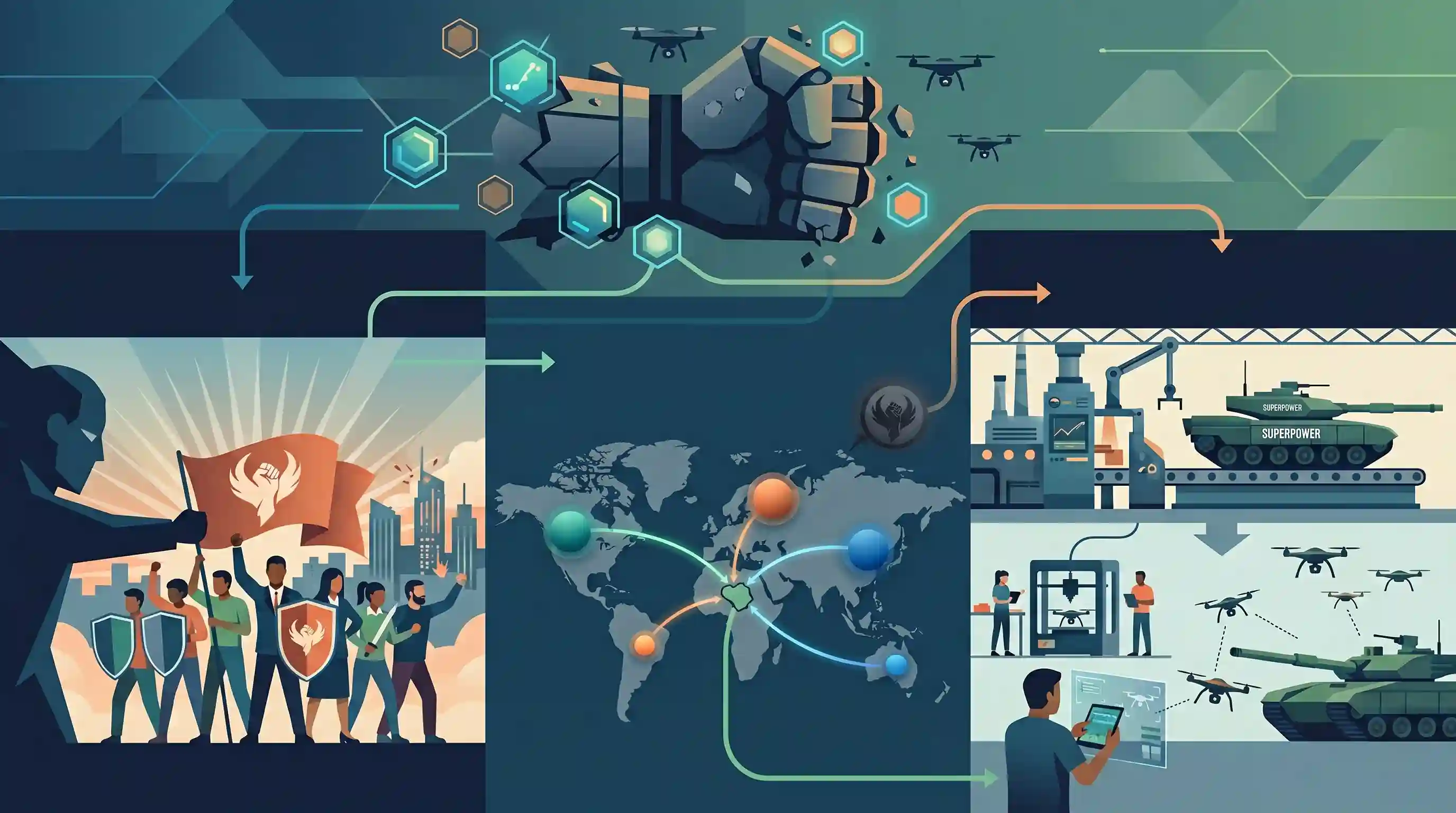
The article explores the diminishing effectiveness of superpower military might in conflicts involving resilient, weaker states like Ukraine and Iran. It outlines three factors contributing to this trend: the sheer political willpower of the smaller states to withstand aggression, the shifting dynamics of a multipolar world that allows them to seek support from alternative global powers, and the equalizing effect of cheap, advanced technologies such as drones and AI. These elements combined demonstrate that large arsenals alone no longer guarantee strategic success against highly motivated and technologically adaptive opponents in modern asymmetric warfare.
Key Points
- Weaker states like Ukraine and Iran have demonstrated exceptional resilience against superpowers by maintaining strong political resolve and united elites.
- The emerging multipolar world order provides smaller nations with strategic options to hedge risks by allying with alternative power centers like the EU, Russia, and China.
- Inexpensive new technologies, such as cheap drones and AI integration, have neutralized the conventional military advantages of superpowers, vastly increasing the cost of defense for states like the US and Russia.
- The ongoing conflicts illustrate the limits of superpower might, showing that immense military stockpiles alone cannot coerce smaller resilient regimes into capitulation.
Important Terms
Asymmetric Warfare

A mode of combat where opposing forces have significantly different military capabilities, leading the weaker side to use unconventional tactics and technology to exploit the stronger side's vulnerabilities.
UPSC context
GS Paper 3 (Security): Essential for understanding modern internal security threats, non-state actors, and evolving defense strategies.
Multipolar World Order
An international system where power is distributed among several major poles or centers of influence (e.g., US, China, India, EU) rather than a single superpower.
UPSC context
GS Paper 2 (International Relations): Core concept for discussing India's strategic positioning and the democratization of global governance.
Strategic Autonomy
A nation's ability to make sovereign foreign policy and defense decisions based on its own interests without being constrained by external pressures or alliances.
UPSC context
GS Paper 2 (International Relations): Key tenet of Indian diplomacy in balancing relations with major global powers like the US and Russia.
Global South
Developing and less-developed nations, primarily in Asia, Africa, and Latin America, characterized by shared colonial histories and a desire for more equitable global systems.
UPSC context
GS Paper 2 (International Relations): Crucial for India's leadership aspirations and its role as a bridge between developed and developing worlds.
Drone Warfare
The use of Unmanned Aerial Vehicles (UAVs) for combat or surveillance, allowing smaller states to neutralize expensive conventional military assets at a fraction of the cost.
UPSC context
GS Paper 3 (Security & Technology): Focuses on the indigenization of defense and the changing nature of technological threats on India's borders.
State Resilience
The capacity of a state and its society to withstand, adapt to, and recover from external shocks like invasion or economic sanctions through high political willpower.
UPSC context
GS Paper 2 & 3: Relevant to national security, psychological warfare, and the stability of democratic institutions under external pressure.
Prelims Trap
The proliferation of advanced AI and drones has significantly widened the conventional military advantage of global superpowers.
Cheap, commercially available tech acts as an 'equalizer' in asymmetric warfare. It neutralizes traditional superpower advantages and drastically increases their defence costs, rather than widening their lead.
Static Concepts Connected
What characterizes Asymmetric Warfare in modern security contexts?
- Core Definition: Conflicts where belligerents possess vastly unequal military or economic power, forcing the weaker side to creatively exploit the superior power's vulnerabilities.
- Force Equalizers: The use of unconventional tactics, cyber warfare, and cheap off-the-shelf technologies like drones to bypass traditional conventional military dominance.
- Economic Attrition: Strategies aimed at imposing disproportionate financial costs, such as forcing a superpower to use million-dollar interceptor missiles against thousand-dollar drones.
What is the strategy of 'Hedging' in International Relations?
- Strategic Posture: A foreign policy approach where a state avoids full alignment with a single superpower, instead cultivating overlapping partnerships to offset security risks.
- Utility: Allows weaker or middle powers to leverage a multipolar world order to extract maximum economic and military support from competing global power centers.
Cross-Topic Patterns
Asymmetric tech + Defence economics
The cost-disproportion of using expensive interceptor missiles against cheap drones highlights the urgency for cost-effective defence shields like Directed Energy Weapons (DEWs) for India's military.
Economic sanctions + De-dollarization
The resilience of targeted states against Western economic coercion exposes the limits of sanctions, accelerating the push by the Global South for alternative payment systems and de-dollarization.

Mains GS2/GS3 will likely test how cheap asymmetric tech (drones/AI) limits traditional superpower coercion and reshapes global multipolarity.
Linked PYQs · 4
Linked PYQs · 4
- 2025MainsGS2
"With the waning of globalization, post-Cold War world is becoming a site of sovereign nationalism.” Elucidate.
- 2023MainsGS3
The use of unmanned aerial vehicles (UAVs) by our adversaries across the borders to ferry arms/ammunitions, drugs, etc., is a serious threat to the internal security. Comment on the measures being taken to tackle this threat.
- 2023PrelimsGS1
Consider the following pairs: Area of conflict mentioned in news Country where it is located 1. Donbas : Syria 2. Kachin : Ethiopia 3. Tigray : North Yemen How many of the above pairs are correctly matched?
- 2023PrelimsGS1
Consider the following pairs: Regions often mentioned in news Reason for being in news 1. North Kivu and Ituri : War between Armenia and Azerbaijan 2. Nagorno-Karabakh : Insurgency in Mozambique 3. Kherson and Zaporizhzhia : Dispute between Israel and Lebanon How many of the above pairs are correctly matched?
