Indian Rupee Depreciation and RBI Forex Interventions
Source:The Hindu ↗
Why It Matters
The interplay between domestic monetary policy, exchange rate volatility, and external trade is central to India's macroeconomic stability. Understanding the RBI's tools (e.g., currency swaps, forex sales) and the structural impacts of energy imports and FTAs is essential for GS3 answers concerning inflation, trade deficits, and monetary policy management.
Summary
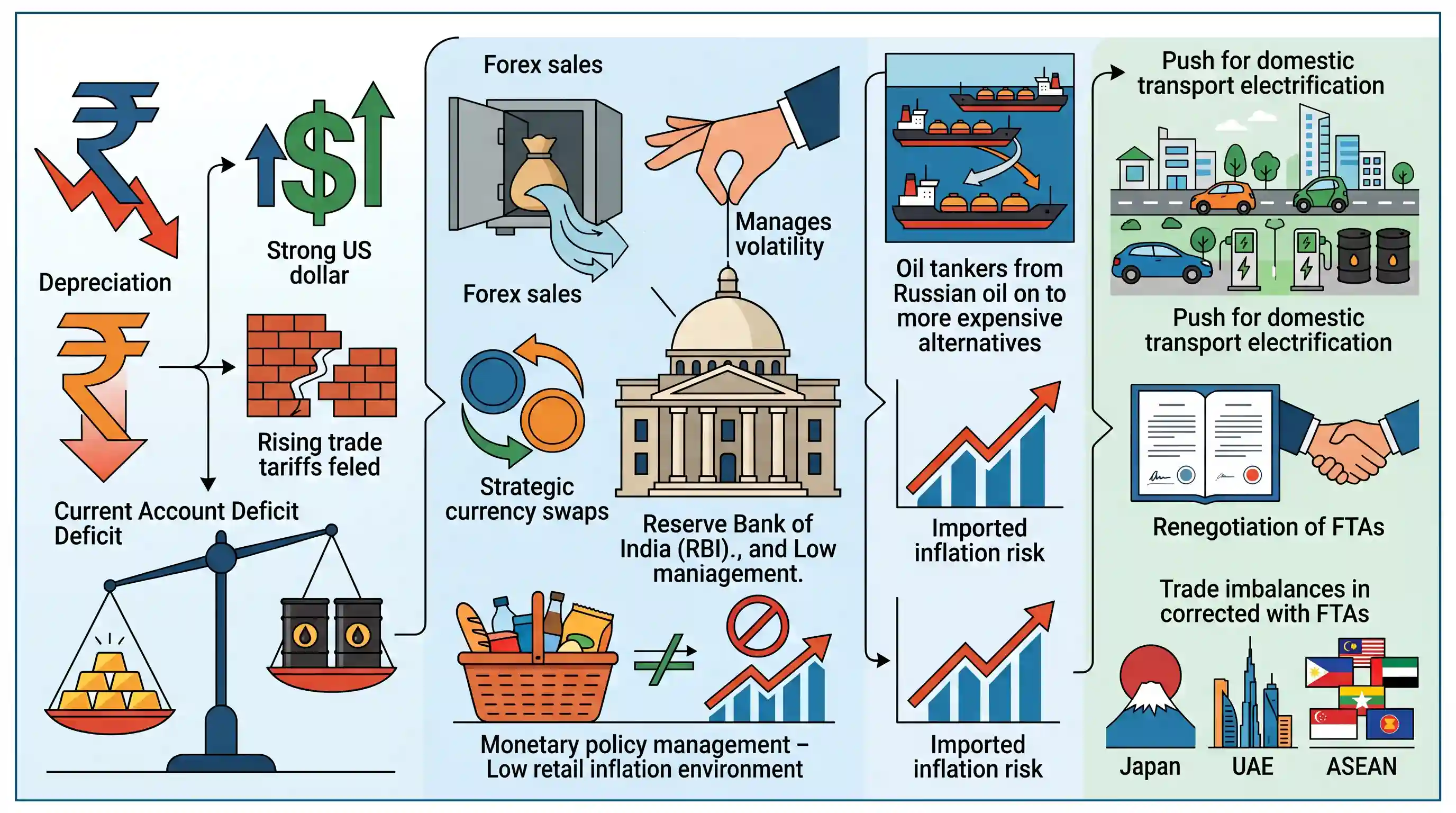
The article analyzes the recent depreciation of the Indian rupee against the backdrop of a strengthening US dollar, rising trade tariffs, and a widening current account deficit driven by high bullion and crude imports. The Reserve Bank of India (RBI) has actively managed this volatility through substantial forex sales and strategic currency swaps, capitalizing on a low retail inflation environment to avoid premature interest rate hikes. However, shifting from cheaper Russian oil to costlier alternatives risks exacerbating imported inflation. The piece concludes that sustainable currency management hinges on deeper structural reforms, notably accelerating domestic transport electrification and renegotiating Free Trade Agreements (FTAs) to correct persistent trade imbalances with nations like Japan, the UAE, and ASEAN.
Key Points
- The Indian rupee has significantly depreciated from ₹83.4 to roughly ₹89.2 against the US dollar, pressured by a strong global dollar, impending US trade tariffs, and a widening Current Account Deficit (CAD).
- To stabilize the currency and manage liquidity, the RBI has intervened by selling approximately $50 billion in forex reserves and deploying longer-term $10 billion buy-sell currency swaps.
- Sluggish retail inflation (clocking at 0.25% in October 2025) provides the RBI with the policy space to absorb mild rupee depreciation without resorting to immediate interest rate hikes.
- The transition from heavily discounted Russian crude oil to more expensive US imports threatens to import inflation if the rupee continues to weaken.
- Long-term currency stability requires structural remedies such as expediting the electrification of transport to reduce oil dependence and reassessing FTAs (e.g., with Japan, UAE, ASEAN) to mitigate skewed trade balances.
Important Terms
Reserve Bank of India (RBI)

India's central bank responsible for monetary policy, issuing currency, and managing foreign exchange reserves to ensure financial stability.
UPSC context
GS-III (Economy): Core institution for monetary stability, inflation targeting, and managing currency volatility.
Current Account Deficit (CAD)
A measurement of a country's trade where the value of the goods and services it imports exceeds the value of those it exports.
UPSC context
GS-III (Economy): Key indicator of macroeconomic health and the sustainability of the external sector.
Free Trade Agreements (FTAs)
Formal treaties between two or more countries to reduce or eliminate trade barriers, such as tariffs and quotas, on goods and services.
UPSC context
GS-II/III: Important for trade policy, bilateral relations, and correcting structural trade imbalances.
Imported Inflation
A general rise in domestic prices caused by an increase in the cost of imported raw materials or finished products.
UPSC context
GS-III (Economy): Tests understanding of cost-push inflation and the impact of currency depreciation on consumers.
US Federal Reserve
The central banking system of the United States, whose monetary policy decisions significantly influence global capital flows and currency values.
UPSC context
GS-III (Economy): Crucial for analyzing capital flight, FPI flows, and the Rupee's external value.
ASEAN
A regional intergovernmental organization comprising ten Southeast Asian nations, serving as a significant trade and strategic partner for India.
UPSC context
GS-II (IR): Central to India's 'Act East Policy' and regional economic integration efforts.
Prelims Trap
The RBI automatically hikes benchmark interest rates to defend a rapidly depreciating Rupee.
The RBI's primary mandate is inflation targeting. If domestic inflation remains low, the RBI can tolerate mild currency depreciation without hiking rates to preserve growth.
Static Concepts Connected
How does the RBI intervene to manage Rupee volatility?
- Spot interventions: Selling or buying US dollars directly in the spot market to immediately influence foreign exchange supply-demand dynamics.
- Currency swaps: Deploying sell/buy or buy/sell forex swaps to manage currency volatility and domestic rupee liquidity concurrently without permanently altering reserves.
- Volatility targeting: Under a managed float system, the RBI does not target a specific exchange rate; it only intervenes to smooth out sudden, excessive volatility.
What is imported inflation and what drives it in India?
- Mechanism: When the domestic currency depreciates, the cost of imported goods in Rupee terms rises, directly inflating domestic prices across the economy.
- Key drivers: India's high dependency on price-inelastic imports like crude oil, edible oils, and bullion (gold) makes it structurally vulnerable to this phenomenon.
- Policy dilemma: It forces the central bank into a tight corner, requiring monetary tightening to control prices even if domestic demand and growth are sluggish.
Cross-Topic Patterns
EV push as a CAD management tool
Electrification of transport is often viewed through a climate lens, but it is equally a critical macroeconomic imperative to permanently reduce India's crude oil import bill and structural CAD.
FTA renegotiations and structural trade deficits
Persistent trade deficits with ASEAN (AITIGA) and Japan have forced India to reconsider its trade strategy, demanding strict Rules of Origin and reciprocal market access in newer FTAs.

Expect a 2026 Prelims multi-statement question on RBI's forex swap interventions, linking domestic liquidity, imported inflation, and CAD.
Linked PYQs · 5
Linked PYQs · 5
- 2022PrelimsGS1
With reference to the Indian economy, consider the following statements: 1. If the inflation is too high, Reserve Bank of India (RBI) is likely to buy government securities. 2. If the rupee is rapidly depreciating, RBI is likely to sell dollars in the market. 3. If interest rates in the USA or European Union were to fall, that is likely to induce RBI to buy dollars. Which of the statements given above are correct?
- 2022PrelimsGS1
With reference to the Indian economy, consider the following statements: 1. An increase in Nominal Effective Exchange Rate (NEER) indicates the appreciation of rupee. 2. An increase in the Real Effective Exchange Rate (REER) indicates an improvement in trade competitiveness. 3. An increasing trend in domestic inflation relative to inflation in other countries is likely to cause an increasing divergence between NEER and REER. Which of the above statements are correct?
- 2021PrelimsGS1
Consider the following statements : The effect of devaluation of a currency is that it necessarily 1. improves the competitiveness of the domestic exports in the foreign markets 2. increases the foreign value of domestic currency 3. improves the trade balance Which of the above statements is/are correct?
- 2022PrelimsGS1
Consider the following statements: 1. Tight monetary policy of US Federal Reserve could lead to capital flight. 2. Capital flight may increase the interest cost of firms with existing External Commercial Borrowings (ECBs). 3. Devaluation of domestic currency decreases the currency risk associated with ECBs. Which of the statements given above are correct?
- 2024MainsGS3
What are the causes of persistent high food inflation in India? Comment on the effectiveness of the monetary policy of the RBI to control this type of inflation.
