Jaisalmer Limestone Mining Project Near Great Indian Bustard Habitat
Source:the-print ↗
Why It Matters
The Great Indian Bustard is Rajasthan's state bird and critically endangered. Its habitat preservation against industrial activities like limestone mining in Jaisalmer is a recurrent theme for RPSC exams, testing candidates on the intersection of economic development and environmental conservation.
Summary
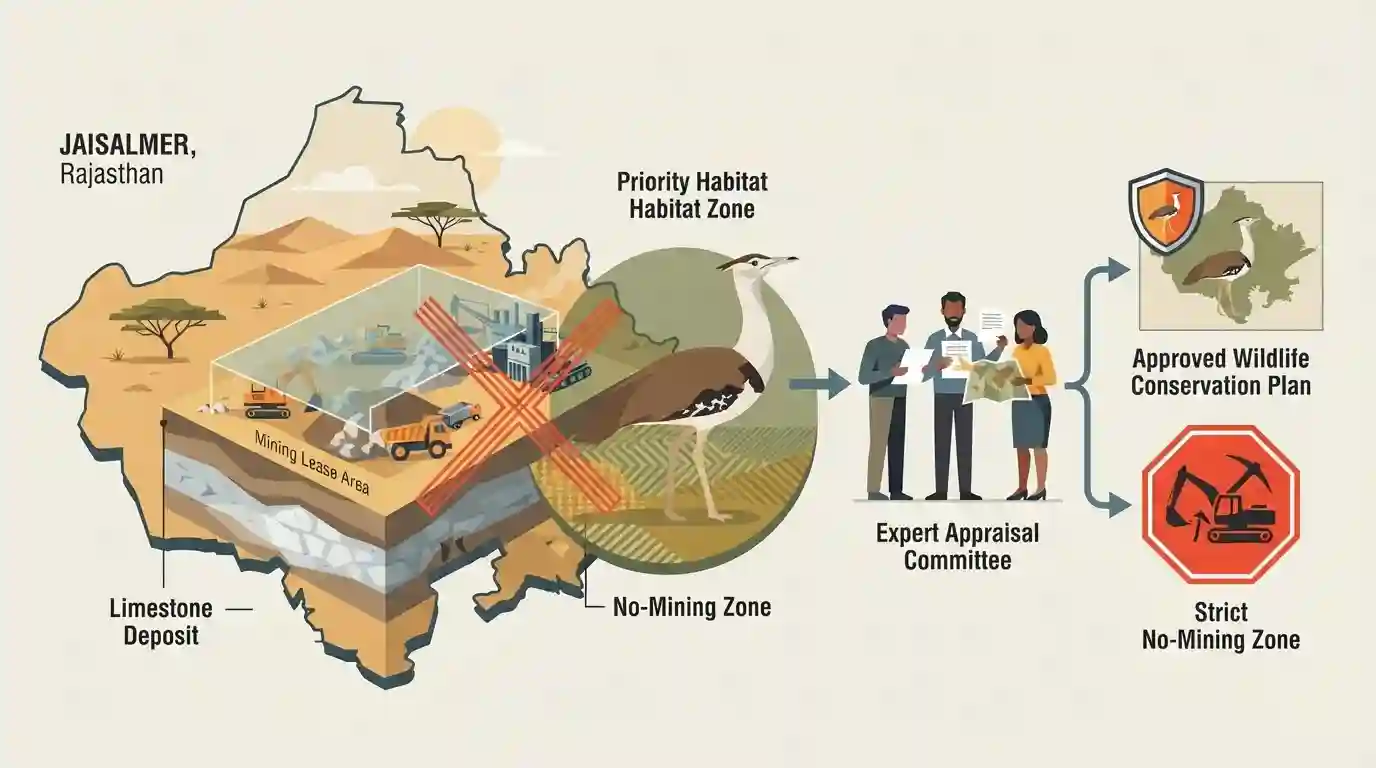
A limestone mining project in Jaisalmer has received initial environmental clearance (Terms of Reference) despite overlapping with the priority habitat of the critically endangered Great Indian Bustard (GIB). The Expert Appraisal Committee has mandated strict conservation measures, including declaring the overlapping area as a no-mining zone and requiring a state-approved wildlife conservation plan.
Key Points
- The Expert Appraisal Committee (EAC) has granted Terms of Reference (ToR) to Star Cement North East Limited for a limestone mining project in Joga village, Jaisalmer.
- The proposed mining lease covers 960 hectares, with 283 hectares (29%) falling within the critical priority area for the Great Indian Bustard (GIB).
- The EAC mandated that the 283 hectares inside the GIB priority area must be maintained as a strict no-mining zone.
- The project developer is required to submit a comprehensive GIB conservation plan, encompassing mitigation measures and habitat management, subject to approval by Rajasthan's chief wildlife warden.
- The Great Indian Bustard is a critically endangered species and the state bird of Rajasthan, making its habitat conservation highly sensitive.
Important Terms
Environmental Impact Assessment (EIA)

A systematic process to evaluate the potential environmental, social, and economic impacts of a proposed project before decisions are made, ensuring sustainable development.
UPSC context
Important for GS-3 (Environment) to understand statutory frameworks assessing developmental impacts on biodiversity.
Terms of Reference (ToR)
A formal document defining the scope, objectives, methodology, and reporting requirements of an environmental impact assessment study for any proposed project.
UPSC context
Tested in GS-3 as the crucial first step in the statutory environmental clearance process for major projects.
Expert Appraisal Committee (EAC)
A multi-disciplinary committee under the Environment Ministry that evaluates projects and recommends whether they should be granted environmental clearance or Terms of Reference.
UPSC context
Relevant for GS-3; UPSC tests the EAC's role in institutional environmental governance and project scrutiny.
Union Ministry of Environment, Forest and Climate Change (MoEFCC)
The nodal central government agency responsible for planning, promoting, and coordinating environmental, forestry, and wildlife policies and clearance mechanisms in India.
UPSC context
Key GS-3 institution; UPSC frequently asks about the Ministry's regulatory powers under the Environment Protection Act, 1986.
Rajasthan Forest Department
The state authority managing regional forests and wildlife. Its Chief Wildlife Warden is mandated to approve statutory conservation plans for protected species like the GIB.
UPSC context
Highlights GS-3 topics on state-level wildlife governance and statutory roles under the Wildlife Protection Act, 1972.
Prelims Trap
Granting of Terms of Reference (ToR) by the EAC implies final environmental clearance for the project.
ToR is issued during the 'Scoping' stage of the EIA process. It merely dictates the parameters for the environmental study, not final approval.
Static Concepts Connected
What are the key stages in the EIA Notification 2006 process?
- Screening: Determining if an EIA is needed based on the project scale (Category A vs B).
- Scoping: The Expert Appraisal Committee (EAC) dictates the Terms of Reference (ToR) detailing the environmental studies required.
- Public Consultation: Gathering concerns from locally affected populations and stakeholders regarding the project's potential impacts.
- Appraisal: Final evaluation of the EIA report by the EAC to recommend clearance or rejection.
What is the conservation status and habitat of the Great Indian Bustard?
- Conservation Status: Critically Endangered on IUCN Red List, Appendix I of CITES, and Schedule I of the Wildlife (Protection) Act, 1972.
- Habitat: Primarily arid and semi-arid grasslands. It is considered an indicator species for the health of grassland ecosystems.
- Key Sanctuaries: Desert National Park (Rajasthan), Kutch Bustard Sanctuary (Gujarat), and Rollapadu Wildlife Sanctuary (Andhra Pradesh).
Cross-Topic Patterns
Mining vs. Grassland Ecology
Highlights the systemic tension in the Thar Desert between resource extraction (limestone/solar lines) and the highly fragile GIB habitat, a recurring GS3 Environmental Impact theme.
EAC's regulatory balancing act
The EAC's use of micro-zoning to carve out strict 'no-mining zones' within a granted lease demonstrates the evolving regulatory mechanisms under the EPA 1986 for habitat protection.

Expect a 2026 multi-statement Prelims question mixing GIB conservation status, Thar desert ecology, and EIA Scoping (ToR) processes.
Linked PYQs · 4
Linked PYQs · 4
- 2025RPSC_PRELIMSGS1
Choose the incorrect statement with respect to the Rajasthan Forestry and Biodiversity Project (Phase-2).
- 2025RPSC_PRELIMSGS1
In which district of Rajasthan is the ‘Khadin’ water conservation method prevalent?
- 2025RPSC_PRELIMSGS1
The IUCN Red List is called:
- 2024RPSC_PRELIMSGS1
In which district of Rajasthan 'Khadin' is a popular method of water conservation?
