Finance Ministry Review on Macroeconomic Resilience and Growth Outlook
Source:The Hindu ↗
Why It Matters
This official assessment by the Finance Ministry provides critical insights into the state of the Indian economy. It is highly relevant for GS Paper 3, as it interlinks domestic inflation (food prices, monsoon impact), monetary policy, core industrial output, and the geopolitical impact of external shocks (Strait of Hormuz) on India's macroeconomic stability.
Summary
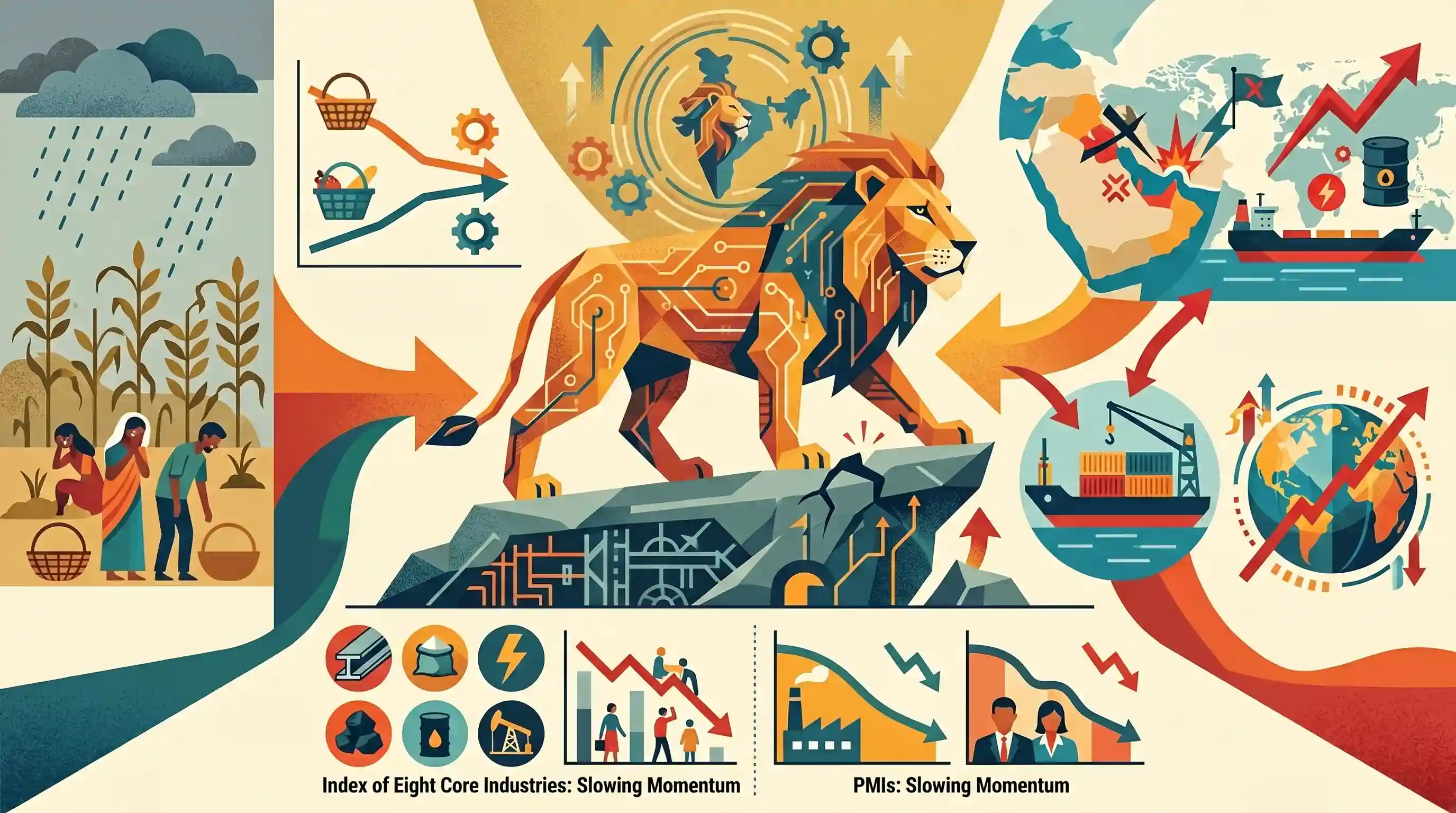
The Finance Ministry has forecasted a potential moderation in India's near-term economic activity, attributing it to a combination of domestic and global headwinds. Domestically, below-normal monsoons and persistent food inflation present immediate challenges, even as the divergence between CPI and WPI narrows. Globally, geopolitical conflicts—particularly the risk of disruption in the Strait of Hormuz—pose significant threats to crude oil prices and India's external sector stability. Additionally, high-frequency growth indicators like the Index of Eight Core Industries and PMIs indicate slowing momentum. Despite these pressures and global stagflation risks, the underlying structural strength of the Indian economy points to a state of "cautious resilience."
Key Points
- The Finance Ministry\'s Monthly Economic Review predicts a near-term moderation in India\'s economic growth, while maintaining an outlook of "cautious resilience" in the medium term.
- Geopolitical tensions, specifically potential disruptions in the Strait of Hormuz, are identified as the single most consequential risk to India\'s external stability and crude oil price outlook.
- Inflation remains a concern driven primarily by food prices and monsoon uncertainties, though the historic divergence between retail (CPI) and wholesale (WPI) inflation is narrowing.
- High-frequency economic indicators such as the Index of Eight Core Industries, Purchasing Managers\' Indexes (PMIs), e-way bill generation, and auto sales are displaying signs of moderation despite remaining in expansionary territory.
- Globally, rising sovereign bond yields and stagflation risks in major economies present additional headwinds to India\'s macroeconomic stability.
Important Terms
Index of Eight Core Industries (ICI)

Measures the output of eight foundational sectors: Coal, Crude Oil, Natural Gas, Refinery Products, Fertilizers, Steel, Cement, and Electricity. Together, they comprise 40.27% of the Index of Industrial Production (IIP).
UPSC context
GS-III (Economy): Tracks industrial health; essential for Prelims (weightage/sectors) and Mains (infrastructure growth analysis).
Strait of Hormuz
A strategic maritime chokepoint between the Persian Gulf and the Gulf of Oman. It is the world's most critical oil artery, handling ~20% of global petroleum and ~50% of India's LNG imports.
UPSC context
GS-I/II/III: Vital for Geography (mapping), International Relations (energy security), and Economy (supply chain shocks).
Stagflation
An economic state defined by the rare and difficult combination of stagnant growth, high unemployment, and high inflation. It typically challenges traditional monetary tools and the Phillips Curve theory.
UPSC context
GS-III (Economy): Conceptual term tested in Prelims/Mains regarding macroeconomic challenges and policy dilemmas.
Consumer Price Index (CPI)
Measures the average change in retail prices paid by consumers for a basket of goods and services. Adopted by the RBI as the primary tool for inflation targeting.
UPSC context
GS-III (Economy): Core metric for monetary policy; frequent Prelims topic regarding base year (2012) and components.
Wholesale Price Index (WPI)
Tracks the change in the price of goods sold in bulk at the wholesale level. It excludes services and is published by the Office of Economic Adviser (DPIIT).
UPSC context
GS-III (Economy): Used to assess producer-level inflation; often compared with CPI in Prelims questions.
Purchasing Managers' Index (PMI)
A survey-based economic indicator reflecting the health of manufacturing and service sectors. A reading above 50 indicates expansion, while below 50 signals contraction.
UPSC context
GS-III (Economy): A 'leading indicator' used to forecast GDP trends and business activity before official data.
Prelims Trap
Moderating PMI indices mean the manufacturing and services sectors are currently contracting.
A declining PMI (e.g., from 58 to 54) still indicates expansion as long as the value is above 50. Contraction only occurs when the index falls below 50.
Static Concepts Connected
What is the composition and weightage of the Index of Eight Core Industries?
- Weight in IIP: The eight core sectors comprise 40.27% of the total weight of items included in the broader Index of Industrial Production (IIP).
- Highest and Lowest Weights: Refinery products hold the highest weight in the index, followed by electricity and steel. Fertilizers carry the lowest weight.
- Publishing Authority: It is released monthly by the Office of Economic Adviser (OEA), Department for Promotion of Industry and Internal Trade (DPIIT).
How do CPI and WPI differ structurally in measuring Indian inflation?
- Goods vs Services: CPI captures price changes at the retail level for both goods and services, whereas WPI measures wholesale price changes for goods only.
- Food Weightage: Food items have a significantly higher weight in CPI (roughly 46%) than in WPI (roughly 24%), making CPI highly sensitive to monsoon-driven food shocks.
- Policy Anchor: The RBI officially uses CPI (Combined) as its key macroeconomic anchor for targeting inflation under the Monetary Policy Framework.
Cross-Topic Patterns
Maritime Chokepoints & Imported Inflation
The Strait of Hormuz is critical for energy security; disruptions here link West Asian geopolitics directly to India's domestic fuel prices and a widening current account deficit.
Climate Variability & Monetary Policy
Below-normal monsoons transcend geography—they drive the structural food inflation that restricts the RBI from cutting interest rates despite moderating industrial growth.

Expect a composite Prelims question linking PMI expansion/contraction mechanics with Core Industry weightages and IIP trends.
Linked PYQs · 5
Linked PYQs · 5
- 2020PrelimsGS1
Consider the following statements: 1. The weightage of food in Consumer Price Index (CPI) is higher than that in Wholesale Price Index (WPI). 2. The WPI does not capture changes in the prices of services, which CPI does. 3. Reserve Bank of India has now adopted WPI as its key measure of inflation and to decide on changing the key policy rates. Which of the statements given above is/are correct?
- 2012PrelimsGS1
In India, in the overall Index of Industrial Production, the Indices of Eight Core Industries have a combined weight of 37.90%. Which of the following are among those Eight Core Industries? 1. Cement 2. Fertilizers 3. Natural gas 4. Refinery products 5. Textiles Select the correct answer using the codes given below:
- 2015PrelimsGS1
In the 'Index of Eight Core Industries', which one of the following is given the highest weight?
- 2024MainsGS3
What are the causes of persistent high food inflation in India? Comment on the effectiveness of the monetary policy of the RBI to control this type of inflation.
- 2018MainsGS3
How would the recent phenomena of protectionism and currency manipulations in world trade affect macroeconomic stability of India?
