Light Pollution Threatens Astronomical Observatories in Atacama
Source:The Hindu ↗
Why It Matters
The article brings attention to 'light pollution' as an emerging environmental and scientific challenge. For UPSC aspirants, it connects the geography of the Atacama Desert with Science & Technology (ground-based observatories like the Extremely Large Telescope) and Environment (impacts of artificial light on ecosystems), illustrating the trade-offs between urbanization and scientific/environmental preservation.
Summary
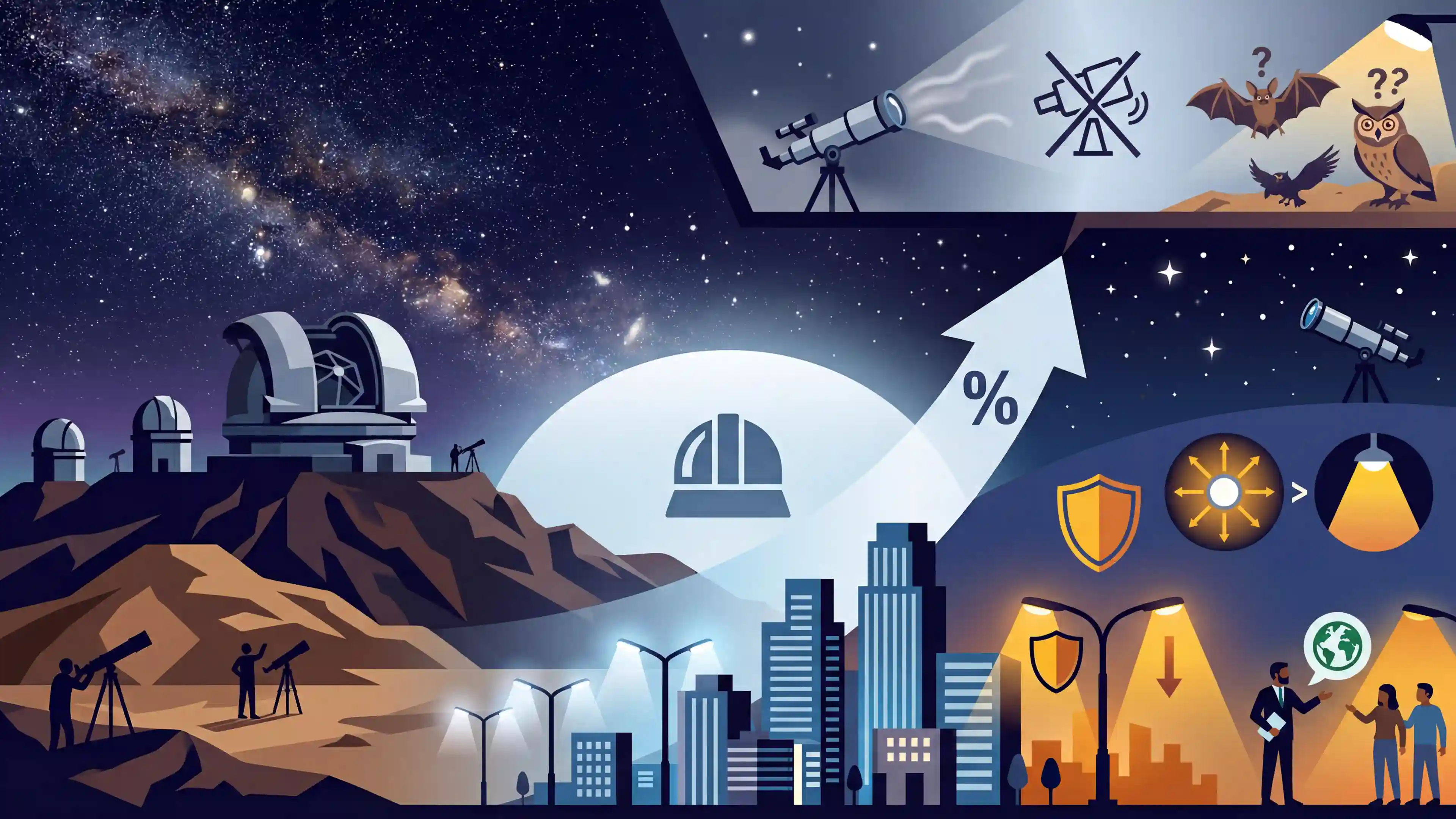
The Atacama Desert in Chile, celebrated for having the world's darkest skies and serving as a premier hub for global astronomy, is facing a growing threat from light pollution. Expanding urban centers and the broad adoption of bright LED lighting are projected to increase sky brightness by up to 30% by the end of the decade. This phenomenon jeopardizes highly sensitive operations at major facilities, including the Paranal Observatory and the forthcoming Extremely Large Telescope (ELT). Furthermore, artificial light is increasingly recognized as an environmental pollutant that disrupts nocturnal ecosystems. Astronomers and environmentalists are advocating for stricter enforcement of lighting norms—such as using warmer LED colors and pointing lights downward—to protect this unique scientific and geographic asset.
Key Points
- The Atacama Desert in Chile, known as the driest non-polar desert, provides some of the world's darkest and clearest skies, making it an unrivaled hub for ground-based astronomical observations.
- Rapid urban development and the widespread transition to cost-effective, bright LED lighting are driving up light pollution, which is projected to increase by 30% by the end of the decade in the region.
- This light pollution threatens the operations of major scientific facilities like the Paranal Observatory and the upcoming Extremely Large Telescope (ELT), managed by the European Southern Observatory.
- Beyond astronomy, artificial light at night (ALAN) constitutes a form of environmental pollution that disrupts nocturnal ecosystems and confuses wildlife.
- Experts are urging the strict enforcement of new lighting regulations in Chile, such as utilizing amber-colored LEDs instead of blue or white ones and directing light downward, to preserve the dark skies.
Important Terms
Light Pollution

Excessive, misdirected, or obtrusive artificial light. It disrupts nocturnal ecosystems, human health (circadian rhythms), and astronomical research by obscuring the visibility of celestial objects.
UPSC context
GS Paper III (Environment/Pollution); essential for discussing urban sustainability, biodiversity conservation, and environmental degradation.
Atacama Desert
A South American plateau in northern Chile, recognized as the world's driest non-polar desert. Its aridity is caused by the Andes' rain shadow and the cold Humboldt Current.
UPSC context
GS Paper I (World Physical Geography); key for studying climate patterns, ocean currents, and desert landscapes.
European Southern Observatory (ESO)
A 16-nation intergovernmental research organization that constructs and operates the world's most advanced ground-based astronomical observatories in Chile, providing international access to the southern sky.
UPSC context
GS Paper III (Science & Tech); relevant for international scientific collaborations and global space research infrastructure.
Extremely Large Telescope (ELT)
A revolutionary ground-based observatory under construction in the Atacama Desert. With a 39-meter primary mirror, it will be the largest optical/near-infrared telescope in the world.
UPSC context
GS Paper III (Science & Tech); focuses on frontier technologies, exoplanet research, and deep-space exploration.
Skyglow
The human-created brightening of the night sky over inhabited areas caused by reflected and upward-directed artificial light, which interferes with the observation of faint stars and galaxies.
UPSC context
GS Paper III (Environmental Pollution); tests understanding of specific urban ecological impacts and the need for dark-sky preservation.
Paranal Observatory
A flagship astronomical facility in Chile operated by ESO. It hosts the Very Large Telescope (VLT) and is considered the world's most productive ground-based optical observatory.
UPSC context
GS Paper III (Science & Tech); significant site for global observational astronomy and high-tech research facilities.
Prelims Trap
"The Extremely Large Telescope (ELT), managed by the European Southern Observatory, is located in the European continent."
The name "European" is deceptive. ESO operates its major telescopes (like the ELT) in the Atacama Desert in South America, not Europe, due to its uniquely clear skies.
Static Concepts Connected
Why is the Atacama Desert the driest non-polar desert in the world?
- Humboldt Current: The cold Humboldt Ocean Current cools the marine air, resulting in coastal fogs but preventing the formation of precipitation-producing rain clouds.
- Rain Shadow Effect: The Andes mountains block warm, moist air coming from the Amazon basin to the east, leaving the western slopes and coast completely arid.
- Subtropical High Pressure: Located in the subtropical high-pressure belt, the region experiences descending dry air masses that suppress cloud formation.
How does Artificial Light at Night (ALAN) impact biodiversity?
- Avian Navigation: Disorients nocturnally migrating birds that rely on starlight for navigation, often causing fatal collisions with illuminated structures.
- Reproduction Disruption: Deters sea turtles from nesting on illuminated beaches; artificial light causes hatchlings to crawl toward cities instead of the sea.
- Endocrine Disruption: Suppresses melatonin production in mammals and amphibians, altering their circadian rhythms, feeding patterns, and predator-prey dynamics.
Cross-Topic Patterns
LED efficiency & the Jevons Paradox
The transition to cheaper, energy-efficient LEDs has paradoxically led to increased overall lighting and skyglow, a classic example of the Jevons Paradox ('Rebound Effect') in environmental economics.
Ground vs. Space Telescopes
Ground-based telescopes like the ELT rely on Atacama's arid, high-altitude environment to minimize atmospheric distortion, offering a cost-effective counterpart to space-based observatories like the James Webb Space Telescope.

Expect a multi-statement Prelims question linking Artificial Light at Night (ALAN) ecological impacts with the 'Rebound Effect' of LEDs.
Linked PYQs · 3
Linked PYQs · 3
- 2022MainsGS3
Launched on 25th December, 2021, James Webb Space Telescope has been much in the news since then. What are its unique features which make it superior to its predecessor Space Telescopes ? What are the key goals of this mission ? What potential benefits does it hold for the human race?
- 2025PrelimsGS1
Consider the following statements : Statement I: The amount of dust particles in the atmosphere is more in subtropical and temperate areas than in equatorial and polar regions. Statement II: Subtropical and temperate areas have less dry winds. Which one of the following is correct in respect of the above statements?
- 2022MainsGS3
Discuss in detail the photochemical smog emphasizing its formation, effects and mitigation. Explain the 1999 Gothenburg Protocol.
