LIC Stake Sale via OFS and Capital Receipts Implications
Source:The Hindu ↗
Why It Matters
The use of Offer for Sale (OFS) for disinvestment is a key intersection of public finance and capital market dynamics. Aspirants must understand how minority stake sales are classified in the Union Budget (Capital Receipts) and how mechanisms like OFS differ from Initial Public Offerings (IPOs) in the context of SEBI regulations and economic liberalization.
Summary
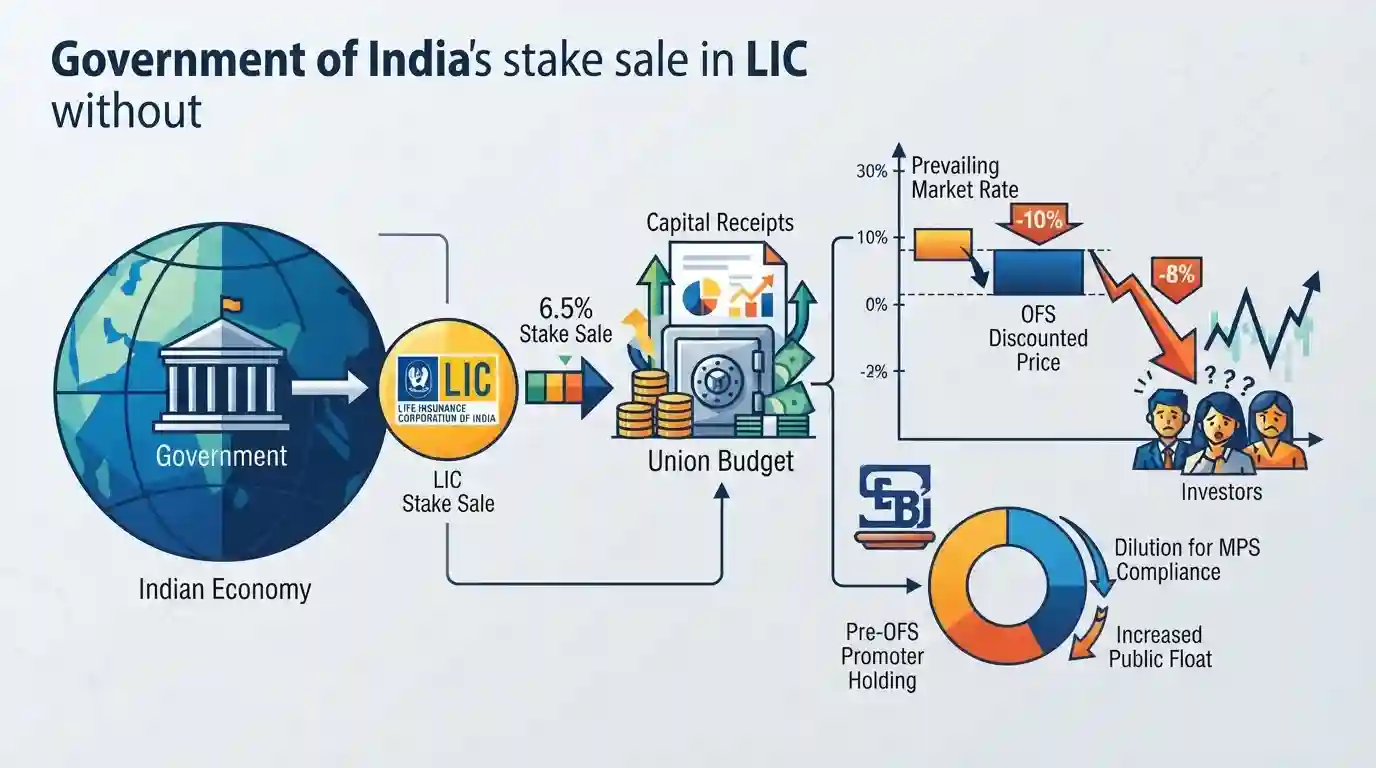
The Government of India has executed a 6.5% stake sale in the Life Insurance Corporation of India (LIC) via an Offer for Sale (OFS). By pricing the shares at a 10% discount to the prevailing market rate, the move triggered an 8% decline in LIC's stock price. This transaction serves as a tool for the government's broader disinvestment strategy, helping monetize public assets to mobilize resources. In budgetary terms, the revenue generated from this disinvestment is categorized under Capital Receipts, as it involves the liquidation of government-owned equity. Additionally, the OFS mechanism provides a transparent route for promoters to dilute their holdings to comply with SEBI's Minimum Public Shareholding (MPS) regulations, though steep discounts can create short-term volatility for existing retail and institutional investors.
Key Points
- The Indian government sold a 6.5% stake in LIC at a 10% discount through an Offer for Sale (OFS), which led to an 8% drop in LIC's share price on the exchanges.
- Offer for Sale (OFS) is a mechanism allowing promoters (like the government) of a listed company to sell their shares directly to the public through the stock exchange bidding platform, differing from a fresh issue of shares.
- Proceeds generated from this minority stake sale are classified as Capital Receipts in the Union Budget, representing a reduction in government assets as part of its ongoing disinvestment drive.
- While the discounted sale helps the government raise funds and inch closer to SEBI's Minimum Public Shareholding (MPS) norms, it can dilute valuation and negatively impact existing minority shareholders in the short term.
Important Terms
Offer for Sale (OFS)

A stock exchange mechanism introduced by SEBI in 2012 that permits promoters and large shareholders of listed companies to dilute their equity holdings directly to the public through transparent bidding.
UPSC context
GS Paper III (Indian Economy). Tests understanding of capital market mechanisms, corporate governance, and government disinvestment strategies.
Securities and Exchange Board of India (SEBI)
The statutory regulatory body established in 1992 to protect investor interests, regulate the securities market, and promote orderly development of India's capital markets.
UPSC context
GS Paper III (Indian Economy). Tests knowledge of financial regulators, market reforms, and institutional framework of capital markets.
Disinvestment
The process wherein the government dilutes or liquidates its equity stake in Public Sector Undertakings (PSUs) to mobilize resources and improve operational efficiency.
UPSC context
GS Paper III (Indian Economy). Tests knowledge of fiscal consolidation, capital receipts, and public sector reforms.
Minimum Public Shareholding (MPS)
A SEBI-mandated regulatory requirement under Securities Contracts Rules directing listed companies to maintain at least 25% of their total paid-up equity with public (non-promoter) shareholders.
UPSC context
GS Paper III (Indian Economy). Tests understanding of market depth, retail participation rules, and listing guidelines for Indian companies.
Capital Receipts
Government inflows that either create a financial liability (such as market borrowings) or reduce physical or financial assets (such as disinvestment proceeds and loan recoveries).
UPSC context
GS Paper III (Government Budgeting). Tests structure of the Union Budget, fiscal deficits, and classification of government receipts.
Life Insurance Corporation of India (LIC)
India's largest state-owned insurance provider, established in 1956, functioning as a major institutional investor and key actor in the country's capital markets.
UPSC context
GS Paper III (Indian Economy). Tests knowledge of public sector giants, financial sector privatization, and resource mobilization.
Prelims Trap
Disinvestment proceeds from PSUs are classified as Debt Capital Receipts because they represent capital raised by the government.
Disinvestment proceeds are Non-Debt Capital Receipts (NDCR). While they are capital receipts because they liquidate a state asset, they do not create any future financial liability or debt.
Static Concepts Connected
What is the difference between Debt and Non-Debt Capital Receipts?
- Definition: Capital receipts are government receipts that either create liabilities or reduce financial assets.
- Debt receipts: These create a future liability to repay, such as market borrowings, treasury bills, and external loans.
- Non-debt receipts: These do not create liabilities but reduce assets, specifically loan recoveries and PSU disinvestment proceeds.
How does an Offer for Sale (OFS) differ from an IPO/FPO?
- No new capital: OFS involves existing promoters selling their current holdings; it does not issue fresh shares or raise new capital.
- Platform & speed: OFS is executed directly on the stock exchange platform over a single trading day.
- Eligibility: Only listed companies can use OFS, primarily to dilute promoter holdings or meet public shareholding norms.
Cross-Topic Patterns
Disinvestment vs. Welfare Funding
Channeling non-debt capital receipts from PSU stake sales into infrastructure spending to optimize the fiscal deficit without escalating national debt.
State ownership vs. Minority rights
Government stake dilution via steep discounts tests SEBI's regulatory mandate to protect minority retail investors from state-driven equity market volatility.

UPSC 2026 may test budget receipts by framing a statement falsely classifying PSU disinvestment as a debt-creating capital receipt.
Linked PYQs · 4
Linked PYQs · 4
- 2025PrelimsGS1
Consider the following statements : I. Capital receipts create a liability or cause a reduction in the assets of the Government. II. Borrowings and disinvestment are capital receipts. III. Interest received on loans creates a liability of the Government. Which of the statements given above are correct?
- 2021MainsGS3
Distinguish between Capital Budget and Revenue Budget. Explain the components of both these Budgets.
- 2021PrelimsGS1
With reference to India, consider the following statements : 1. Retail investors through demat account can invest in 'Treasury Bills' and 'Government of India Debt Bonds' in primary market. 2. The 'Negotiated Dealing System- Order Matching' is a government securities trading platform of the Reserve Bank of India. 3. The 'Central Depository Services Ltd.' is jointly promoted by the Reserve Bank of India and the Bombay Stock Exchange. Which of the statements given above is/are correct?
- 2019MainsGS3
The public expenditure management is a challenge to the Government of India in the context of budget making during the post-liberalization period. Clarify it.
